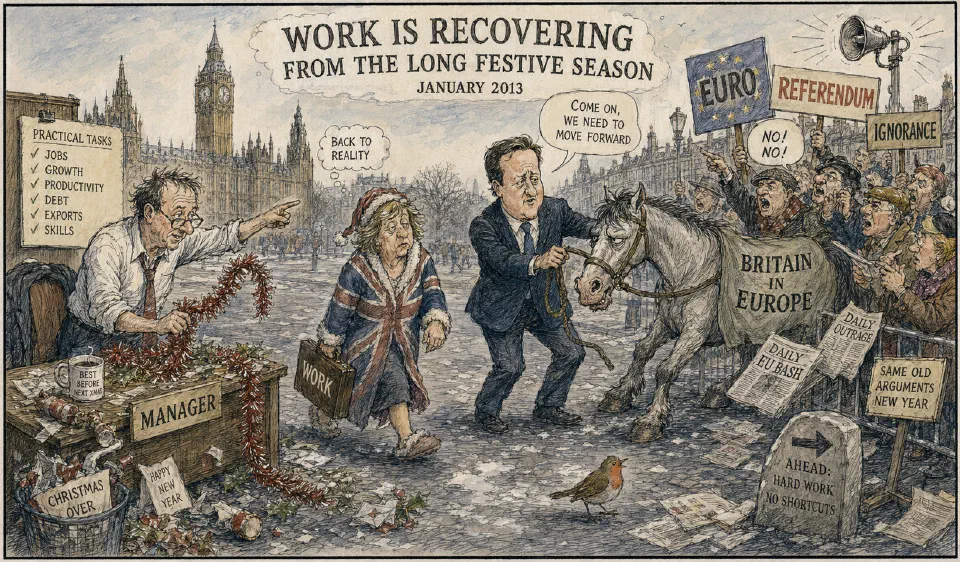
The Prime Minister’s tentative decision to lead a Britain in Europe has re-ignited all kinds of wrangles.
This has happened despite his best efforts to leave the single currency out of the limelight and his emphasis that he is supporting a cross-party campaign. David Cameron insists his intention is to make sure Britain plays its full part in the European Union without endorsement of the euro. But try as he may, the issue will not go away. The debate in Britain has been marked by ignorance and prejudice. But maybe these are the tools of political crusaders? This is no reason for businesses to hide their collective head in the sand. The euro is the coinage of the biggest market in the world after the US. Of course, a weak euro is derided by sceptics, but it is giving our competitors in the euro-zone a big advantage on exports. And this says nothing of balancing base rates in Euroland with Britain’s framework for monetary policy. The scrutinies and commentaries ought to consider hard facts and say less about imagined threats to a sovereignty surrendered years ago to the forces of globalisation. The arguments are not simple ones, nor can they go on for ever.
Politics has fallen into disrepute.
Its leaders are lacklustre and command little respect. Chancellor Merkel is a diminished figure at home because of post-unification realities and scandals in her party. The elections in France brought a most spectacular defeat for its government. The political systems in Greece and Italy are discredited and disintegrating. The Americans voted to keep a new kind of leader from a different generation, but President Obama seems a confused and embattled figure. There have been major shifts of opinion in Canada and New Zealand in recent years. Intra- and inter-religious differences bring daily crises in the world. Japan’s famed stability has been under threat and will not return to its old normality. Moderate socialism is in retreat all over the place. Russia is realising the pains of democracy as we know it. The Communist Party in PR China has just selected a new group for centralised control. The twentieth century was disfigured by the grand ideologies of fascism and communism. The demise of the left/right split and the end of a bipolar world with a Cold War has left contemporary politicians flailing about in a vacuum. They are denied the old certainties and are failing to create activism. Politics has become the preserve of a small and professional political class. There is a lot to do in preparing for the new challenges.
A few years ago, the World Bank published a startling report entitled ‘Managing Development : The Government Dimension’.
It provoked a long, and sometimes bitter, debate on who has the right to tell whom how to run the country. The report’s basic idea was a simple one. It said the World Bank should take more account of how fairly a country is governed. After all, this largely determines whether monies are used effectively. The report dealt rather gingerly with corruption. It asserted unequivocally that, ‘many political leaders in countries with serious poverty have amassed extraordinary fortunes. Foreign exchange reserves were transferred to foreign bank accounts. Such abuse, needless to say, adversely affects economic development.’ So why don’t the providers of funds – rich nations – seek to repossess these monies and channel them into their rightful purpose? Don’t be silly scribe. We have to be pragmatists in a modern world.
Observe the sound habits of true judgement.
There are ten spokes to that wheel. Know what you want; obtain good information; separate facts from assumptions; accept uncertainty without anxiety; pursue outcomes, not personal preferences; try to keep an open mind; draw lessons from your errors; learn from others; stay on the same wavelength; and remember – you are in control.
And there is a difference.
‘Price is what you pay. Value is what you get.’ Warren Buffett, quoted in The Week (12 January).