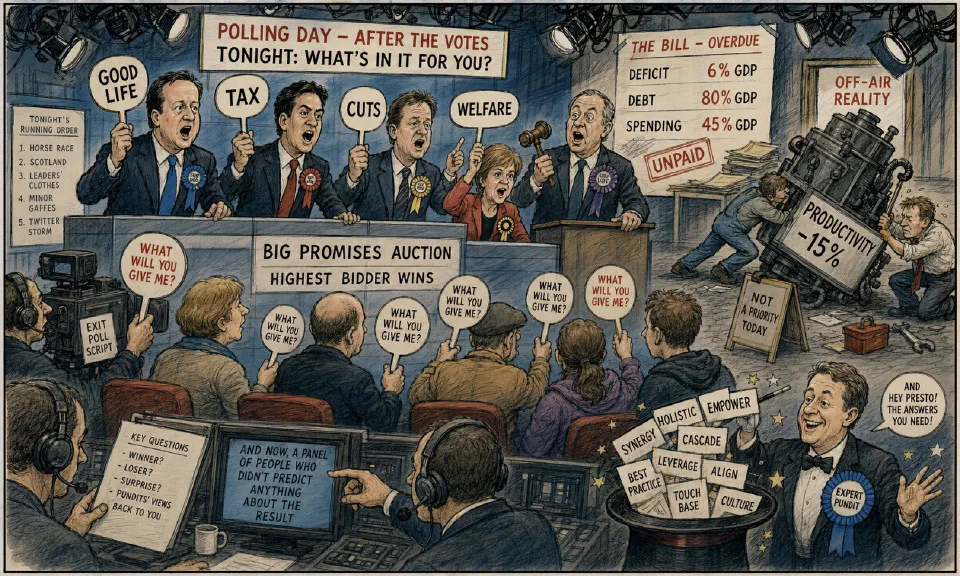
The auction.
Right now we are in election campaigns. ‘What will you promise to give me?’ ‘OK, but I’ll wait for another offer.’ Merryn Somerset Webb reminds us that the Coalition came into office promising to resolve this country’s dreadful financial problems. Its ministers suggest they have rescued our economy. Look at the numbers and you will see this is a doubtful claim. The underlying budget deficit is still 6% of GDP – an overspend of £90bn a year. And the total public debt is 80% of GDP, up from just over 60% in 2009. Another vital figure is that our government collects 36% of GDP in taxation. Since the 60s, this component has been between 34% and 36%. However high or low tax rates go, that is how much is raised by the Coalition. HM Treasury knows that if citizens are taxed too much, they stop paying, one way or other. But the state spends around 45% of GDP. We are told the good life is imminent, but we know the funds are not available to pay for it. What we are hearing from politicians is delusional.
Growth and productivity – silence.
Words on the economy are receiving prominence in the UK’s general election. John Van Reenen and Anna Valero (both of the London School of Economics) point out that the main parties spend most of their time arguing over the speed and extent of cuts and which one would be more ‘fiscally responsible’. We do not hear much about growth. Productivity collapsed in 2008 and has failed to recover. Output per hour is 15% below what we would have achieved based upon pre-crisis trends and is about 30% below America, France and Germany. Of course, several policies affect growth; for example, action on businesses, promotion of exports, infrastructure, skills and taxation. But an emphasis missing is an overarching and longer-term framework. Productivity is probably the biggest challenge facing the UK’s economy. In summary, the current problem is that each worker (from top to bottom) is not as efficient as s/he should be (or has been in the past). This is not a simple issue. The LSE Growth Commission shows that Britain has a chronic problem of low productivity rooted in the failure to make investments. Such an initial statement might start research and discussion.
Surprise, surprise?
The latest World Happiness Report has just been published by Sustainable Development Solutions Network. The first one was launched in 2012 by Ban Ki-moon, secretary general of the United Nations. It uses a questionnaire designed by Gallup. The ten happiest countries are: Switzerland, Iceland, Denmark, Norway, Canada, Finland, Netherlands, Sweden, New Zealand and Australia. The survey covered 158 countries. America is in 15th place, with the UK at number 16. Warm climates do not seem to assure a spot at the top. With the exception of war-torn Afghanistan and Syria, the ten unhappiest nations are in Saharan or sub-Saharan Africa. Poverty and violence is likely to be a major factor. Many of our locals’ holiday destinations are quite low in the list.
Managers are at it again.
Satisfying their need for magic is in good shape. Listen to the buzzwords in conversations, speeches and chats over coffee. Observe the focus on holistic approaches to help us envision the ownership of proposals. In this way, their impact is cascaded in ways which empower the workforce. All this and more in the world of quick fixes, but keep your eye on the margins.
Eye on the ball.
‘At some time in the life-cycle of virtually every organisation, its ability to succeed in spite of itself runs out.’ Richard H Brien, American educator in Educational Record.
Making decisions.
‘Facts do not cease to exist because they are ignored.’ Aldous Huxley; (1894 - 1963). English novelist.