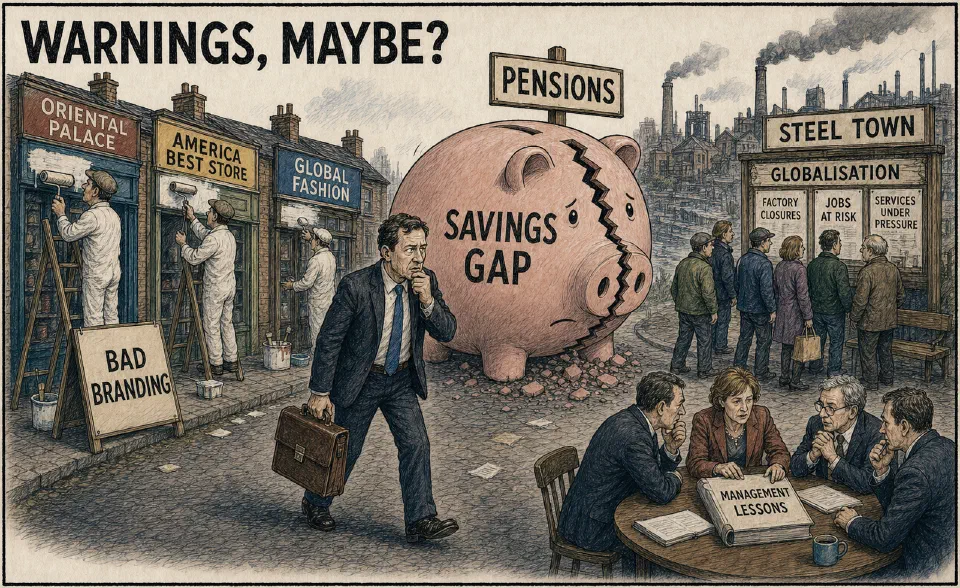
Watch the savings gap.
Deloitte has issued an update on the savings gap – the shortfall predicted between actual pension income and the money needed to live a comfortable life - which is currently at £250 billion in the UK. This could rise to £350 billion by 2050, meaning that UK workers should, on average, each be saving an additional £10,000 a year.
Meanwhile the government is busy restricting the tax advantage of investing in a pension with tax relief tapering down to £10,000 for those with earnings of more than £150,000 a year from April 2016. Further changes are mooted to increase the tax-take as government struggles to reduce expenditure.
Beware of branders.
Colgate introduced a toothpaste in France called Cue, which was the name of a local pornographic magazine. The name Coca-Cola in China was first rendered as Ke-kou-ke-la. Unfortunately, Coke did not discover until thousands of signs had been printed that the phrase means ‘bite the wax tadpole’ or ‘female horse stuffed with wax’, depending on the dialect. Coke then researched 40,000 Chinese characters and found a close phonetic equivalent, ‘ko-kou-ko-le’, which can be loosely translated as ‘happiness in the mouth’. Scandinavian manufacturer of vacuum cleaners, Electrolux, used the following in a US ad campaign: ‘Nothing sucks like an Electrolux’. In Italy, a campaign for Schweppes Tonic Water translated the name into Schweppes Toilet Water. Rolls-Royce was going to call a new model the Silver Mist, until it discovered that it means shit in German. The American slogan for Salem cigarettes, ‘Salem-Feeling Free’ got translated in the Japanese market into ‘When smoking Salem, you feel so refreshed that your mind seems to be free and empty’. Many years ago, Ford had a problem in Brazil when the Pinto flopped. The company found out that the word Pinto is offensive Brazilian slang that mocks men. Ford removed all the nameplates and substituted ‘Corcel’, which means horse. Geddit?
And current?
In December 1992, Neil Kinnock reflected on his policies as Labour leader, saying: “If it had been possible to have led the Labour Party of 1983 or 1987 or 1992 by Attlean acerbity, or Bevanite evangelism, Wilsonian wiliness or Callaghan bonhomie, then the task would have been much easier… In the event, however, the condition of the party made management an obligation, so I got on with it.
“It would have been useful to have had a neat and magnetic central theme… I have to say, however, as a matter of fact rather than self defence, that until as late as 1991 there was always a significant risk that any progressive lunge that was too big or too quick could have fractured the developing consensus… And as far as the central theme was concerned, I and others put repeatedly: ‘the purpose is to win’.”
Ukip and worry.
The conventional political wisdom of the left said that Ukip was on the far right and largely a problem for the Conservatives. Anyway, Nigel Farage’s ‘people’s army’ was stopped in its tracks when it won only one seat in the House of Commons in May and its leader failed to be elected for Thanet South. Just a few unobservant activists believe this is the current situation. Ukip’s supporters tend to have some leftish opinions. They do not show concern about the state intervening in their lives. Instead, they fear that government is not doing enough to protect them from the consequences of free-market globalisation – for example, mining, some manufacturing and steel. They see freedom of movement inside the European Union as driving down wages and pushing-up competition for housing, school places, and maternity and health services. The overall economic benefits can be abstract for those at the bottom of society. The downsides are visible. Could something similar to Scotland happen in the north of England?
The last word.
‘Next Christmas the iPad will be dead, finished, gone, kaput.’ Sir Alan (now Lord) Sugar, in February 2005. Business magnate and media personality.
The law.
‘We do not get good laws to restrain bad people. We get good people to restrain bad laws.’ G K Chesterton (1874 – 1936). English essayist, novelist and critic.