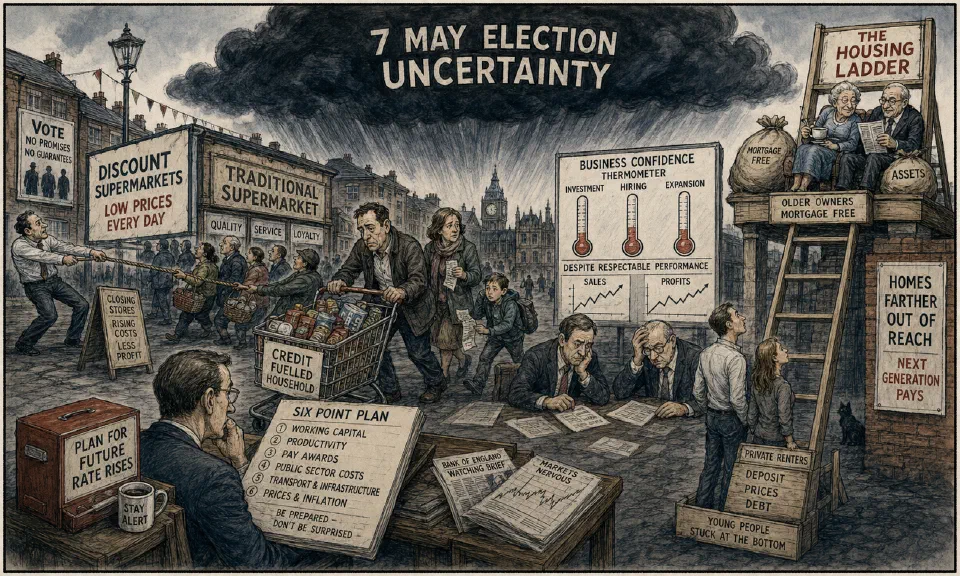
Benefits!
There is a feeling that any economic recovery is not trickling through to lower income groups, but higher earners are gaining from faster growth. The financial results of supermarkets emphasise this trend. Intense competition from discounters such as Aldi and Lidl have taken sales from the likes of Sainsbury and Tesco. Even premium outlets, for example Waitrose, have felt the pinch on margins, but not so severely on turnover. However, a lot of businesses complain about shortages of skills and this is leading to faster increases in pay. In certain sectors, notably construction and the financial sector, these issues are stimulating significant changes. They will not stop at the present points of pressure. Confidence of businesses has taken a dip in early 2015 according to the Institute of Chartered Accountants/Grant Thornton Business Confidence Monitor. However, performances have been reasonably good. There is universal reticence relating to the general election on 7 May. Uncertainty is in the air. Buoyant spending by households, fuelled by higher credit, will help consumers to drive economic growth this year.
Rising to the predicted circumstances.
Several managerial plans must be in place for the expected rises in interest rates: (1) reduction in working capital to compensate for earlier assumptions of consistently low interest rates; (2) additional determination to increase productivity and reduce labour costs; (3) preparation for pay awards in the knowledge that inflation (retail price index) will then start to move upwards; (4) acknowledgement that the targets for public sector pay are unlikely to hold, with the consequential impact on costs; (5) on a more nitpicking point, devise an exhaustive examination of transport and distribution costs. They will be subjected to particular pressures; and (6) awareness that the private sector will need to restore profits and might well risk increases in prices.
Home ownership.
In just ten years, the proportion of people aged 25 – 34 who own their own dwelling went down from almost 66% in 2003 – 2004, to 36% in 2014. Nearly half that age group now rents from private landlords. At the other end of the ‘property ladder’, the number of asset-rich households who own their principal residence outright, without a mortgage has grown rapidly to 7.4 million. For the first time, the number of mortgage-free occupants exceed the number (6.9 million) repaying a loan. One method of accumulating some wealth in a lifetime has diminished dramatically. These figures indicate a country on a road to a more insecure, unstable and unequal future. Ownership of a home is becoming the preserve of richer and older citizens.
Some are from above?
Everyone has seen political leaders who give the impression of a thirst for being living gods and having the associated authority. These oddities have not made much progress in the last hundred years. However, Finance and Management has reminded us that some enthusiastic supporters of Narendra Modi, India’s new prime minister, say he is a god and have built a temple dedicated to him. Mr Modi has declared his dismay and announced ‘This is shocking and against India’s great traditions’.
The Mentor
Charles Handy is 83. He has written a new and essential book, ‘The Second Curve – thoughts on reinventing society’ (Random House Books). The high standard remains. Charles Handy has a gentle, but incisive voice, probing questioning and wondering. For forty years, he has been the UK’s leading observer of the world of work. ‘Work is what we do, not where we go’, he says and then considers that employment itself has become more precarious: it may only be a matter of time before the contractual organisation becomes the norm. However, flexibility should be embraced to make working life better. ‘Growth should always be the means to greater purpose, rather than an end in itself’. The unifying theme of this book is that change is needed. However, he has retained the stance that companies should be concerned with creating wealth for all, not only shareholders.
We need more.
‘People don’t believe in ideas, they believe in people who believe in ideas.’ Scholar Zeev Mankowitz; quoted in The Guardian.
Feeling important.
‘All governments like to interfere; it elevates their position to make out that they can cure the evils of mankind.’ Walter Bagehot (1826 – 77); English economist and journalist.