Feeling good about the economy.
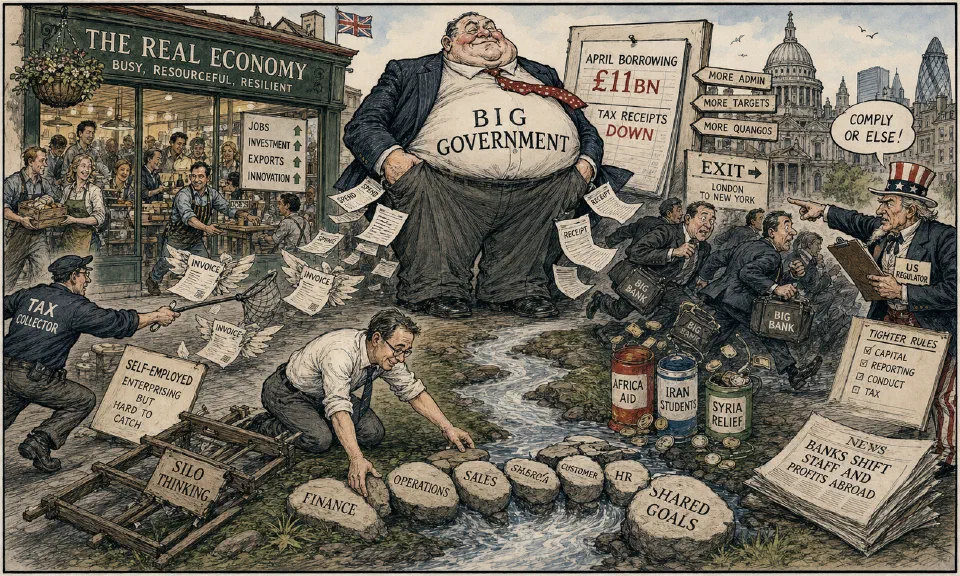
Economic growth has recovered better than predictions. Output is almost back to the level before 2008. Employment is increasing. Inflation seems to be under control and wages are beginning to rise. Shops say they are busier and people feel better about their prospects. However, a big problem remains. Matthew Lynn points out in MoneyWeek that the government’s finances are still in a ‘shocking state’. In April, our masters borrowed in excess of £11 billion for the month, £2 billion more than a year earlier. This is contrary to expectations and promises. Tax receipts were 6.8% lower than 2013. The Office for Budget Responsibility said this was a one-off factor caused by citizens shifting income into the new tax year to take advantage of the top rate coming down from 50% to 45%. One suspects this is not a full explanation. Since 2008, there are 330,000 extra self-employed people compared to 201,000 fewer employees. They can shift income from one year to another, depending on when they invoice customers. They can turn themselves into companies, or take any range of steps to reduce tax. In summary, the self-employed are a moving target for the collector of taxes. Employees are in clusters and easier prey.
On the run from regulators.
The Economist says big banks are retreating quickly from markets, countries and types of businesses which might attract the disapproval of regulators in America. There have been several prosecutions for lapses connected to sanctions, the financing of terrorism and laundering of money. Stricter standards include the need to know banks’ customers and to have information on customers’ clients. The main casualties of these removals of risks is ‘correspondent banking’. This is when a customer of a bank in one country sends money to someone overseas. The cost has soared of remittances to Africa, Iranian students cannot open an account in the UK and charities are having difficulties in transferring funds to places such as Syria. If poor nations are unable to have access to international finance, this is likely to worsen the circumstances that fuel the disruption and crime the rules were designed to prevent.
Any need for ladders?
- Create each job to suit the individual. Do not force people to adapt to rigid job descriptions.
- Be a coach, not a command and control general.
- Realise that many employees seek to be independent of a company’s structures in pursuing their careers. Show them how to take charge of their own occupational destinies.
- Encourage people to solve problems and make decisions by consultation and collaboration, not by passing paper up and down for approval elsewhere. Unclog and shorten channels of communication and responsibility.
- Promote the idea of advancement by taking additional responsibilities, doing a different job and gaining visibility.
- Create cross-functional groups to give broader experience.
Sounds correct.
‘What makes most of us who we are is not our minds and not our bodies and not what happens to us. But how we respond to what happens to us.’ Joshua Prager
Ouch!
‘Consensus: the process of abandoning all beliefs, principles, values and policies, in search of something in which no one believes.’ Margaret Thatcher