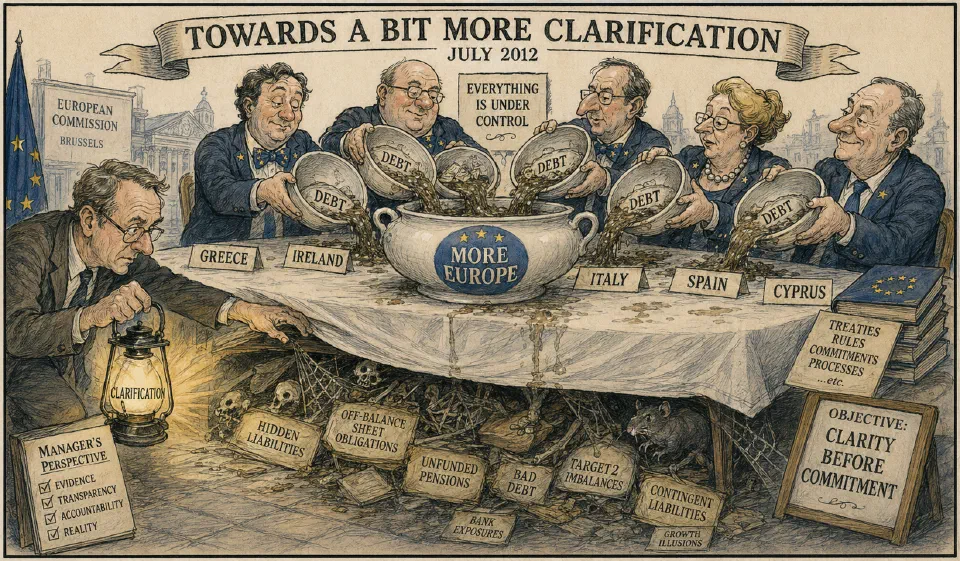
In Europe, the one that includes this country, crisis is a near-permanent condition.
After the concerns about Greece, Ireland, Italy and Spain, Cyprus has popped-up with its bowl. Are others waiting in the wings? The constant certainty of politicians that everything is under control does not inspire confidence. Devoted believers in the project of Europe regard every predicament as an opening for ‘more Europe’, which means more European Commission. Indeed, the proper emphasis on debts of all shapes, sizes and origins has passed unprecedented powers to intervene in national economic policies. Do we understand fully the consequences of these shifts? Do they raise concerns relating to the Commission’s legitimacy? David Cameron likes to offer advice to his counterparts when they talk in Brussels. But he is unable to calm the storms in the eurozone. For sure, he cannot afford to end his commitment in the medium term to fiscal balance. He does have an obligation to set out strategic purposes in making decisions and providing the support to encourage growth. Austerity cannot be an end in itself.
The world of business and economics frequently looks monochromatic.
Marks and Spencer was the epitome of British commercial virtues not so long ago. Then the company did nothing right for several years. Much the same happened at Sainsbury. General Motors was once America’s most admired company. The revolving door of fashion and favour turned rapidly for IBM – in, out and nearly back in. The same is true of national economies. It is barely ten years since the Asian tigers were dangled before us as exemplars. Those who claimed to see virtues in Germany’s system of industrial organisation were ridiculed until five years ago. And what about all those techniques and seminars which attempted to connect us with the triumphs of Japan? Corporations have characteristics and personalities. Weaknesses are frequently the converse of strengths. Determination can be seen as obstinacy; ambition as arrogance; inventiveness as unreliability; precision as bureaucracy. The sustained success of Marks and Spencer was a testimony to the ability of basic routines to extract exceptional performances from ordinary people. These methods were effective at securing incremental changes. The demand for improvement was ingrained. But such organisations find discontinuity difficult because they have created the need for consensus. Simultaneously, the keys to the future had become speed and initiatives for reinventing the business. As Charles Darwin observed, it is not the strongest of the species that survives, nor the most intelligent. The ones most responsive to change retain life and get new vigour.
A complaint is a gift. TMI brought us this expression from Denmark
The Americans reckon a buyer who is pleased with a new car informs, on average, eight friends about it. An unhappy customer tells twenty-two. New technologies based on the internet enable companies to form clubs of complainers. That is, regulars willing to be monitors of performance and represent the attitudes of the customer. Finding and rewarding these individuals and handling their information would be impossibly expensive under old systems. The prize is enormous for working out how to apply the news ones. Quality assurance in services is extraordinarily difficult. Without customers who care it is impossible. Ideally, participants would be consumers who see it as their duty to keep suppliers of all kinds up to scratch. The next trick is to take non-regulars and encourage them to behave like everyday customers at an acceptable cost. But the starting point is a conviction that a complaint really is a gift. Well, sort of.
Robert Craven at the Directors’ Centre places emphasis on personal performance
He says that successful entrepreneurs are:
- impatient and driven by results
- in need of achievement, setting high but realistic and attainable goals
- competitive, with self-imposed standards and a readiness to learn from their own failures
- pushed by a strong sense of self-responsibility and a belief that they can control their destinies
- takers of calculated risks
- creative thinkers, with strong belief in their intuitions
- tolerant of uncertainty, such as not knowing when the next cheque is coming
Pay close attention to how you reach a deal in the next few years
For example:
Concentrate on what you can control. You cannot do much about tomorrow’s shifts in marketplaces. You can put your house in order. Use telephones, renew your contacts, make appointments – get information and opportunities for additional customers.
Share the burden. When the economy goes downwards, risks increase. Discussions with colleagues will bring recommendations and support.
Stay confident. Reviews and commentaries might overflow with despair. Allowing that to affect your approach will not help. Determined and coherent belief will hearten customers and employees.
Do not look over-keen. This passes advantages elsewhere. Completing the transaction brings a good feeling. But the stock you accepted in your impatience to do so can be an expensive error.
Cultivate affinity. Your interpersonal skills become especially important in difficult trading conditions. Visit people. Stimulate trust in your company. Understand what present and new buyers want.
Get them to pledge purchases. But be careful. Promises beyond reality lead to disenchantment.
Strive for balance.
Make sure the deal fits the publicity. Chances are rare. Be certain that the agreement will realise the value you expect. Make sure the other party is happy to get what you want.
About right.
‘We know what happens to people who stay in the middle of the road. They get run over.’ Aneurin Bevan.