Well, well. Unintended consequences sometimes have beneficial effects.
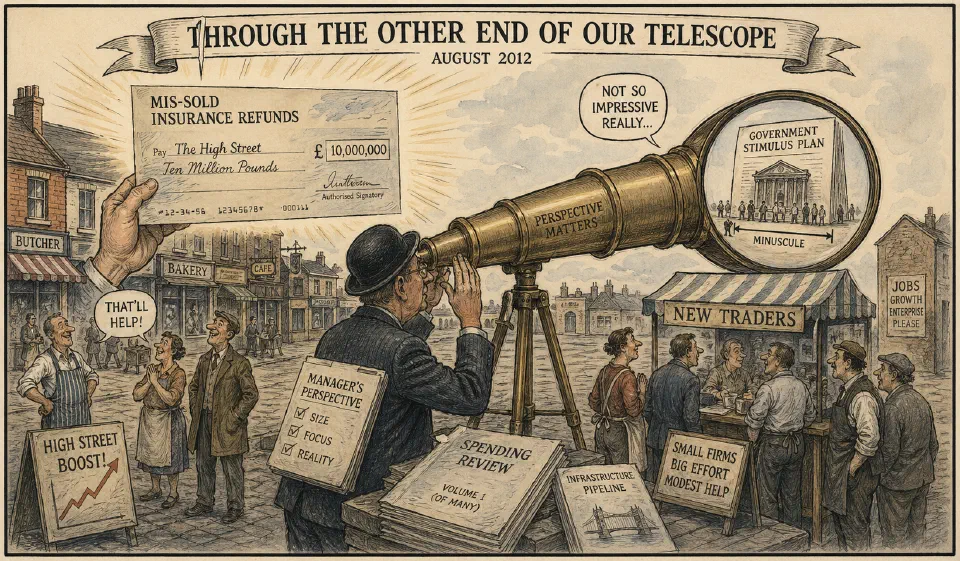
The Financial Times (7 August) pointed out that refunds to banks’ customers in the UK for mis-sold insurance are having a more positive impact on the country’s economy than initiatives by government.
It is shrewd politics to stand up for small firms.
They are a large majority of registered businesses. We know that when unemployment rises so does the formation of new traders. But the total declines when the labour market improves. We must keep in mind that large companies in the private sector are generally more productive, offer higher wages and pay more taxes than the smaller ones. Economies dominated by small firms tend to be sluggish. Think about Greece, Italy and Portugal. This comment is not intended to deny the importance of small businesses. The large organisations can be slow to react to customers’ expectations, changing tastes and disruptive, but essential, technologies.
A recent study by Experian for Santander examined the growth patterns of businesses with turnovers between £50,000 and £10 million from 2002 to 2010. Less than 5% play a major part in boosting the economy and account for two-thirds of all employment in the private sector. There is an emergent awareness that policymakers ought to look at growth. Government should concentrate on removing barriers to expansion. Some incentives encourage businesses to remain small.
Most town centres used to be a mixture of residential, light industrial, commercial and retail properties.
It is only since the end of WW2 that the typical British high street became a long row of chain shops that have closed or moved out. Formerly, there were at least one public house, a small covered market, a blacksmith, an ironmonger and some occupied houses. Morrisons, Sainsbury, Tesco are not going to return. The schemes led by Mary Portas will not have much sustained impression. An imperative is to rethink laws on local planning. As retail outlets close, why not convert the buildings into workshops, small factories, offices and houses?
Successful managers will return to basic concepts – ‘the four Rs’
Reframing the company’s notion of what it is and what it can do. Restructuring the corporate body for competitive performance. Revitalising by propagating growth in present products/services and inventing new ones. Renewing individuals and the organisation so they become integral parts of a connected and responsible community. Sounds easy. It’s not.
Gore Vidal was a sharp observer of political and social behaviours.
He died recently. Bill Bonner has pointed to something Vidal said in 2003: ‘I can recall thinking, when I got out of the army in 1946, ‘Well, that’s that. We won. And those who come after us will never need to do this again. Then came the two mad wars of imperial vanity – Korea and Vietnam. They were bitter for us, not to mention for the so-called enemy. Next, we were enrolled in a perpetual war against what seemed to be enemy-of-the-month club. This war kept major revenues going to the military procurement and secret police, while withholding money from us, the taxpayers, with our petty concerns for life, liberty and the pursuit of happiness.'