The big divide.
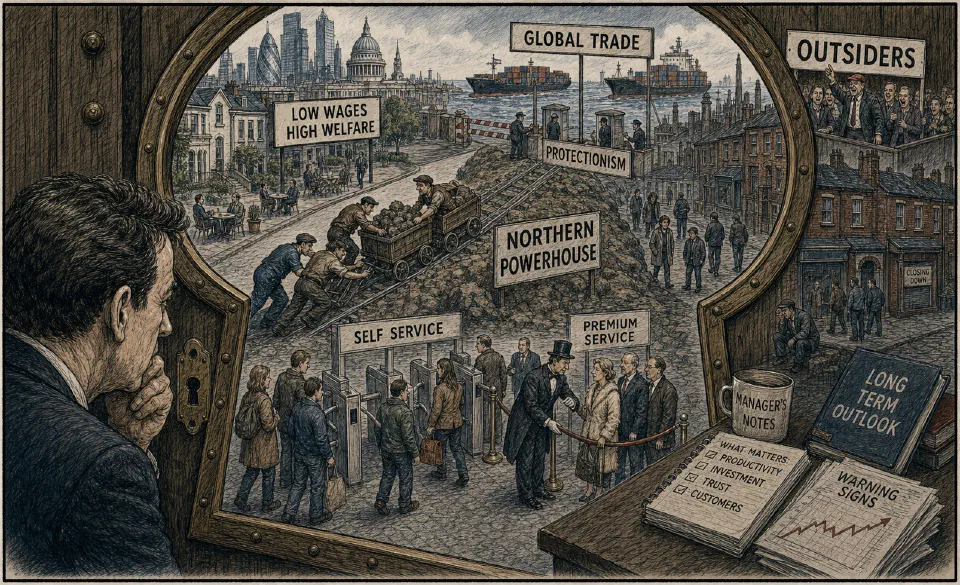
The Centre for Cities is a respected think-tank. It notes in a new report that 29 of Britain’s 63 largest cities are ‘low-wage, high-welfare economies’. They have average wages below the UK’s at £504 per week (2014), and expenditure on welfare at above the average of £3,368 per head (2014/15). Nine of the ten worst places on this measure is in northern England and the midlands. Hull has the lowest wages, £376. Blackpool receives the highest welfare spending - £4,338 per head. The fourteen cities with above average wages and below average spending on welfare are mainly in the southeast of England, plus Aberdeen and Edinburgh in Scotland. Wages in London are the highest at £629 a week. Cambridge has the lowest welfare spending at £2,121 per head. The Northern Powerhouse will have an uphill struggle. We can expect determined political demands.
Stagnation.
Heather Stewart and Ferguson Ryan (the Observer) say global trade is stagnating and this has difficult implications for those of us who try to build businesses. Many economists suggest that the sharp drop in trade, driven by PR China, is a signal of a worldwide recession. What is causing it? The OECD (rich countries) blames the slowdown in emergent markets, led by China. But Global Trade Alert, a think-tank, reckons ‘a creeping rise in protectionism’ is another problem. It observes ‘there has been a flurry of more subtle manoeuvres’ than earlier tit-for-tat regulations. These included restricting public procurement and tightening regulations to raise the bar against imports. If this is so, the results are ‘a measure of the fragility of globalisation’.
What is service?
The constant increase in self-service for customers brings two worries. First, the personal touch has been removed from the majority of transactions in mass markets. Nonetheless, providers pursue the well-off with offerings at premium prices. Consumers are now either herded into speedy and basic standards or flattered with big lumps of fawning at a higher price. Does this intensify the resentment of the haves, a minority, by the have-nots, a large majority? The second, and bigger, concern is for businesses as operating units. If they never meet their customers, they will lose touch with them. This will lead to purchases on price alone. The Economist points out that if firms abandon a determination to differentiate themselves with good service, they will become vulnerable to the kind of assault suffered by the UK’s mainstream supermarkets.
Into the fracas.
The caucuses in Iowa were supposed to be between a Bush and a Clinton, both from the establishment. We were told to expect coronations, rather than elections. Instead, the rush for the world’s most powerful office has been interrupted by outsiders. One of them declares himself as a democratic socialist. So, the contenders for America’s next president have moved on to New Hampshire. The United States is not the only country where the political elite is on its back foot. Britain’s Labour Party has a new leader who is to the left of predecessors since the ‘30s. In the first round of France’s regional elections, the far-right National Front won the largest vote. Populists are leading the polls in Holland and heading the governments in Hungary and Poland. In radical Sweden, the anti-immigrants are polling at 30%. Electors are angry. They have been saying for a long time that their countries are going in the wrong direction. Wages have stagnated even as incomes at the top have increased dramatically. Cultural fears add to economic ones. In recent months, dangers of terrorism have assisted the populist assertions. Conventional political parties have to reconsider their listening and consequential proposals. `
Reality.
‘Life is full of misery, loneliness and suffering – and it’s all over much too soon.’ Woody Allen, American screenwriter, actor, director, short-storywriter and occasional jazz clarinetist.
Shush.
‘To talk well and eloquently is a very great art, but an equally great one is to know the right moment to stop.’ Wolfgang Amadeus Mozart (1756-91), Austrian composer.