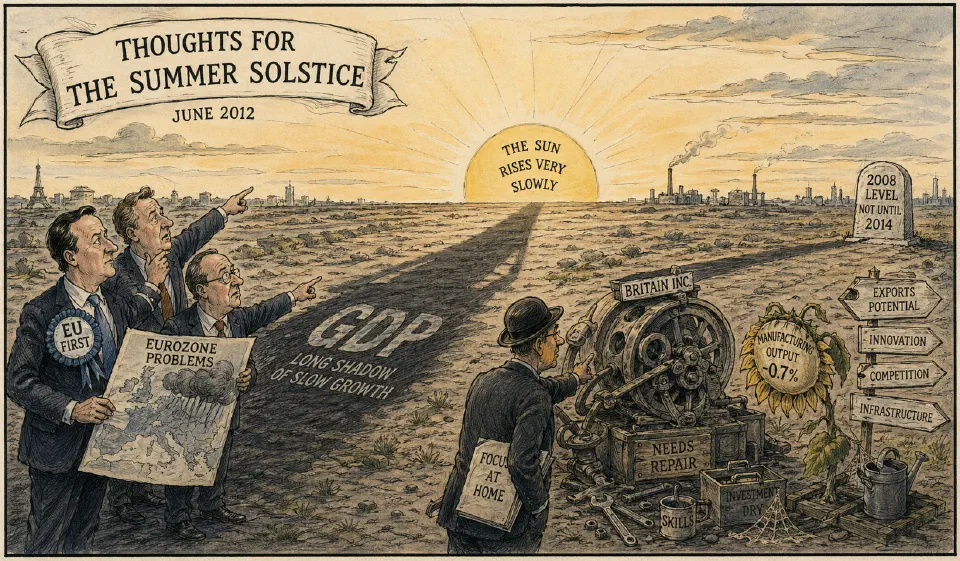
There is some certainty that the UK’s double-dip recession will last another quarter.
Output from manufacturing fell by 0.7% in April. The wider measure of industrial production was flat and 1% lower for the year. The National Institute of Economic and Social Research says the economy will not reach its level of GDP in 2008 until 2014. Politicians, pundits and economists have compiled a standard mantra of blaming the crisis on the eurozone. It sounds plausible, but is untrue. Of course, the turmoil across the Channel has some effect. Greece, Ireland, Portugal and Spain are in serious economic difficulties. Banks have become more reluctant to lend money when they wince at the possible losses on their portfolios of bonds. We wait to see the results of last week’s move on quantitative easing by the Bank of England. Stockmarkets are twitchy and the potent quality of confidence remains low. But why are some countries doing much better than us? Germany grew last quarter and outlooks are better for the whole of 2012. Norway and Sweden are on the edge of the eurozone, but not part of it, like the UK. Both are experiencing growth. Poland depends heavily on markets in the eurozone; GDP went up by 3.5% in the first quarter – we would call that a boom.
Exports from the UK are 26% of GDP and the eurozone accounts for 46% of that figure. So, exports to the eurozone are roughly 13% of GDP, an important sum but not as large as the standard script implies. Even the 13% that depends on the eurozone consists mostly of sales to France, Germany and Holland. The reality is that the UK is not expanding because of serious structural problems. Spending on the state has increased over the last two years and is 50% of GDP. Productivity and output in these occupations have almost certainly gone down. The aggregate of corporate, personal and government debt is more than 500% (yes, 500%) of GDP. Only Japan is worse than this situation. The Bank of England is not creative. The quantitative easing is likely to have a negative impact on savings. Subdued household consumption is the major issue. Demand in the economy will remain weak for quite a long time. Nonetheless, opportunities remain for the businesses that are fleet of foot and mind.
Nine ways to spot a disenchanted employee:
- s/he arrives just in time for elevenses;
- s/he is aloof;
- it is six months since her/his last idea;
- s/he keeps ducking out with a mobile;
- appointments with a doctor are on the up;
- his/her workload is a struggle;
- s/he has become over-sensitive;
- working longer hours is not helping;
- the person from human resources would like a word with you…
Thanks to ‘Management Today’.
As flexibility replaces tightly regulated working hours on the list of employers’ priorities, the five-day week is becoming a thing of the past
In the US, high-tech companies are offering workers alternate four and five-day weeks. In Germany, Fridays are already considered half working days. Yet the country that has succeeded in creating variable hours is France. Contrary to the outraged assertions of the international press, France’s legislation does not limit its workers to a 35-hour week, but to a 1,600-hour year. This makes sense in an economy that has a substantial agriculture and tourism and hence seasonal work. Moreover, an increasing number of France’s employees are in the irregular, deadline-intensive fields of research, management and academia. Apart from raising the hourly workers’ productivity and attracting more women to the workforce, the legislation has created 200,000 new jobs. If Britain is to face the challenge of the new working world created by technology and market places, we would do well to look closely at France’s example.
There is an enthusiasm for mergers and acquisitions around the world
Politicians in continental Europe have reacted defensively and noisily , but market forces are likely to prevail. Some sectors moved quickly: for example, banking, broadcasting, motor vehicles, retailing, telecommunications and websites. The ubiquitous Japanese electrical giant, NEC, unveiled a sweeping plan to reposition itself as an internet-based company. The subsequent opportunities for buy-outs of disposals from the new titans will be buoyant over the next five years.
‘The first myth of management is that it exists
The second myth of management is that success equals skill.’ Robert Heller in ‘The Great Executive Dream’.