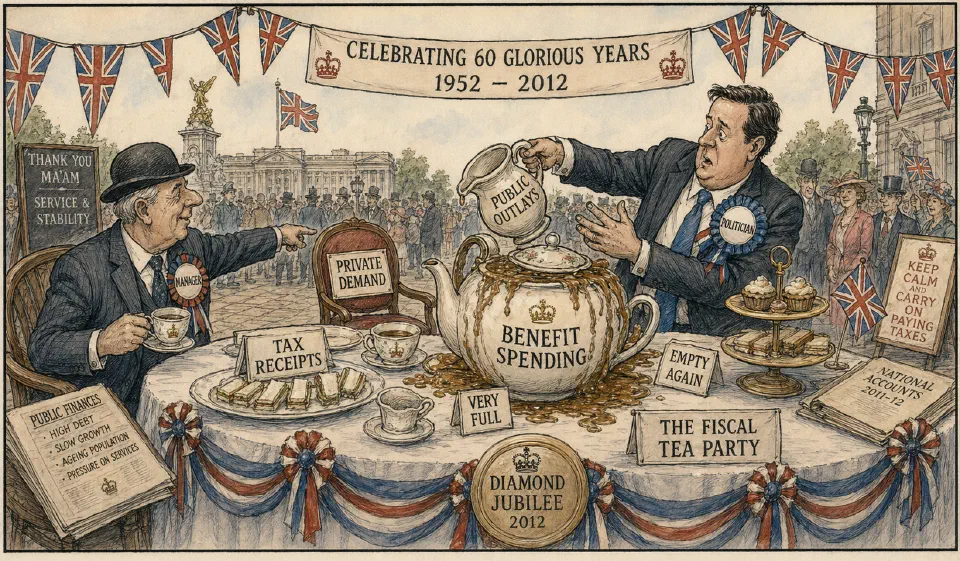
Correcting the UK’s awful public finances is proving to be more worrying than forecasters have been telling us.
Economic growth has evaded most sectors. Revenue from taxes has been subdued as a consequence and benefits have remained high. Income from taxation went up by 1.8%, expenditure rose by 3.8%. The figures suggest there is no scope for a substantial rise in public outlays to stimulate growth. A recovery must come from private demand. However, the credit bubble has burst. People are repaying debts and the banking systems seem fractured. Official borrowings for April were unpleasant. The deficit was £11.5billion compared to £9.1billion in April 2011. The International Monetary Fund (IMF) approved the government’s priority to reduce the deficit. It said also that the Bank of England should consider another round of quantitative easing as an additional attempt to promote growth. Moreover, the various authorities should improve efforts to expand lending to businesses. Another suggestion was to cut pay in the public sector and use the savings to enlarge capital expenditure. All easier said than done. One thing is certain. The evidence is that urging decision-makers to be simply optimistic has failed to deliver better results. Maybe we face the realities of managing a smaller economy?
Labour is ahead of the Conservatives in opinion polls. Ed Miliband’s personal ratings are in front of the Prime Minister’s.
It is no longer regarded as silly to consider the prospects of this Miliband as a tenant at number 10 Downing Street. Of course, such a rapid and dramatic shift is a reaction against the Coalition. It has been an assertion of political organisers for a long time that elections are lost, not won. But a vigilant eye ought to note the arrival of Jon Cruddas and Lord (Andrew) Adonis in the Shadow Cabinet. Cruddas has been MP for Dagenham and Rainham since 2001 and become associated with the new creed of ‘faith, flag and family’. The futurists suggest he might lead the connection of Labour’s heart to its head. He frightens the pants off others. Inevitably, Cruddas has been a politician of sorts all his working life. Lord Adonis is a former journalist with the Financial Times and the Observer, and was said to be New Labour’s action man. He was in Prime Minister Blair’s policy unit from 1998 to 2005 and a minister via the House of Lords. He is a director of the Institute for Government.
A few ex-big beasts are coming out of their hiding places, too. Lord Peter Mandelson, the old in-and-outer, has written an article with his adversary, Ed Balls. This is a signal for us to think about, he must be reckoning that the odds are narrowing for 2015. Tony Blair has indicated a wish to ‘enter the fray’, according to Rachel Sylvester in The Times. Alan Milburn was MP for Darlington from 1992 to 2010, was in Tony Blair’s cabinets for several years and a devoted Blairite. He has popped-up with a report and opinions on ‘social mobility’. Alistair Darling, ex-Chancellor, has started to offer his accrued wisdom. Watch out for new presences on the Ed Miliband bandwagon.
Our old friend John Courtis – the former doyen of search and selection – pointed to the way Hans Keller defined and censured bogus professionals in his book, ‘Criticism’.
First, the ‘profession’ has to be highly respected within its civilisation. The second and central criterion is precise : in order to prove its phoniness beyond reasonable doubt, a ‘profession’ has to create grave problems that it then fails to solve. The third test is the capacity to criticise somebody or something both negatively and self-righteously, with moralising aplomb.
The World Future Society set out fifty major trends that will reshape our lives.
Some of the highlights were:
- the labour market will become much tighter as the pace of technological change continues to accelerate. At the same time, entry-level and low-paid workers will be scarce
- our values will be based on the dot.com crowd, rather than the baby-boomers
- the overall work ethic is declining. Tardiness is increasing and abuse of payment during sickness is common. These erosions could have a negative impact on corporate performance
- time will become the most precious commodity. American workers already spend about 10% longer at work than they did fifteen years ago
- there is an expanding emphasis on preventive medicine. People will control stress as they realise that 80 to 90% of all diseases are stress-related
- the worldwide loss of biodiversity will be an increasing concern. Half of all the drugs used in medicine are derived from natural sources, including 55% of the top 100 drugs prescribed in the United States.
Just a thought.
‘Let a man start out in life to build something better and sell it cheaper than it has been built or sold before, let him have that determination and the money will roll in.’ Henry Ford 1