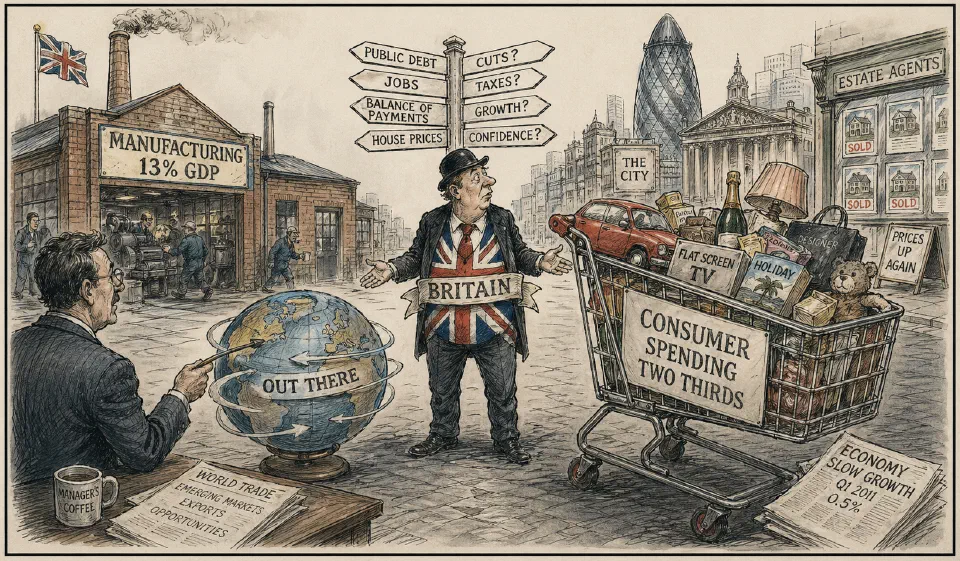
After years of Britain’s prospects being dominated by what is happening in the City and in estate agents’ windows,
all of us welcome signs that other parts of the economy are now doing better. Recent strong manufacturing figures prove that Britain still has some great companies left. But as Samuel Tombs at Capital Economics pointed out, manufacturing now accounts for just 13% of UK’s GDP. So it can ‘only make a modest contribution at the best of times’. In other words, it cannot save our economy alone. Consumers’ spending, in contrast, accounts for around two thirds of the overall GDP. So it’s clearly the key factor in growth. That is why the latest statements from major retailers concentrate the mind.
Businesses in industrialised countries must learn to live in two realms simultaneously.
One is the world economy, with its transnational money. The other is the nation state, where money is the servant of short-term political goals. The first will drive towards greater economic integration, but nationalism in its various guises will bring fission and smaller units of sovereignty. Even quite tiny firms will have to start their strategic thinking and planning within an international context. Global information is reasonably reliable, whereas domestic data have become distorted and treacherous. Inflation was one culprit but governments manipulate figures as they adhere to theories which have reducing connections with reality and little predictive value. Economic dynamics are in what is now the universal trading village. Even localised companies will have to analyse trends, expectations and developments in the proverbial ‘out there’.
The nation state is not going to wither away
It is likely to remain the most powerful political organ for a long time but will cease to be the indispensible one. It will share power with other vehicles, institutions and policy-makers. What is to remain in the local domain? What is to be done internally by autonomous bodies? What is to be transnational? What is to be separate and local? These will be central political issues for two or three decades. The outcome is unpredictable. Managers cannot ignore the possibilities.
Pearls from Bill Gates at Microsoft:
- ‘You cannot count on conventional wisdom. That only makes sense in conventional markets.’
- ‘If the 1980s were about quality and the 1990s about re-engineering, the 2000s will be about velocity.’
- ‘It’s brains that provide the edge.’
- ‘We always over-estimate the change that will occur in the next two years and under-estimate the change in the next ten years.’