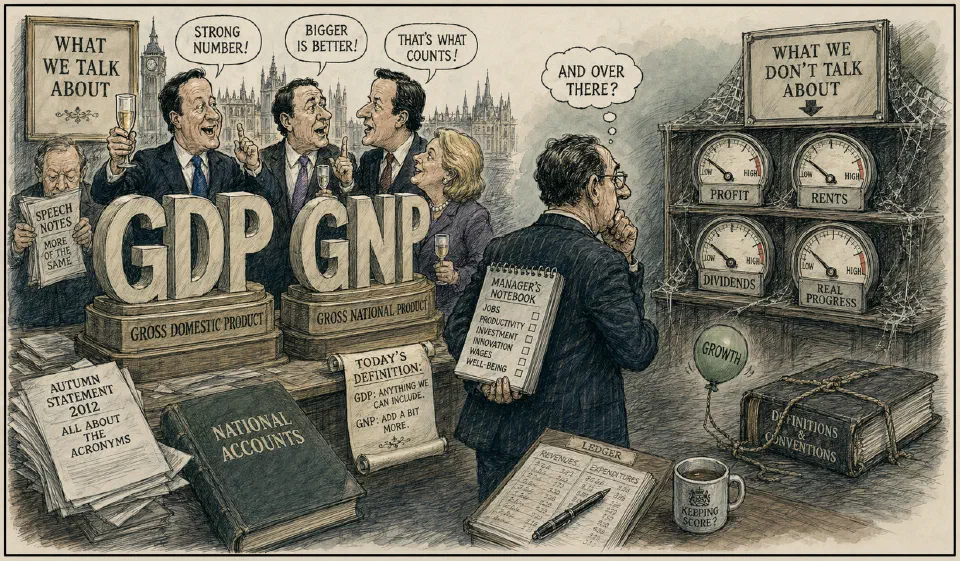
Everyone talks about growth
Politicians insist it is the measure of our progress towards economic prosperity. ‘GDP’ and/or ‘GNP’ trip off the tongues of the chattering classes. So, to remind only your writer, Gross Domestic Product is the revenue generated in the UK from employees’ remuneration and profit. Gross National Product starts with GDP and claims to make adjustments to reflect profits, rents and dividends, either paid from abroad to the UK or vice versa. So what? Well, GDP cannot differentiate between real expansion from exporting more goods and services or increasing profits and – for example – higher salaries in the private or public sectors paid for by larger borrowings. It does not measure the assets and liabilities – the value – of British businesses. Neither does it indicate the true prosperity of Joe Soap. Boosted credit for people to buy cars, washing machines and the like is shown as growth. So is the clearing of oil slicks near the Shetland Islands. There is fools’ gold somewhere.
We are told constantly by politicians that the successful use of the proposals from John Maynard Keynes
suggest the UK ought to raise more money to get out of the various recessions. Such propositions have become almost the mantra of some advocates. But is this a defensible stance? It is almost certain that Keynes’ views do not offer much help. His core assumption was that governments would enter a crisis with a balanced budget. This has little connection with our situation. Also, he said, ‘By a continuing process of inflation, governments an confiscate, secretly and unobserved, an important part of the wealth of their citizens. By this method they not only confiscate, but they confiscate arbitrarily, and, while the process impoverishes many, it actually enriches some’. Maybe in the Western economies we cannot expect living standards to rise as they did during the 60s to 90s? There is need for information and debate.
Information Technology (IT) shrinks the globe,
bringing the networked corporation and altering the nature of every product and service. Nonetheless, plans for IT have fallen short of their promises. They have been shoehorned into old-style organisations. This is the primary reason for modest payoffs in productivity from huge investments by the service sector, especially in America. The re- or new-shaped firms are taking advantage of IT. The outfits in aspic are getting left in the dust. It is particularly worrying that, as a whole, smaller businesses are lagging badly. A lot may lose their competitive advantage from speed of response.
Do not dismiss competitors.
Take heed of Minute 802 of United States’ Security Council, 12 September 1954. ‘Secretary Dulles told Premier Yoshida frankly that Japan should not expect to find a big US market because the Japanese don’t make the things we want. Japan must find markets elsewhere for the goods they export.’
Welcome to the nano-second decade.
Are you being re-engineered? There is a state of flux in the permanently ephemeral, flattened hierarchy. Are you managing change, functions and activities? But many managers are bitter, unfulfilled, confused and depressed. They may feel ‘The corporation does not own me; I owe it nothing. The reason for this situation is that I am disposable also.’
From the textbook for managers
Two profound observations: ‘The rule is, jam tomorrow and jam yesterday – but never jam today.’ And, ‘You see it’s like a portmanteau – there are two meanings packed up into one word.’ Through the Looking-Glass (Lewis Carroll)
Little wonder that UK’s companies are approaching claims of recovery with caution
And it is unsurprising that the likes of The Bank of England predict the curve of an upturn will not be steep. Budgets of all kinds will be guarded jealously by those who see their political leaders distracted from the task of rebuilding an economy by old obsessions with inflation. And businesses are right to be nervous and wise to delay recovery as a result of it. There will be more corporate corpses from this recession. Managers who rush into a phoney peace might be among them.
Reality?
Ouch! ‘The English people believes itself to be free; it is gravely mistaken; it is free only during election of members of parliament; as soon as the members are elected, the people are enslaved; it is nothing. In the brief moment of its freedom, the English people make such a use of that freedom that is deserves to lose it.’ Jean-Jacques Rousseau, The Social Contract, 1743
Sounds right.
‘The taxpayer – that’s someone who works for the government but doesn’t have to take the civil service examination.’ Ronald Reagan