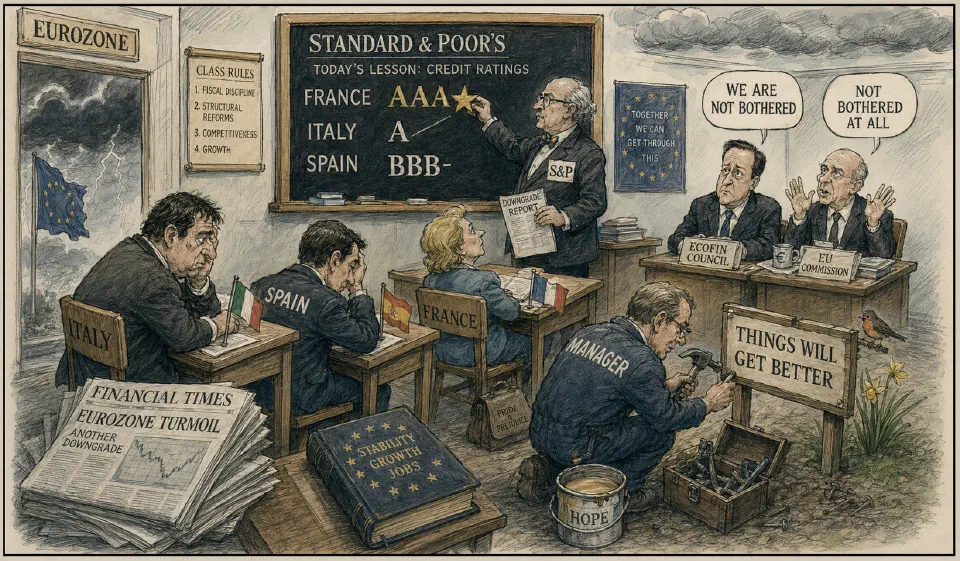
Standard and Poor’s downgraded nine European economies last Friday.
Italy and Spain were lowered again to a BBB+ rating and a lonely A, respectively. France had been rated AAA for thirty-six years and was reduced to AA+. This caused damage through publicity, but its politicians said they were not bothered about such antics and did believe the figures anyway. Everyone else knows the action is another blow to the notion of Europe. France and Germany were the financial strengths that would underpin the weaknesses of others. Will France now need its own bail-out? Do we make too much fuss, I wonder? The United States lost its status of AAA last year. The pain was not life-threatening. Bonds became more desirable. Investors knew they would get their money back.
Back home
we remain with the dilemma that economic reality is often surrounded by spin and fables. One sometimes suspects that the silent and applauded civic servants from HM Treasury are not bright and shrewd. They do not seem to encourage the truth. For example, we are not told that we owe in the order of $5.75 trillion overseas - £100,000 for every citizen. We have sold our businesses to anybody who pops up with the money: ASDA, Chelsea FC, Eon, HSBC, Liverpool FC, Millennium Chemicals, Pilkington Glass, Princes Foods, The Times, and so on. Forty-two per cent of shares on the Stock Exchange are owned overseas. HM Treasury has been our watcher, but, but, but. Goldman Sachs has predicted that Britain will overtake France and Germany to become Europe’s biggest economy by 2050. Of course, your writer will be in another place.
Competitive advantage is about doing something better than competitors do.
It is relative. Do not attempt to achieve an ideal standard. Competition in most markets takes place at the edges, where little things determine who gains the upper hand. Aspects of service come to mind. Put ten points on your checklist: superior product or service; perceived benefit; global skills; low-cost operator; first-rate competences; outstanding assets; scale; focus and attitudes; legal protection; and powerful relationships. Bear in mind that most companies bring together a number of small and consistent selling points. Strategic thinking (not the same as formal strategies) and marketing plans covering attitudes and skills sustain the differences. Marketing with practical steps brings a soul to the business.
The UK is overcrowded with giant institutions
scientific, religious, commercial, educational or artistic – that are not centres of conviction, but monuments to an ego. They have lots of money and good people, but no results. So, before you embark on a new effort or direction, ask yourself: ‘Are we really trying to open up new territory, or are we just building another fortress to defend the status quo?’
Management and organisation are still quite primitive notions.
In a rapidly evolving discipline, the gap between the leading practitioners and the majority is enormously wide and closes slowly. Not many of today’s managers realise that management is defined by responsibility and not by power. Even fewer fight the debilitating disease of bureaucracy: the belief that big budgets and huge staffs are accomplishments, rather than the marks of fools.
Just a thought
‘There is this weird superstition of management that if you could just use the right techniques you could make dumb people smart and lazy people energetic.’ Scott Adams, creator of Dilbert, the world’s favourite downtrodden office worker.