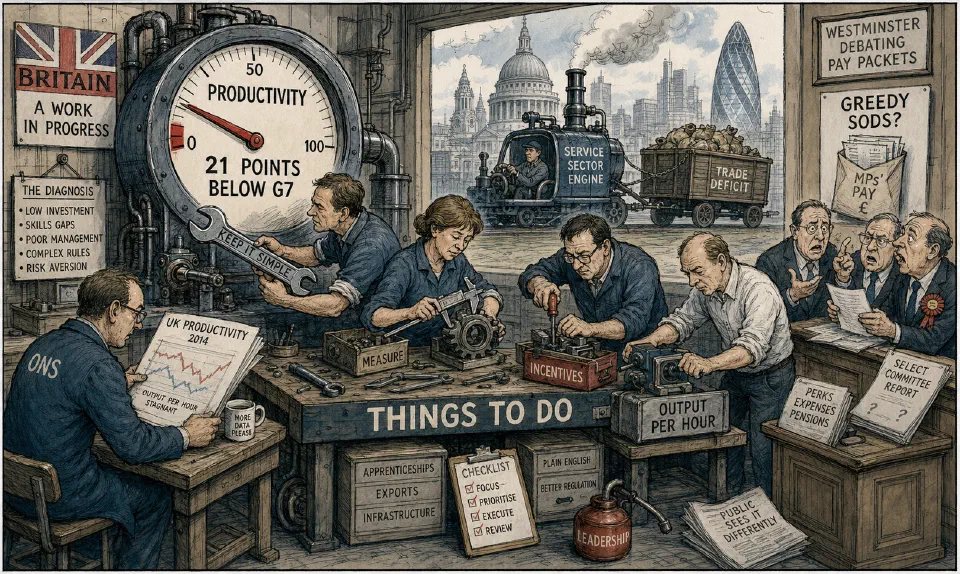
A productivity crisis?
The economy is mired in problems and excuses relating to productivity (GDP per hour worked). The latest estimates from the Office for National Statistics (ONS) show that the gap between performances in the UK and those of other leading countries are now at their widest since 1992. In 2012, output per hour in the UK was 21 percentage points below the average for major G7 industrialised economies. And results in this country fell from 2011 to 2012. Canada, France, Germany, Italy and USA were all more productive than the UK in 2012. Managers have a lot to do.
We have a toe in the stream of recovery.
However, these encouraging trends are driven by growth in the service sector. It produces 80% of output. Financial services, leisure and retail are the frontrunners. Great Britain needs a successful and expanding London to offset the deficit in trade of goods. Pushing so-call ‘balance’ contains important ambitions. We would be unwise to disturb the London model.
EVA is not a musical
EVA has entered the lexicon of managers. Unusually for an acronym, the advocates refuse to say what the letters mean. Economic value added? Well, possibly, but … . There is common ground that in the 50s it was called ‘residual income’ by General Electric of America. The formula is: EVA = (return on capital – cost of capital) x capital. The enthusiasm has all the signs of a fad. EVA, we learn, is not merely a financial resource, nor simply a method or running a business and engaging everybody in the process: it is way of life. This stimulates our caution. EVA is offered as a sure technique for marrying financial incentives to a system for measuring performance. There is no doubt that this approach is a step forward. It is not a panacea. Recall your hard lessons from previous nostrums. They might be : allow a year; have small working parties of operational people; do not move a muscle without knowledge and support at the top; keep it simple; take it slowly; communicate uncomplicated examples, not mathematic formulae. If you incentivise, start with the five or six senior people. Bear in mind always that incentives should connect with things the particular people can influence.
‘Greedy sods’
is the reaction when an independent body (Independent Parliamentary Standards Authority) suggests MPs ought to have an increase in pay. MPs are too scared to accept. Their leaders express horror at such a decision. No one says it is pointless to debate money when we do not know what we want from our representatives. The business of governing, opposing, communicating and winning elections is done by a handful of MPs and so-called professionals in each of the three main political parties. These people are said to be up-to-the-job. An MP has to be seen as showing concern for the locality and being a social worker. Maybe they compete with local councillors? Or is it possible there are too many MPs, councillors and ‘public’ institutions and appointments? A debate is essential on an MP‘s duties, responsibilities and relationships with other political/elected jobs. When we resolve this matter, we can answer the other questions.
Good sense.
‘Big business is not dangerous because it is big, but because its bigness is an unwholesome inflation created by privileges and exemptions it ought not to enjoy.’ Woodrow Wilson, former president of America in his acceptance speech at the Democratic National Convention in 1912.
The quote has a respectable pedigree.
‘The avoidance of taxes is the only intellectual pursuit that still carries any reward.’ John Maynard Keynes (1863-1946).