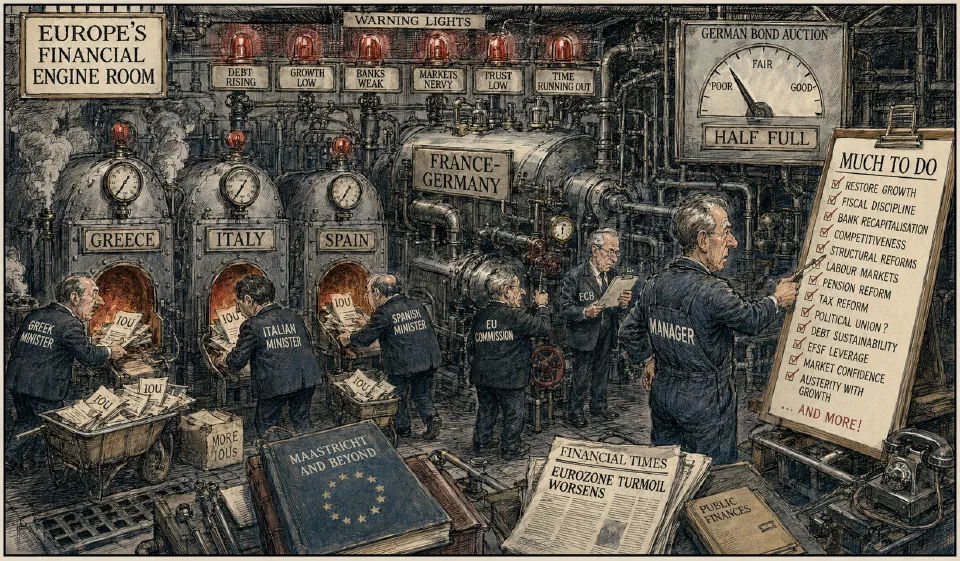
The initial emphasis of the crisis in Europe was on the weaker, peripheral countries
such as Greece, Ireland and Portugal. They were the first to receive bail-outs. Then attention shifted to larger economies like Italy and Spain. The financial engines of France and Germany looked OK, at least to the noisy newspapers. But last Wednesday the warning lights switched on in Europe’s lynchpin. Its government held an auction of ten-year bonds to raise 6 billion euros. Only just over half were sold. This prompted large sales of stocks in European markets and sent yields (at 2.06%) of Germany’s bonds above those of the US Treasury. One has to wonder if these events have called into question Germany’s status as a safe haven.
Evidence indicates we will have coalition governments beyond 2010.
Paul Whiteley is co-director of the British Election Study, University of Essex. This group completed a large-scale survey of electors during the campaign associated with a referendum on the Alternative Vote in May 2011. One of the questions asked respondents what they thought about coalition governments. Twenty-one percent said they are a good thing. Forty-one percent disapproved of them and thirty-eight percent recorded ‘neither good nor bad’. It became clear that the British public does not like the idea that parties could fight an election on one set of policies, which can then be changed overnight as a result of post-ballot bargains for coalitions. However, an examination of voting patterns suggest that we are likely to have to put up with coalitions. This is because of long-term changes taking place in the electorate. Partisanship, or attachments individuals have to one of the major political parties, has weakened at each election since the 1960s. So, electoral politics are more volatile and the core vote for each of the primary parties is smaller. In 1992, the Conservatives and Labour combined took 76% of the votes. This was down to 65% in 2010. In addition, there has been a rise in support for minor parties – from 6% in 1992 to 12% last year. Then consider the moves in voting patterns for Scotland and Wales. Put these factors together and it becomes clear that coalitions can be an expectation.
The instruments of speed are indispensible components in the managerial scene:
fax machine, lap-top computer, cellular ‘phone, jet aircraft, express mail, couriers, email, texts, internet, teleconference and computer-aided design and manufacturing. And more. We have witnessed what is alleged to be participative management – empowerment. Our posty says ‘Empowerment is when your boss gives you all the boring parts of his job to do, and works half as hard himself’. Slander. The born again project manager uses (no, utilises) project teams, task forces and work groups. Then add networks, global subsidiaries, affiliates, joint-ventures and licensees to the structure. It is enough to make an old organisational planner implode. Indeed, that is what happens as he faces boundaryless definitions, horizontal charts, re-engineered relationships and managed change. Are we turning to the Japanese style of management? Is the pyramid dead? Is The Boss going to be just a co-ordinator? Not by a long shot. But the principles, techniques and practices are in a state of flux. The indications are:
- the corporate staff as we know it will disappear. No competitive company can afford the expense and clutter
- the number of people between chief executive and routine contact with customers will shrink further. In some companies, it is already down to three
- the direct-reports for a supervisor were linked to six or seven. This will rise to twenty-five or so
- paths for careers will become imprecise as people move up, across and through the organisation in new ways and on different tracks. Rivalry will intensify for managers who have learned the latest systems. An increasing number of senior executives of British companies will come from foreign affiliates.
- the unrest and volatility of the corporate world is not nearly over. The fresh ideas and approaches will multiply
- not all chief executives accept the latest organisational theories with anything other than lip service. Plenty of tough oldies are not contemplating amendments to their ‘I am the boss’ stance. A few have the clout to pull it off. Most will lose out to innovative competitors. Some younger managers will delude themselves they are they already operating these latest concepts. They send out signals of complacency in aspic.
Gains by the Republican Party in the United States’ recent elections were reported widely as a rejection of President Obama’s policies.
But the results may be of greater significance: the inability of governments in the world’s major democracies to fulfil the aspirations of divided and demanding electorates. As with shelves of supermarkets, political brand loyalty is not what it used to be. Canada’s Conservatives were reduced to a rump. Since the Liberal Party was overthrown in Japan, coalitions have become short-lived and unstable. Berlusconi’s triumphs in Italy showed the connection between hubris and nemesis. The alliance between the Christian Democrats and Free Democrats have suffered painful losses in Germany. The story could go on and on – France, New Zealand, Spain, Sweden ….. and the UK. Many of the grievances stem from economic problems governments can do little about. Promises and action seem to intensify unpopularity. Reducing budget deficits, over-generous social benefits and integration in Europe are examples of unrewarding dilemmas. Others are almost ideological: crime, homelessness, poverty, and rights and obligations of citizens.
C Northcote Parkinson – remember him and his observations?
Reckoned the person who is denied the opportunity for taking decisions of importance begins to regard as crucial the judgements s/he is allowed to make. S/he becomes fussy about filing and fonts, keen on seeing that pencils are sharpened, eager to ensure that windows are open (or shut) and apt to use two or three different-coloured inks. He might have added and sends emails on anything and everything to people in the same room.
The World According to Student Bloopers by Richard Lederer, St Paul’s School
‘Eventually, the Ramons conquered the Greeks. History calls people Romans because they never stayed in one place for very long. At Roman banquets, the guests wore garlics in their hair. Julius Caesar extinguished himself on the battlefields of Gaul. The Ides of March murdered him because they thought he was going to be made king. Nero was a cruel tyranny who would torture his poor subjects by playing the fiddle to them.’
Crumbs
In the US, thefts of dogs are up 50 percent this year and have more than trebled since the start of the recession. American Kennel Club