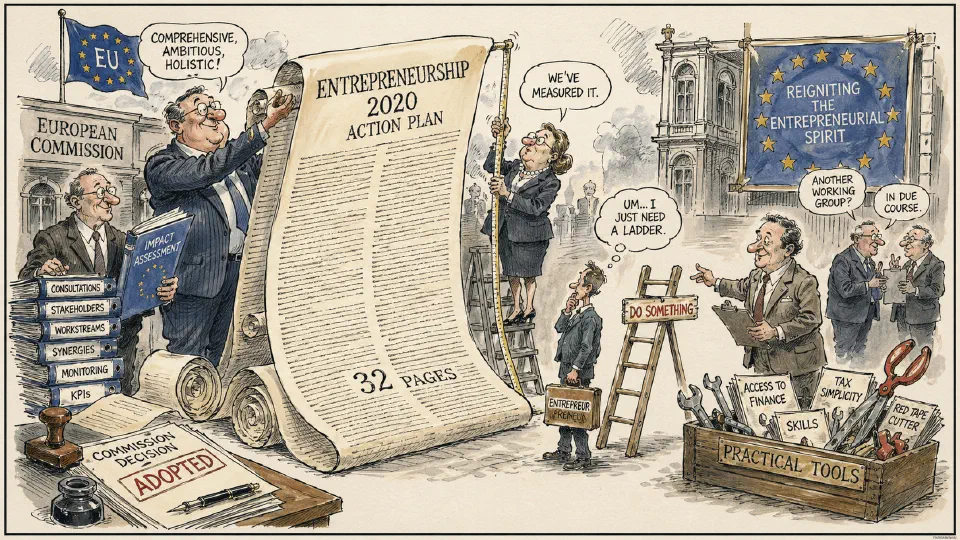
The European Commission has decided encouraging entrepreneurs is not supping with the devil after all.
It has published an ‘Entrepreneurship 2020 action plan’ for ‘Reigniting the entrepreneurial spirit in Europe’. There seems to be no sense of irony in taking thirty-two pages to tell us. There are some level-headed proposals. But most of them are a genius for stating the obvious and give a hypothetical posture. Nothing much will happen in terms of an impact on economic growth until the centralised bureaucracy realises delivery is not through additional regulations, spending taxpayers’ money and interventions into market places. The starting point has to be correction of the Commission’s own admission that the cost of its rules for businesses is €128.8 billion a year.
The Government is putting together this summer’s spending review.
Ministers are preparing for a fierce fight with HM Treasury. Watch out for arguments that more ought to be charged to the protected big spenders: education and the health service. Politicians are good at moving deckchairs. Whitehall’s departments have been instructed to find cuts of 10% in their budgets. The International Monetary Fund (IMF) has made a few mild criticisms of this country’s plan for austerity. It will visit London soon for the annual review of our economy. Insiders say the Chancellor will make an aggressive defence of his strategy.
A million pounds in 1982 had the same buying power as £3 million in 2012.
‘Finance and Management’ points to this finding in a report from Lloyds Private Banking on inflation’s erosion of the value of money over thirty years. Food has not kept up with general inflation. The worst commodities for worth were the costs of beer, petrol and housing. The price of a detached house is six times higher today than in 1982. Average salaries/wages rose by 372%. Employees’ standard of living has increased by 150% over the same period.
Managing into 2014.
The theories and practices of management and organisation in a business enterprise are still fairly primitive. This should neither surprise nor distress us. As is common in a relatively new and rapidly evolving discipline, the gap between the leading practitioners and the majority is wide, but closing slowly. Such was the situation, for example, in medicine until quite recently. A manager’s obligation is to acknowledge the limitations of her/his knowledge, techniques and skills. Far too few realise that management is defined by responsibility, not power. Not enough fight the debilitating disease of bureaucracy; the belief that big budgets and a huge staff are accomplishments rather than incompetence.
Importance of people.
It is observable that successful companies have a particular stance on policies for employee relations. They do not pronounce individuals as the most important part of an organisation, but pursue the realistic stance that individuals are but one part of the total resources and influences, whose importance varies under different conditions. Employees who are self-responsible are not fooled by talk of their ‘importance’, especially when they experience the tensions and frustrations inherent in production bogies, budgets and other daily issues of co-ordination (your writer does not say this is bad!). Most are willing to accept the need for organisational constraints placed upon them. At best, employees view statements ‘that people are the most important’ as unreal whims of directors and managers, who might feel guilty about being the boss. At worst, as conscious manipulations that betray managers’ basic but perhaps unknowing, lack of confidence in the individual.
Aristotle is still around.
‘We are what we repeatedly do: excellence is therefore not an act but a habit.’