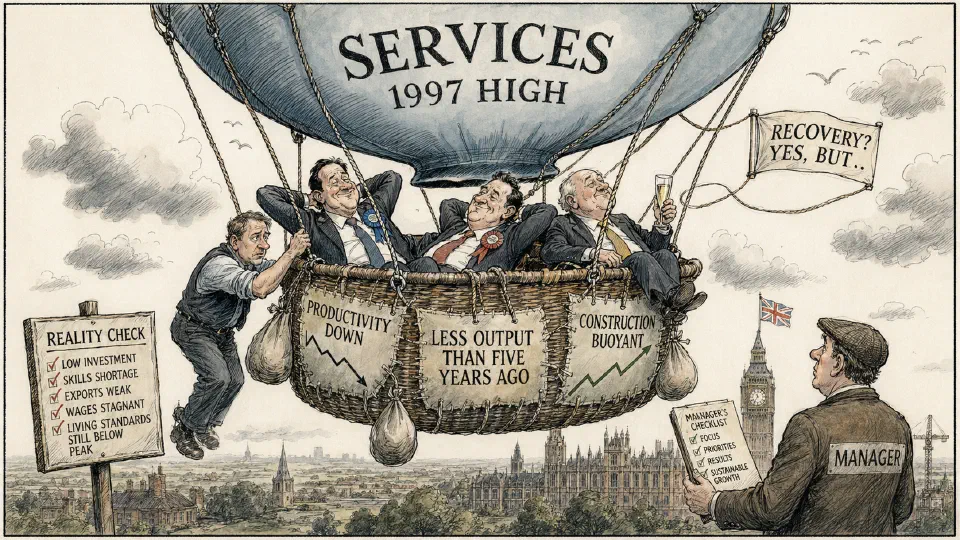
Britain’s economic progress continues to exceed predications.
Activity in services during October was the highest since 1997. Employment in that sector is close to a record. Construction is buoyant. Before we rest on our laurels and assume that things look OK for the long-term, we ought to have a look at the nature of this growth. It would be a good idea also to recall that we are still producing and consuming less as a nation than we did five years ago. Output and productivity remain on a downward trend. In truth, we do not understand the figures. We know increases in gross domestic product (GDP) can be sustained only with underpinning by additional investment and exports. There is little evidence of these pivotal factors. A reasonable conclusion indicates growth as being driven again by household-based demand; consumption pushed by an eased housing market and access to cheap credit. There are no signs of a bounce-back in manufacturing, which is down to 10% of GDP, despite the declining pound. Services are encouraging. Financial services and public administration have shrunk, while professional, business and support resources are in good shape. Creative, media and digital industries are thriving. Britain’s post-WW2 experience emphasises a pre-disposition to generate inflation. Examine the prices of services since 2011 and the fastest expansion of money supply for nearly ten years. The cost of essentials – housing, fuel and food – is soaring. A decade ago they accounted for 19.9% of our income; today it’s 27.3%. It must be likely that the Bank of England will cool things off by increasing interest rates. Another boom and bust would be depressing.
‘Scrap HS2 now.’
This is an urging from a respected and relatively neutral magazine, The Economist. It says that many governments have been beguiled by high-speed rail, but the evidence from continental Europe is that it is costly and often little used. Several new lines have been abandoned. The case for HS2 has not been blessed with consistency. Openers talked about cutting times of journeys. They ignored the fact that people work on trains and have wi-fi, smartphones and tablet computers. And just give a thought to the technologies available to us in 2023 – the promised date for completion. Then, we were told HS2 will rebalance the economy away from London. Analysts deduced quickly that London will benefit most from this investment of £42 billion. The advocates rest their case now on capacity. But is HS2 the solution? Of course, many lines are over-crowded, but there are other ways of increasing capacity. Bear in mind also there is a notion that passengers place merit on getting to destinations quickly and are willing to pay for the extra speed. But HS1, the high-speed link from London to the Channel Tunnel, suggests otherwise. Even at peak times, this line only used 55% of its capacity in 2010, according to the National Audit Office.
Some assertions might be a bit dodgy. Recent estimates are based on a survey in 2004/05. Earlier calculations presumed 30% of passengers would be on business. This has advanced to 64%. The case is flattered because business travel is counted as five times more valuable than that of others. Options have not been looked at closely. Britain’s big cities will still grow, partly because jobs are becoming more concentrated there, but mostly because of fierce opposition to building homes elsewhere. The full environmental statement on HS2 will not be published until next year. Is it a vanity project? Politicians do not get their names on upgradings. They cannot boast to their foreign counterparts. Economies will rely upon superfast broadband soon. This country has the worst record in Europe for direct fibre-optic cabling. 1% of homes are connected, compared to 57% in South Korea. Maybe we should spend money on embracing technologies of the 21st century?
Innovative people rarely talk about ‘creativity’.
It is the buzzword of functionaries. Innovative companies discuss work and self-discipline. Then they ask ‘what is the next point at which we should review this project? What result should we expect by then? And how soon?’ The manager(s) reckons, ‘Isn’t it time we did something else?’ A business of this kind organises itself to abandon the old, the obsolete, the no longer productive product or service.
Marketing and goodness.
Back in the ‘80s, our dilemma of ‘business in society’ was resolved once-and-for-all. The private sector’s task was to be ‘greedy’. Companies would become more competitive by maximising profits and creating employment and wealth to overcome the country’s problems. Asking firms to take their eyes off the competitive ball, confusing them by diluting their single-minded concentration on financial results would rebound on us all. Profits would fall and so would investment, jobs and general prosperity. So that was that. We slept at night. Then, ‘public purpose marketing’ zoomed across the Atlantic. Businesses can pursue profits and show concern for ‘the community’. Indeed, the only way to do the former is by doing the latter, because this is what consumers want. Kind people have long-term advantages in the market place. All this can disturb us a bit. However, bear in mind the dangers of confusing novelty with strategy.
Dangers of being right.
‘You may be on the right track. But don’t just sit there or you’ll be run over.’ Anonymous.
Put your foot down.
‘If you don’t drive your business, you will be driven out of the business.’ B C Forbes, publisher.