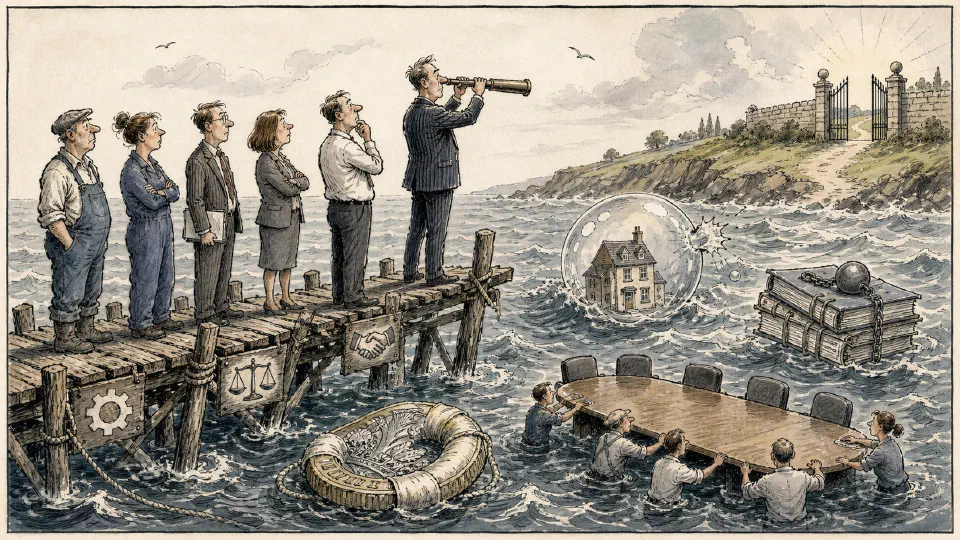
Policies for the economy and businesses.
The vote for leaving the European Union (Brexit) is a rejection of the Government’s plans. In general, electors felt they saw support for business, while their working prospects diminished. Central banks reduced interest rates to historical lows in the name of stimulating the economy and encouraging investment. Several rounds of quantitative easing inflated the prices of assets, driving the price of a home further out of reach. There was official hope that some of the gains would trickle down and benefit those citizens without reserves. However, evidence suggests that shareholders and executives gained from loose monetary policy, but the majority of employees did not. Watch out for changes in regulation. These are likely to include: curtailing the legal powers of shareholders; creating a mandatory place for employees in resisting unwelcome takeovers; controlling speculative acquisitions; making boards of directors more accountable to employees; protecting companies from being distributed to short-term shareholders.
Blame.
UK’s decision to leave the European Union (Brexit) is not the cause of the problems we will read about over the next few months. It might press to start consideration of the problems we have already. These include large private and public debt, a tax credit system which is driving that debt upwards, dreadful productivity, a property bubble, the insolvency of Italy’s banks and so on. But Brexit will not be the reason for them. Nonetheless, Brexit will present an unusual opportunity to examine the UK’s version of capitalism and to make it a better model.
Volatility.
This is not the time for hasty decisions and fast judgements. The UK’s decision to leave the European Union has bounced markets into confusion. People are doing silly things with their money. We are in the most turbulent situation for many years. Value of the pound has fallen. Yields from bonds have dropped. Sales of property are in turmoil. Guessing what to do next is now a dangerous activity.
May on democracy in the workplace.
Our new Prime Minister has emphasised that ‘putting people back in control’ is central to her vision. She has shown her government is neither a continuation of David Cameron’s stance, nor a bonfire of regulations in the labour market, as favoured by Andrea Leadsom, her former rival. Theresa May’s proposal to have representatives of workers on the boards of public limited companies puts commercial democracy at the top of political agendas. Of course, the devil will be in the detail. Has the Labour Party been out-manoeuvred on this issue? In 1977, the then Prime Minister, Tony Blair, received an extensive report on industrial democracy from a commission led by Oxford academic Baron Alan Bullock. There were many recommendations. Nothing happened. The trades unions could not agree how it would all work.
Get the facts.
From an article titled ‘Humanism in Medicine’ - The Lancet (1978): ‘One way of catching class attention is to ask what advice students would give when presented with the following family history. The father has syphilis, the mother tuberculosis, they already had four children - the first is blind, the second died, the third is deaf and dumb, and the fourth has tuberculosis. The mother is pregnant with her fifth child, and the parents are willing to have an abortion should you so decide. Assuming there aren’t too many Roman Catholics in the class, you will usually find a majority in favour of abortion. You congratulate the class on their decision … and then tell them they have just murdered Beethoven.’
There is evidence.
‘History teaches us that men and nations behave wisely once they have exhausted all other alternatives.’ Abba Eban, Foreign Minister of Israel, 1966-74.
Debts.
‘A promise made is a debt unpaid.’ Robert W Service, 1874-1958. English born Canadian writer.