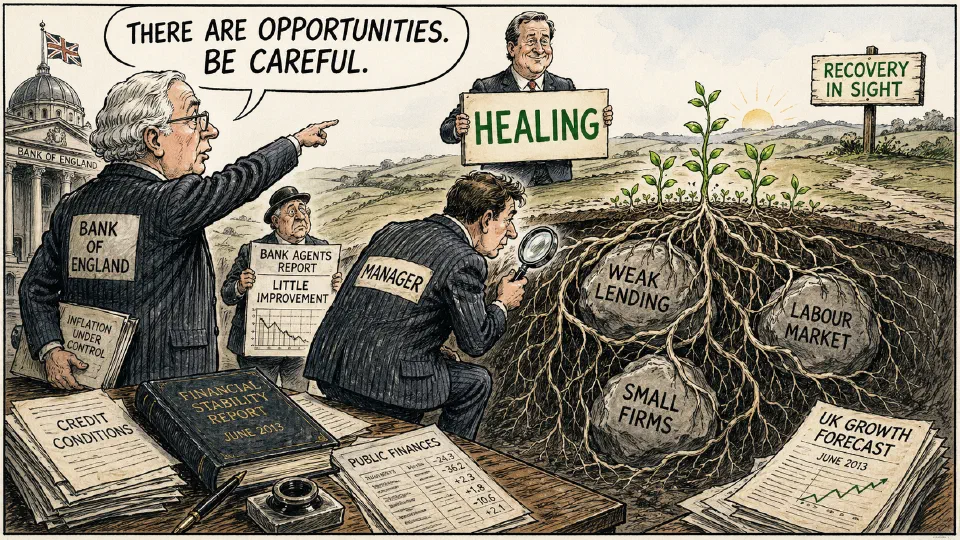
Green shoots. Do they have roots?
Sir Mervyn King, the Bank of England’s governor, has said, more than once, that ‘a recovery is in sight’. Of course, some growth is better than none. Chancellor George Osborne suggested recently that the economy is ‘healing’. The purchasing managers’ index showed some pick-up, but reports from the Bank of England’s agents indicated little improvement. The labour market continues to weaken. Net lending to businesses, especially small firms, remains sluggish, at best. The CBI’s quarterly review of the service sector showed hotels, bars and restaurants had the fastest increase in sales since 2007.
A survey by Lloyds TSB concluded that consumers’ confidence is at a three-year high. We would be unwise to expect improvements in sentiment to translate immediately into expenditure. Ministers do not seem to deny that the government’s Help-to-Buy scheme will push house prices upwards. It might give sales a boost and be popular. But it will leave tax payers on the hook for risks the banks will not take. All in all, managers of businesses must push harder and be careful.
Do we need more doctors?
Between 1960 and 2011 the population rose from approximately 52.4 million to 62.6 million. An increase of 20%. Over the same period, the intake of medical schools went up by more than 70%. From 1990 to 2010, the number of consultants alone increased from 21,410 to 35,781, an expansion of 65% and in ten years to 2009, managers in the NHS swelled by 82%. Advances in technologies and drugs have made investigations, operations and treatments easier and faster. Is there attention to efficiency and productivity? Thanks to L S Illis, Lymington.
Concepts in strategy are a bit like information from the stockmarket.
The first person with a useful insight makes more money than the last. Nifty strategies do not remain proprietary for long. When everyone climbs on the same wagon, the concept no longer yields a differential benefit. Good strategies are usually transient. They lose their value as they enter the public domain. The challenge is to create tomorrow’s advantages faster than competitors mimic today’s. The essence of strategy is the ability to learn; not calculating competitive edge at a point in time. It is the skill to engage an entire organisation in a continual search for new forms of advantage.
Vision focuses on productivity.
The search for higher performances at all points in a business is the permanent priority of managers. Service (or overhead) functions are major issues: costs are increasing faster than profit; they often no longer relate to current business needs; managers lack an impartial judgement of those which ought to be removed, reduced or expanded; their output has become an end in itself; some activities are known to be ‘generally useful’ rather than needed by a specific user; and users do not know the costs of services. Remember the macro-economy is never right and cannot be properly fine-tuned. Managers must not expect some golden days just around the corner when rising aggregate demand, coupled with stability where it counts, will make their lives easier. Instead, the emphasis is on productivity at the individual firm.
Costs, quality . . . time.
Alvin Toffler surprised thoughtful managers in his books ‘Future Shock’ and ‘The Third Wave’. He observed that ‘all nations now face one inescapable rule – the survival of the fastest’. The then president of Apple confirmed, ‘Companies that can quickly get ideas and information through their organisations for discussion and action will have distinct competitive advantages over others’.
Reality, 1743.
‘The English people believe themselves to be free; they are gravely mistaken; they are free only during election of Members of Parliament; as soon as the Members are elected, the people are enslaved; it is nothing. In the brief moment of its freedom, the English people make such a use of that freedom that they deserve to lose it.’ Jean-Jacques Rousseau - The Social Contract, 1743.
Probably.
‘The secret to creativity is knowing how to hide your sources.’ Albert Einstein.