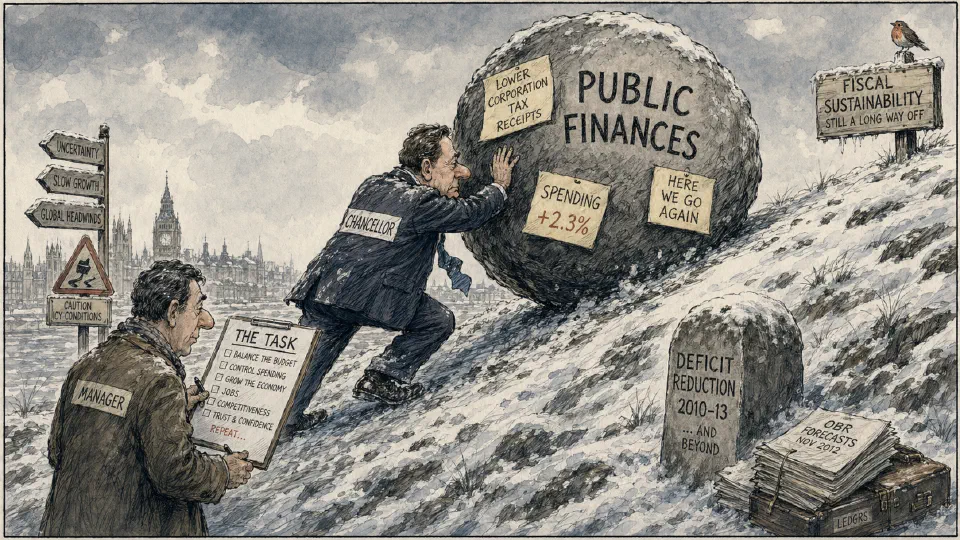
The figures on the UK’s public finances are not all moving in the right direction.
Those published on 21 November will have given the Chancellor a disappointing feeling of ‘here we go again’. The decline in receipts for corporation tax in October was worse than expectations. This contributed to an overall lower rise in revenues than relatively recent predictions. Spending by central government rose by 2.3% for the year (2012-13). That is, below the Office for Budget Responsibility’s (OPBR) forecast in the budget last March. Net investment by the public sector was £10.4 billion for the first seven months of the financial year (£1.9 billion in October). The figure excludes transfer of assets from Royal Mail Pension Scheme to the public sector and closure of the Special Liquidity Scheme.
If the trends in receipts and non-investment expenditure remain the same throughout 2012-13, borrowing by government will be in the order of £13 billion more than estimates by the OBR. This information is not easy reading for those finalising the imminent Autumn Statement. It is tempting to think simply that David Cameron is incompetent. There is some truth in this observation, but the same conclusion is correct for Labour’s front bench. The country pays dearly for an absence of previous responsibility for results in any job and a disenchanted civil service. Also, we are seeing how hard it is to hold office during austerity.
Labour’s rebrand is in every big speech from Labour.
Ed Miliband is right to reposition the Party as ‘one nation Labour’. However, anyone who has the slightest connection with marketing and selling knows rebranding cannot produce lasting results by a label alone. This is a certainty even if the national and local big beasts use the words at every touch and turn. Mr Miliband must now follow through. This can be done only by making sure that every policy up to 2015 must pass the test of ‘one nation’. The slightest smell of internal squabbles and descriptions of ‘us’ and ‘them’ would bring irreparable damage. As an individual, Ed Miliband must persuade electors that he has the will and skill to keep promises. As Prospect (November) suggests, those members who shout for abandonment of the strategy, a ‘return to Labour’s roots’ and a shift of the Party to the left are not simply on the wrong side. They are fighting the wrong battle. If Miliband tries to form a government without permission to inflict pain or make enemies, he will quickly find this country politically ungovernable.
Line managers are beginning to understand their total job.
‘Rethinking HR for a Changing World’ was published in September by KPMG and the Economist Intelligence Unit. 83% of 418 global executives surveyed think specialists in managing human resources ‘have failed to keep pace with the changing nature of workplaces and are unable to assist the management of a global workforce’. HR has ‘wasted the past twenty years’, failed to demonstrate its business value and will itself become redundant unless it can meet the challenges of today’s commercial environment. This stance will receive support from line managers of all shapes and sizes.
Teams are popular.
There is much talk about creating team-work. But most work is done by people in teams, hermits are rare. There is an ill-founded assumption that the present organisation does not have teams. Also, commentators suppose there is only kind of team and they rarely describe it to us. There are at least three. The first is exemplified by cricket (or baseball across the pond) or one which operates on a patient in hospital. The players play on the team but not as a team. Each person has a fixed position. The strengths – tasks, measurement and trainability – should not be discounted without thought. The second sort of team plays soccer or in an orchestra. The basic structure has firm places again. The pianist does not take over the violins. However, the members behave as a team. Each co-ordinates his or her part with the rest of the team. There is a need for a conductor or a coach, whose word is law. Effectiveness demands practice and rehearsals. Unlike cricket, these teams can respond quickly and flexibly if they are well-led and the intention is clear. Thirdly, there is the doubles at tennis – or Vorstand in a German company. The participants have a preferred rather than a fixed position. They cover for each other. And they adjust to the strengths and weaknesses of fellow members. But consider the self-discipline. The types of team cannot be mixed. A switch from one to another is often difficult and painful. Beware of advisers who cannot be persuasive about the facts and history of your particular situation.
Sounds correct.
‘If you owe the bank $100, that’s your problem. If you owe the bank $100 million, that’s the bank’s problem.’ J Paul Getty.
A seasonal thought.
‘I am terrified of the Santa at the shopping centre where I work. Our HR person talked it over with me, and discovered I am Claustrophobic.’