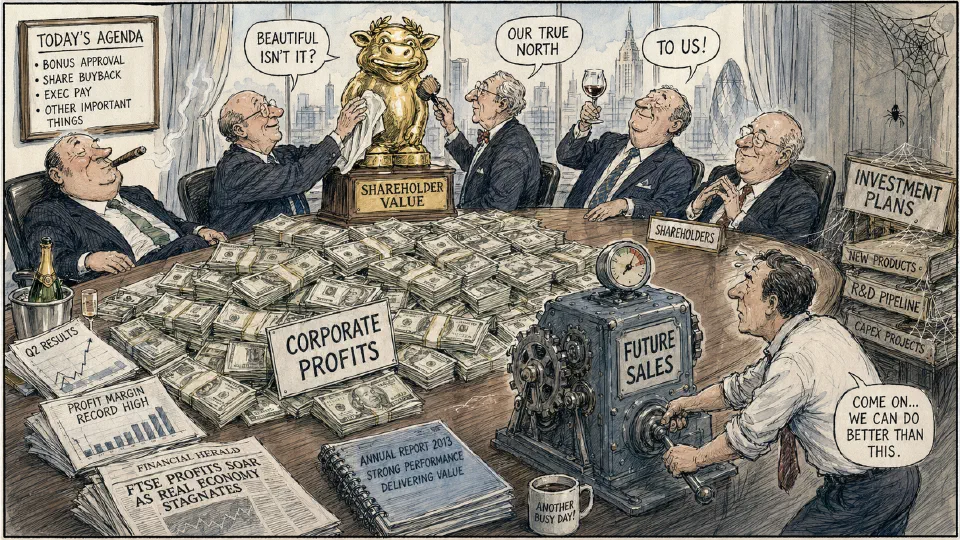
Corporate profits as a proportion of gross domestic product (GDP) are at record highs in developed countries.
Big companies do not seem to be investing in the projects that will yield sales at reasonable margins in the future. In short, low interest rates right now permit cheap capital. It is reasonable to expect that businesses ought to borrow and invest. Instead, they are hoarding lots of cash. ‘Shareholder value’ caught the imaginations of shareholders in the 80s. Retrospection might provide support for the notion that this prompted a serious intention of executives to do little other than increase earnings per share (EPS). There was a short-term need for such an emphasis. However, it has outlived its position as the top priority. When businesses fund opportunities or new equipment or pay higher wages, EPS goes down. Some self-criticism would not go amiss.
The Independent noted in late July that, because of inflation, the national minimum wage in Britain has fallen below the figure for a reasonable standard of living.
The consequence is a huge cost to the taxpayer. This is because the welfare state has to intervene to pay the wages employers refuse to pay, and sometimes say they cannot afford. A distortion of this kind has to come to an end, particularly given the low tax receipts from large corporations. Low wages are a problem across the world. The position is not sustainable. There are signs of disaffection at the bottom of pay ladders in several countries. Bloomberg says that thousands of workers for fast-food restaurants in America are striking for higher pay, including those employed by McDonalds and Wendy’s. Shifts in operating ratios are on the cards.
Negotiations.
There are between two and four minutes to set the stage for a successful negotiation. Use them wisely, or everything you say later may be lost. Appearance and ‘body language’ determine the other side’s initial reactions. Remember: there is never a second chance to make a good first impression.
Decisions, decisions, decisions.
All decisions should be made as near to the action as possible. The infamous Charge of the Light Brigade was ordered by an officer who was not looking at the territory. There are two kinds of decisions. Those which are expensive to change, and the rest. A decision on relocation from London to Cardiff should not be made hastily. Nor should one to build a new computerised system. Plenty of contributions from operating people and specialists are essential, too. But the common or garden decisions should be made quickly. Brand of pencil and times for the canteen can be decided in three seconds and changed at little cost later. The company might lose a lot of business while you oscillate between blue or white coffee cups.
The Peter Principle: but why?
Everyone knows the Peter Principle, that people are promoted often to their point of incompetence. But little is said about why this happens. The overwhelming reason for over-promotion is the visibility of technical expertise, which is recognised by elevation as a supervisor or manager. Here, untried (and possibly non-existent) abilities and interpersonal skills are tested and found wanting. Worse, many poor souls are prevented from doing the things they are good at: the brilliant sales representative who becomes a pedestrian sales manager, the former financial analyst who is unhappy as an assistant controller, the embarrassing supervisor who has been an inspired fitter. The good news? A lot of employees are passed over because their results and qualities are not noticed by ‘the system’. They are performing at below their competence. Better appraisal (or tests) will reveal these hidden stars. They are likely to blossom without the training wasted on specialists.
Deserves a thought or two.
‘Any intelligent fool can make things bigger and more complex. It takes a touch of genius and a lot of courage to move in the opposite direction.’ Albert Einstein (1879 – 1955)