We know. What will happen?
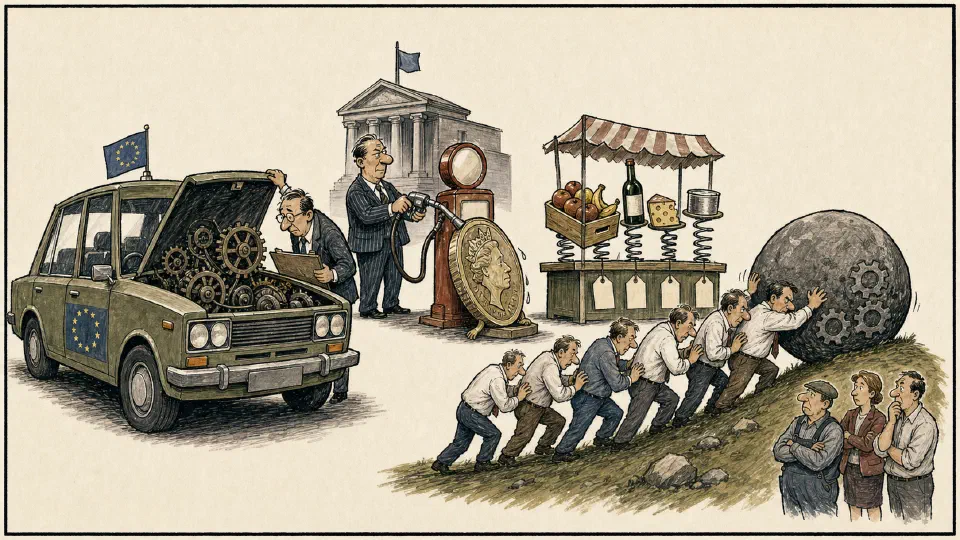
The European Court of Auditors (ECA) says governance at the European Commission is functional but lags behind international good practice and is in need of an update. Lazaros S Lazarou, a senior member of ECA, likened the Commission’s governance to a car manufactured in 2000. It’s in good working condition. It takes you from A to B, but hasn’t got the technology and the features of a modern vehicle. The ECA found, for example, that the Commission’s own audit service is constrained when compared with those in international bodies because it has limited access to information on spending. There is also too much interest on internal audit, rather than risk management and internal control.
The pound and inflation.
There are good reasons to assert that the Bank of England (BoE) wants a weaker pound. Most people know the Bank has a target for inflation which it has not been able to reach for many years. How do central banks achieve inflation? They used to believe printing money (quantitative easing) would bring inflation, but discovered that this alone does not do it. As well as printing the bank notes, people must spend them. And did not. The money sat undeposited at the BoE as excess reserves. So, the Bank has to find another method – cheapen the pound. As Jim Rickards points out, this means every time you buy imported goods, or you travel abroad, take a vacation in Switzerland, enjoy French wine, obtain Chinese technology …. it’s more expensive. In summary, whatever you buy will be at increased cost, if your currency is worth less. This is uncomfortable, but does stimulate inflation. That’s what Mr Mark Carney and the BoE want.
Productivity and poor management.
The Institute for Employment Studies says research reveals a clear link between low productivity and bad practice. There have been rumblings for some time that the UK’s managers and leaders are not as good as they ought to be. This suspicion, combined with a deep rooted belief that management and leadership are important for organisational performance, have caused successive governments to worry about what it can do to obtain improvements. The work of Nick Bloom (Stanford University) and John Van Reenan (Massachusetts Institute of Technology) has shown that regardless of country and size of organisation or sector, the quality of managerial behaviour correlates positively with corporate performance. The UK is behind the top results – Canada, Germany, Japan, Sweden and the USA. Other research indicates that management and leadership are essential factors in workplace innovation.
Big questions.
The major questions for large, nontech companies are: 1) What are the core competencies of my organisation when size no longer matters? 2) How much of my organisation’s managerial expertise is entirely dedicated to market co-ordination? 3) If new competitors replicate these capabilities by replacing human experts with machine algorithms, what is my cost structure compared to theirs? 4) Going forward, what new offering can I extend if product distribution is broadened? 5) Can I partner with new players and recombine my current capabilities to enter new markets?
Sounds right.
‘We are what we repeatedly do. Excellence, then, is not an act, but a habit.’ Aristotle, (384-322 BC). Greek philosopher and scientist.