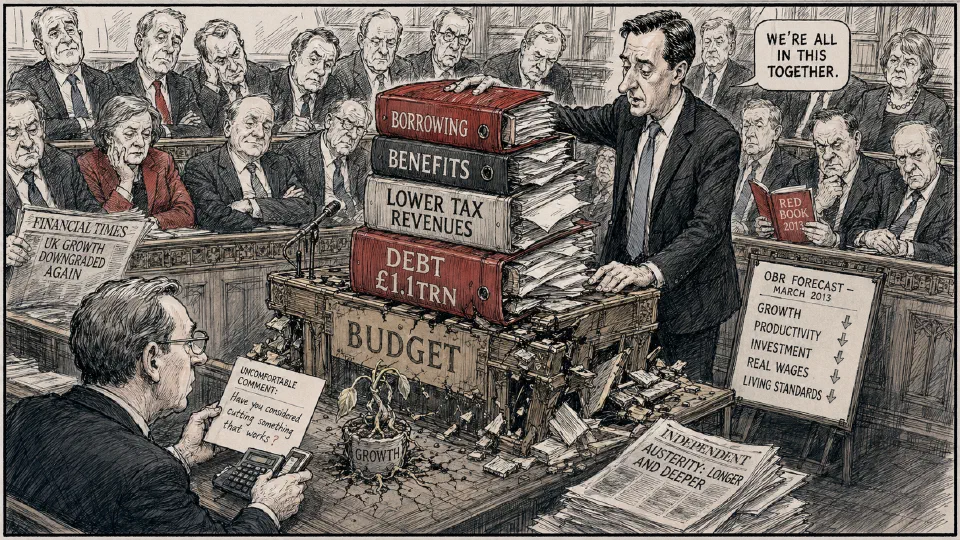
Chancellor George Osborne will present a budget on Wednesday 20 March.
This is an unenviable task. His credentials as a reliable custodian of the economy are falling apart. Things have gone wrong. Public borrowing is likely to exceed last year’s figure. The consequences of slow growth are pushing the annual deficit upwards. Major factors are higher expenditure on benefits and lower revenues from taxation. Debt has risen from £600 billion in 2008 to £1.1 trillion now. A cautious calculation says this figure will rise to £1.6 trillion by 2016, five times higher than in 2000. And this estimate assumes that the austerity programme is implemented fully. Public spending continues on an upward trend. The Bank of England reckons output, which reached a peak at £1.5 trillion in 2007, will not return to this size in real terms until 2015. These are huge sums, even for a big economy. Of course, the crisis across the euro and a damaged financial system have to take much of the blame for these difficulties. And there is not a quick fix. Mr Osborne has to face the UK’s position in a global economy; we must recognise an inevitable reduction/correction in comparative size and strength.
Infrastructure is a priority. Roads, railways, bridges and broadband give more punch per pound of public outlay than other kinds of investment. Why is the value of land not taxed? This would make the hoarding more expensive. There is a good case for creating a special bank to promote innovation. There is still a lot to do in amending the rules on bankruptcy and to loosen the rules on takeover of small firms. Zombies are unhealthy. Some parts of the public sector remain unfit for purpose. ‘Red tape’ of all kinds should have constant challenge and removal. It gets in the way of initiative and effective results.
This country is on the edge of another row about ‘rebalancing the economy’. These are important explorations. It is a fact that the gap is widening between London (not London and the South East) and the regions. However, research by the Centre for Economics and Business Research (CEBR) shows that London provides a net subsidy at 20.3% of gross domestic product (GDP). For example, the North East (-22.2%), North West (-8.5%), Yorkshire and Humber (-8.8%), Northern Ireland (-29.4%), and Wales (-26.0%) all receive a net subsidy. We would be unwise to take any action which might damage London as an international centre for financial services.
Does all this throw down a gauntlet for the prime minister and Ed Miliband?
Their treasury spokesmen have fought each other to a standstill. The evidence is that George Osborne and Ed Balls (Labour) have lost support in their political parties and obtain low scores in polls. Maybe both will be moved on?
Rankings and corruption.
Transparency International released the results of its annual survey at the end of last year. This project ranks countries in terms of perception of their corruption. The UK is ranked at 17, so it is regarded as more corrupt than Australia, Barbados, Hong Kong, Ireland and Singapore. Chandu Krishnan, chief executive of Transparency International, commented: ‘Despite the passing of the Bribery Act, and measures to improve transparency in government, the opinion of experts is that the UK continues to be more vulnerable to corruption than the political establishment is willing to admit’.
Management is not a plot of the political right.
Nor is it a process than can be wished away. Co-ordination and the setting of priorities have to be performed in some fashion. Whether the organisation is a hospital, a ship or a business, its resources have to be marshalled to complete its tasks in the face of dilemmas. We have to make the point persuasively. One does not lead by pointing to and telling people a place to go. Leading is about going to that location and making a case. Effective leadership is for the benefit of followers, not enrichment of the alleged superiors.
Peter Drucker reckoned the organisation of businesses has witnessed three major revolutions.
The first was between 1895 and 1905 and separated management from ownership. The second started in the inter-war years and saw the emergence of modern corporations. They were exemplified by Alfred Sloan’s reform of General Motors. This was the era of mass production, assembly lines, specifications for thousands of jobs, and the hierarchical company with a quasi-military mode of command and control. This remained the dominant form for many years. But there has been a third explosion. A shift from top-down organisations to an information-based structure – leaner, less layered, flatter, more mobile. And we have enabling technologies. Drucker said in 1989: ‘Twenty years from now, the typical large business will have half the levels of management and one-half the managers of its counterpart today’. Those companies which were first into place and have all managers as marketers secured an enviable competitive edge. There is room for others.
That’s correct.
‘They say such lovely things about people at their funerals. It’s a shame I’m going to miss mine by just a few days.’ Bob Monkhouse