Deflation for September.
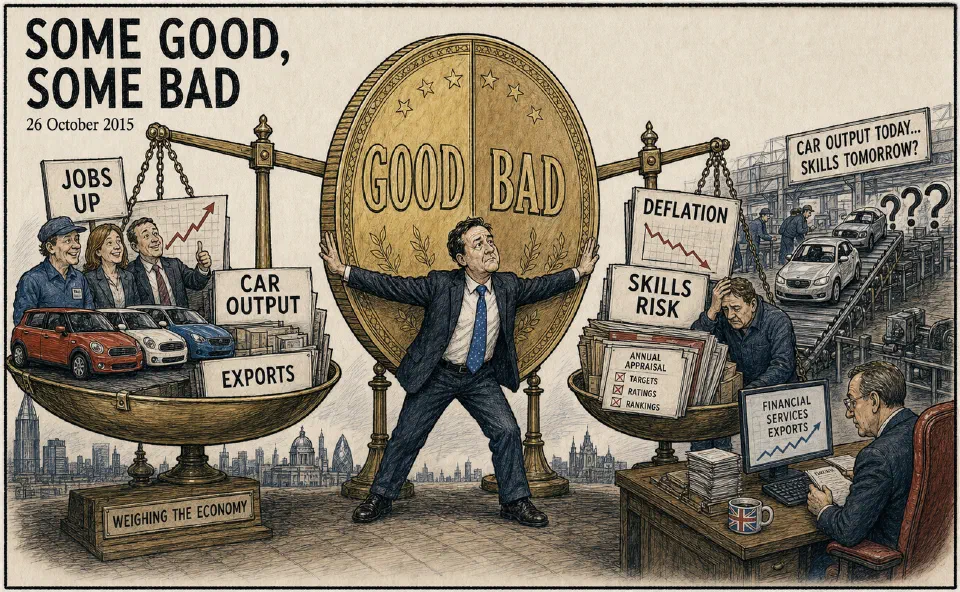
The UK returned to deflation last month. This is twice since April that prices fell, year-on-year. An annual rate of the consumer price index (CPI) moved to -0.1% from 0% for August. Before April, prices had not dropped since 1960. Unemployment went down to 5.4%, a new low since 2008. In the three months to August, employment rose by 140,000. The number of people in work, 31.1 million, was the highest since records began in 1971. These figures are good and bad news. The downsides reflect a lack of overall demand. Indebted firms and households become cautious. Retrenchment brings lower purchases. The other side of this proverbial coin has falling energy and food prices. This gives households a boost and together with increases in pay should lead to higher expenditure by consumers. It is feasible that recent predictions saying the Bank of England’s increase for interest rates is more than a year away will be wrong.
All-time record? But.
This country’s motor manufacturers are on track to break the record by 2020 of 1.92 million cars a year. Such a forecast assumes there will not be more global shocks and we remain in the European Union (EU). The Society of Motor Manufacturers and Traders (SMMT) says that with more than 1.5 million cars built in the UK last year, plus higher productivity and increasing volumes towards the end of this decade, it is likely 1972’s record will be exceeded within five years. Additional jobs and a move to premium-end vehicles were possible outcomes as local investment of £2 billion to date in 2015 makes its impact. The report went on to say ‘. . . there is a clear danger that changes in manufacturing systems, which the UK will not be able to avoid, will place many existing and imminent new jobs at long-term risk.’ And later, ‘As a result, industry and government need to future-proof training and skills development and apprenticeships must prepare people for very different manufacturing environments . . .’
Appraisals away.
The annual ritual is disliked by many employees and their managers. Peter Cheese, chief executive for the Chartered Institute of Personnel and Development, suggests that among the drivers for a shift is a desire among younger workers for instantaneous feed-back, increasing fragmentation of the line manager’s job (with fewer people managed by a single individual) and a change in the opinions of human resources’ professionals who have seen the failings of performance management. Also, there is an overall wish to reduce the number of processes imposed on organisations. Accenture announced in July it was scrapping annual appraisals for its 300,000-plus workforce. Deloitte is piloting other options in its US-based offices. Microsoft, Gap and Expedia are moving towards less formal and more frequent methods accompanied by faster action. Facebook, Google and Netflix have bypassed the conventional approaches. Sheila Heen, co-author of ‘Thanks for the Feedback’, reckons people seek three types of response: appreciation, coaching and evaluation. Traditional appraisals tend to muddle them together. Of course, and properly, there are no intentions to abandon measurement and management of performances.
Excellence.
The UK is the world’s largest net exporter of financial services, with the City of London as frontrunner. This country has a creditable $95 billion (£61.2 billion) of net exports, nearly twice as high as it was worth in 2005. Second in the table was America at $36 billion, then Switzerland ($24 billion), Luxembourg ($23 billion) and Singapore ($15 billion).
Pay-back.
‘We have no more right to consume happiness without producing it than to consume wealth without producing it.’ George Bernard Shaw (1856 - 1950). Irish dramatist and critic.
Reach for the top!
‘Nothing is impossible for the man who doesn’t have to do it himself.’ A H Weiler. American newspaperman and former editor of The New York Times.
Graffitti project:
‘Woman’s faults are many, Men have only two: Everything they say And everything they do.’
or
‘When in doubt, do what the chairman does. Guess.’