A good contest to lose?
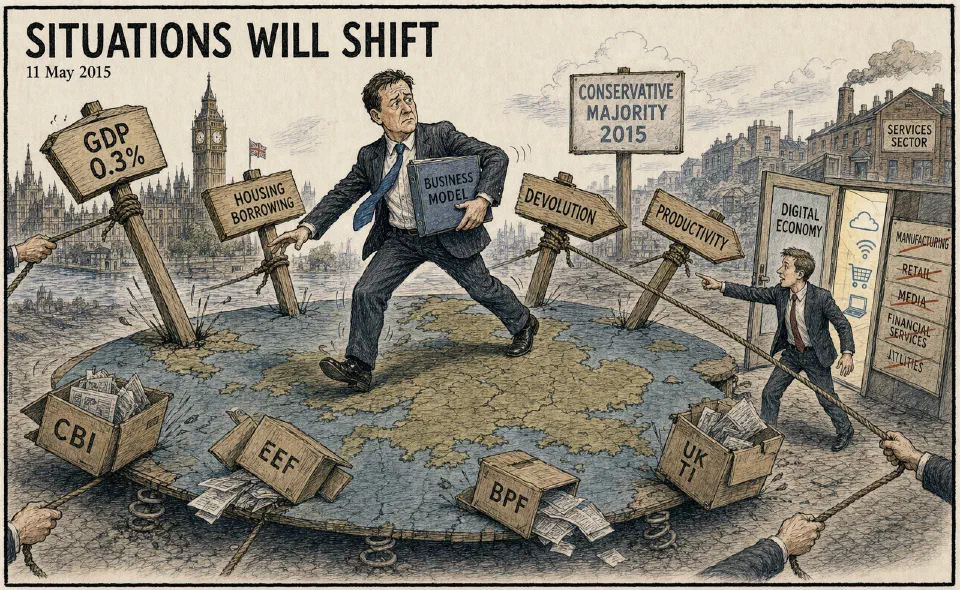
Richard Batley of Lombard Research suggested that last week’s election is ‘the harbinger of a new era of persistent political fragility’. Britain could go from being a comparatively stable economy, with an attractive tax regime ‘to a much more uncertain home for anyone’s money’. Look at the figures. The figure on gross domestic product showed the rate of growth halved to 0.3% in the first quarter. The Observer suggested that ‘the upturn of which the Tories are so proud may already be starting to fade’. There are several other warning signs. Higher productivity is essential for economic growth, but the record since 2008 is poor. The Office of National Statistics describes ‘a prolonged period of essentially flat productivity unprecedented in the post-war era’. The UK’s continued reliance for economic growth on consumers’ borrowing and the housing market might be dangerous. The weakness of sectors unconnected with personal expenditure is a third concern. ‘Confidence is certainly higher than five years ago, but aside from notable successes such as the car industry, there is little sign of a radical shift in the economy.’ Nonetheless, Roger Bootle said in The Daily Telegraph, ‘Macro-economic data are notoriously unreliable, and the GDP figures are frequently revised, usually upwards. …. my money is on a rebound’. Managers would be wise to be cautious.
Go where angels fear to tread.
Not so long ago, if you managed a business you had a clear notion of what industry you were in, which trade association represented your interests, and those customers you counted as yours. There was talk of SICs – Standard Industrial Classifications. This has all come unstuck because of rapid technological change. The former industrial boundaries have become irrelevant. Kamil Munir, Judge Business School (Cambridge) pointed to this prospect several years ago. The concept of ‘industry’ is obsolete. All of this has huge implications for managers. First, anyone who still thinks in terms of ‘industry’ and traditional ‘expertise’ is doomed. It is an illusion. The successful ones will think only about which business model they can establish. Also, business schools must stop telling students about ‘manufacturing’, ‘banking’ or ‘high tech’. The new competitive world has no limits. Everybody has to learn about sectors and capabilities other than her/his own. We have to handle four interacting patterns: a digital economy; an eroding middle-class and democracy; one world; and, a requirement for new narratives. Technological change is so fast it has outstripped political and legal frameworks. The social glues – religion, nation and class – are losing their power.
‘Anglicisation’ of politics.
The Conservative and Labour parties have realised there is need for catch-up with devolution taking place in Northern Ireland, Scotland and Wales. England has solidified as a distinct national and political community. There is more emphasis now on England in political outlooks and policies.
Leadership.
Styles of leadership are changing as responses to globalisation, technology, digitisation and demographics of ageing employees. People are working longer, so there will be more generations in a business or institution. The oldest person will not be the most senior. Seasoned managers will have to learn the importance of opinions and expectations of younger and less experienced people. They are the future.
Words.
‘To exploit and govern mean the same thing …. Exploitation and government are two inseparable expressions of what is called politics.’ Mikhail Bakunin (1814-76). Russian anarchist and writer.
Get ahead.
‘The only limit of our realisation of tomorrow will be our doubts of today.’ Franklin D Roosevelt (1812 - 1945). Former president of America.