Earn our keep?
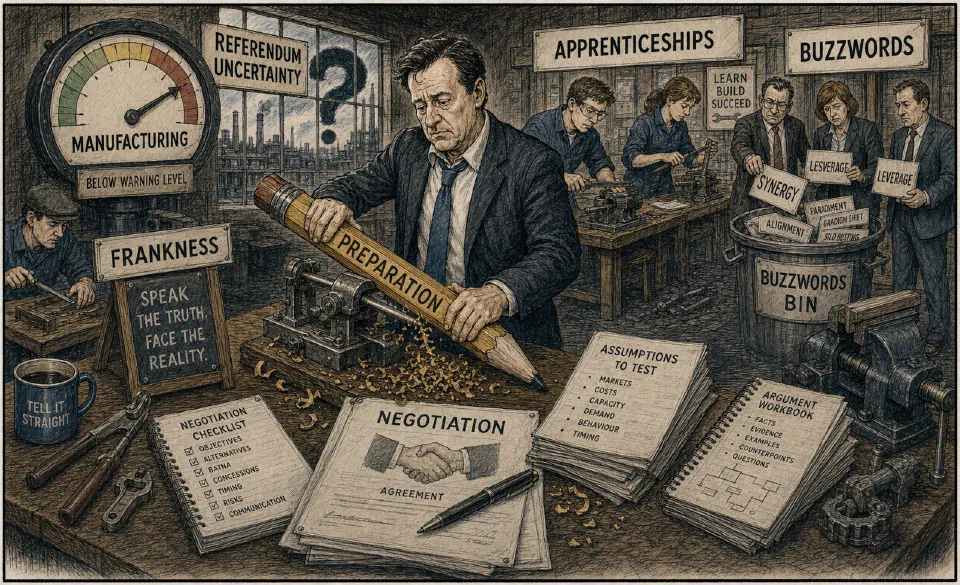
Some sociological panaceas are coming back into fashion. Of course, companies must review constantly the organisation of their resources to meet changing markets and technologies. But let’s avoid the managerial magic of the ‘60s. Management is not complex, it’s just difficult. There is a shift from the statement that individuals are the most important factor in a business. The more realistic stance is they are one essential part in the process of economic performance, whose effective contribution varies under moving conditions. Employees are not stupid. They are not fooled by talk of their ‘importance’, especially when they experience the pressures and frustrations in the production bogies, budgets and so on, and this is not always bad. Many of them understand and are willing to accept the organisational demands made upon them. Frankness of the truth works wonders. At best, employees often view a constant ‘you are our most valuable asset’ protestations as whims of managers who might feel guilty about being in charge. At worst, as conscious manipulations which betray a lack of confidence.
Sudden fall.
There has been a reduction in output from manufacturing. Uncertainty caused by the UK’s referendum in June on membership of the European Union is said to be the primary reason. The purchasing managers’ index dropped to 49.2 in April, its lowest level since March 2013. Any figure below 50 indicates contraction. Open Europe quotes Lee Hopley, chief economist at EEF (the trade association) as saying these figures are ‘the clearest sign yet that referendum uncertainty is starting to weigh on the real economy’.
The age of apprenticeships.
Research by the Chartered Management Institute shows that 61% of parents would rather see their children embark on a degree apprenticeship with a leading British employer, than take a traditional Oxbridge degree. 72% support the Government’s planned apprenticeship levy.
Corporate clangers.
A poll of more than one thousand business owners and professionals revealed a dislike of certain buzzwords. The top ten are: Think outside the box. On the same page. Low hanging fruit. Synergy. A window in my diary. Reaching out. Starter for ten. Close of play. Moving forward. Can I just pick your brain?
Negotiations.
Every problem can be resolved at a cost. Negotiation concentrates on differences between parties. Preparation matters, always. Challenge all assumptions and clarity of the business’s plans. Homework, persistence and knowledge of intentions assist removal of fears about the face-to-face component of a negotiation. But do not use a representative who needs to be liked by the other side. If you feel pleased, leave the room. Improve decisions during implementation.
You get what? . . .
‘One of the penalties for refusing to participate in politics is that you end up being governed by your inferiors.’ Plato (428 – 348 BC). Greek philosopher.
Methods.
People ask the difference between a leader and a boss . . . ‘The leader works in the open, and the boss in covert. The leader leads, and the boss drives.’ Theodore Roosevelt (1858 – 1919) 26th president of the United States and winner of Nobel Prize.