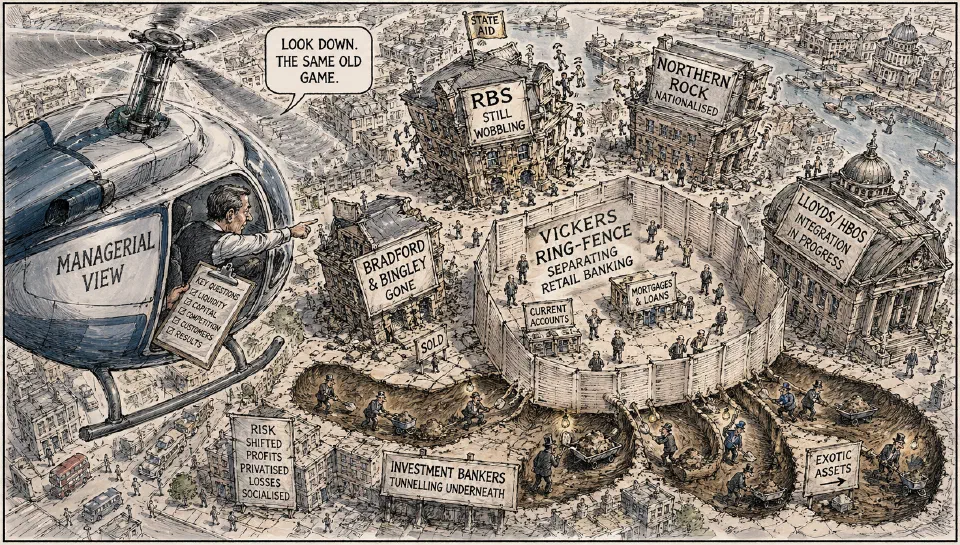
The Royal Bank of Scotland went bust.
A longish list of mortgage lenders that included Bradford and Bingley and Northern Rock were rescued from inevitable liquidation. Lloyds TSB takeover of Halifax Bank of Scotland became a costly bailout by government. Now we have the Vickers report. It sounds tough and recommends that British banks ought to be compelled by 2019 to separate investment and retail banking activities. Much talk of ring-fencing seems to ignore the abilities of major corporations to minimise the impact of regulations. Definitions of ‘retail’ and ‘investment’ will stimulate exciting debates for openers. Sir Mervyn King, governor of the Bank of England, has said if a bank is too big to fail it is too big. There is unlikely to be a practicable method for micro-regulating banks so that one lump of a business can be disconnected effectively from others. Do you recall the charade of ‘Chinese walls’ back in the 80s? Of course, the banks do not enjoy this debate and its prospects. Despite the threats, it is a reasonable assumption they will not move easily from the base of an industry so generously subsidised by the indigenous taxpayer. Moreover, they know they are one of the UK’s most profitable industries.
There is a lot of noise from politicians right now
They are all experts in managing the affairs of other people and have the certainties of priests during the middle ages. This time of the year imposes the annual conferences upon us. One thing is accepted by everyone. To do nothing in the economy is not an option. A longish period of sluggish growth seems certain. The government’s primary job is to prevent a recession. Maybe the Chancellor, George Osborne, ought to grab the chances offered by low interest rates and launch a few large investments in infrastructure? Manufacturers and constructors need stimulation. Retailers seek customers who will spend money. Services would benefit too. HM Treasury longs for additional taxation in its coffers. John Maynard Keynes talked about the ‘paradox of thrift’. That is, the effect would be counter-productive if every person and institution reined-in expenditure and borrowing. The reduction in demand would increase borrowing and debt.
‘The Fleet Street Letter’ says four serious threats face all of us.
(i) The emergence of stagflation. Remember the 70s? This problem has gone from an unpleasant recollection to a current danger. (ii) Vulnerability of sterling started its retreat in January 2007. There is still further scope on the downside. (iii) The US with a weakened economy. Influence has waned as debts have accumulated. This brings special concerns to UK-based investors. (iv) There are real prospects of an energy crisis. The Arab Spring this year has brought new dimensions to stability in the Middle East. Is Saudi Arabia the joker in this pack?
My pals from University of Central Arkansas and Chuck Williams (MGMT3) reckon there are five major factors that encourage people to withhold effort in teams. They are, if:
- another team-member is highly qualified to make a decision or comment on an issue
- the arguments for a course of action are persuasive or similar to their own thinking
- they are unsure about their ability to take part in discussions, activities, or decisions. This is especially so for high-profile judgements
- outcomes do not affect them or their units, or they cannot see a connection between their contributions and the team’s successes or failures. Then they will withdraw mentally or adopt a ‘who cares’ attitude
- other members are frustrated or indifferent or if a group is floundering or disorganised
‘I’m a nice customer – I never complain, no matter what kind of service I get’
I go into a restaurant and sit quietly while the waiter gossips with a friend. It is the same when I enter a shop. I don’t throw my weight around. If a snooty salesperson gets nettled because I want to look at several things before deciding, I am as polite as can be. I neither kick nor criticise and would not dream of making a scene as I’ve seen some people do in public – that’s uncalled for. No, I’m a nice customer. But I’ll tell you what else I am – I’m the customer who never comes back!’
Do unto others…
Times they are a-changin’.
‘For the first time, there are more than 100 women in the Sunday Times’ Rich List.’ Daily Telegraph, 8 May 2011.