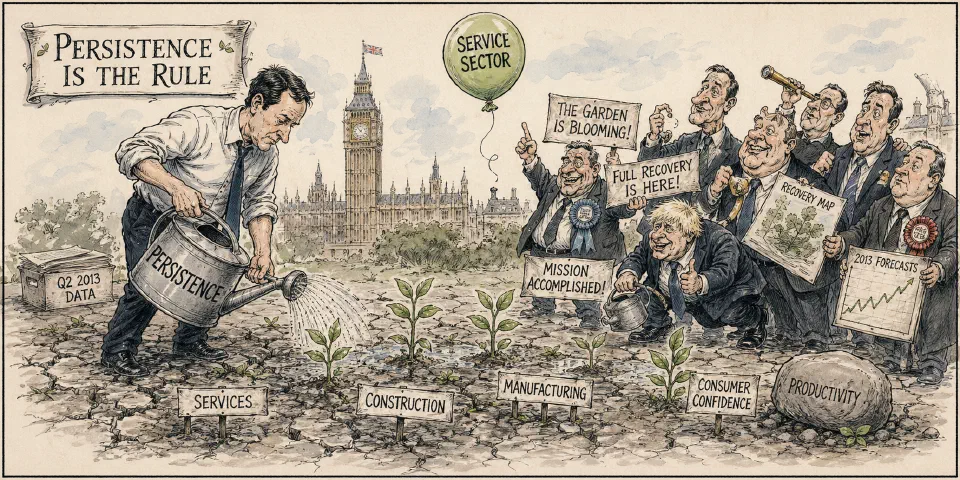
Is the recovery on its way?
Observers have started to raise their predictions for growth this year. Services are 75% of this country’s economy and moved to the highest figure for more than twelve months and new business increased faster in April than at any time for three years. Construction and manufacturing seem to be on an upward trend. Industrial output went up for the third consecutive month. The confidence of consumers is in better shape. There have been slight improvements in the overall labour market. However, it is difficult to see a self-sustaining upswing soon. Ernst and Young’s ITEM Club noted that the eurozone is still our biggest market for exports and weak demand will continue to restrain exports. Also, there are unhelpful signs coming from PR China. The Centre for Economics and Business Research (CEBR) expects that households in the UK will focus on restoration of savings as they guard against low rises in pay, high unemployment and continued austerity. So, the emphasis remains on persistent and skilled management.
Is there a silence on banks that are too-big-to-fail?
Your scribe suspects politicians have realised there would be problems for proposals to replace them with small ones. They, too, can be reckless. Comprehensive and regulated services might present challenges. Troubles at the Co-operative Bank will have created doubts. It is important to bear in mind that reviled casino banking is relatively safe. It is the old-fashioned offerings that make sustained losses. The snags hereabouts have been in the property market. Valuations have been excessive. Those banks which threw money at developers and high personal mortgages caused a mess. Additional loans might go wrong as retailers in high streets fail. Smaller banks rooted in their local communities have attractive features. They deserve careful and well-informed guidance. There is a lot of thinking to be done.
Character is the mark.
When all is said and done, one managerial quality is almost certainly inborn. It is that priceless component called ‘character’. The manager’s job can be analysed in systematic ways. With training and experience, much of it can be learnt. But ‘character’ illuminates the whole process. It adds a unique lustre to competence because it opens up the scarce vistas of courage, imagination and adventure.
Selling.
We are all in the business of selling: products, services, ideas, decisions and proposals. Upwards, downwards, sideways and out there to the poor old customer. People love to buy, but hate to be sold. Do not sell the ‘product’, ignite the want. The ‘customer’ will sell to her/himself. Generate sales and action by translating features into benefits. A feature is something the ‘product’ has or does – it belongs to the product. A benefit is what the feature does for the ‘customer’ – it belongs to the user.
Excellence into management.
T J (Tom) Peters studied the management practices of thirty-seven companies often used as examples of well-run organisations. He found that they have common attributes. The outstanding performers work hard to keep things simple: simple organisation structures, simple strategies, simple goals and simple communications.
Consistent characteristics are: a bias towards action; simple form and tight staffing; continuous contact with customers; productivity improvement through people; operational autonomy to encourage entrepreneurship; stress on one key business value; emphasis on doing what they know best; and simultaneous loose-tight controls. One or two amplifications might be useful. Significantly, recognition in all the companies is never with monetary rewards only. The ‘business value’ is not the same in each company, but when established it is pursued with almost religious zeal. Tight control is of a few variables, but there is flexibility in others.
Excellence in management is brute perseverance – time, repetition and simplicity. Constant pressure must be upon the creation of an organisation with fast responses. Then there is less reliance on forecasting and other planning techniques.
We sit on the evidence.
‘In the youth of a state, arms do flourish. In the middle age of a state, learning, and then both of them together for a time. In the declining age of a state, mechanical arts and merchandise.’ Francis Bacon (1561-1626), English writer and philosopher.