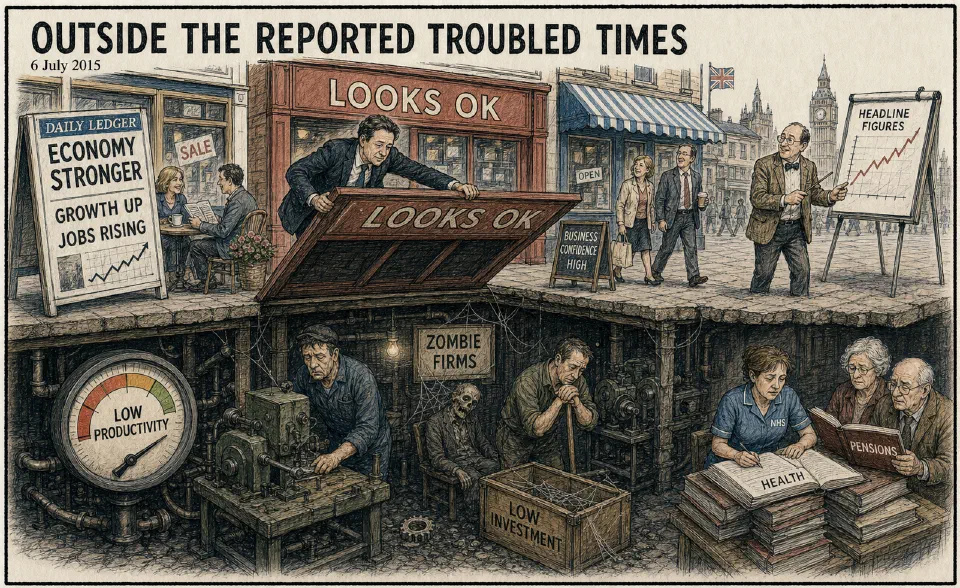
On every commentator’s lips.
Britain’s economy looks OK from the outside, ticking over nicely. It grew by 2.8% last year. This is more than any other member of the G7 club of rich countries. Employment has never been higher. Nonetheless, ‘low productivity’ is said by economists to be the biggest risk to prospects for growth. In using this term, they generally mean the value of goods and services per hour of labour. The calculation is made usually by dividing gross domestic product (GDP) by the number of hours worked. Why this stagnation? There are three components. The pain of recession was spread widely, through lower wages. So there is slack in terms of under-employment at workplaces and low investment in technology and other equipment. The Bank of England suggests that ‘zombie’ businesses may have been kept alive by low interest rates. This has slowed the reallocation of resources to new and dynamic firms. Also, there are substantial structural changes. For example, John Redwood MP has pointed to a rapid drop in output of North Sea Oil leading to the loss of high value-added activities. Others have asserted that labour intensity in services is seen often as better customer-care rather than poor performance.
What is to be done? There is broad agreement when ‘talking the talk’. Rebalance the economy away from services (75% of GDP), towards making things (10%). Reverse the long record of low investment in plant, machinery and physical infrastructure. And take serious and substantial action to create a climate for businesses based upon innovative products and processes which produce high productivity jobs. And the big last item is to improve the skills of people. There are no quick fixes in ‘walking the walk’.
What is GDP – a reminder?
Mostly this is the measure of output. The value of the goods and services produced by all sectors of the economy. That is, agriculture, manufacturing, energy, construction, services and government. Note: this includes everything, including clearing an oil slick or collecting litter.
Expenditure by government on health was 3% of national income in the early ‘60s.
It rose to 5% in the mid-1990s and hit 7% by the early 2000s. Its share of the government’s spending went up from just over 8% to 18% and outgoings on state pension increased from 7% of the total to 12% by 2013. These significant changes were ‘managed’ by sharp falls in outlays on defence, housing and other economic support – especially that associated with nationalised industries. The current situation is described as fiscal austerity. A more accurate portrayal would be accelerating transition towards a state focused on the needs and expectations of an older population. The Office for Budget Responsibility (OBR) and the Institute for Fiscal Studies (IFS), seem to be saying that this is a trend which will continue for the foreseeable future. It will be difficult to sustain these ‘promises’ without raising taxes and/or cutting costs on ‘protected’ health and pensions. There is a strong case for transparency and discussion.
Confronting paradoxes.
Managers like to congratulate themselves by declaring we face unprecedented challenges. There is a temptation to advocate all kinds of compelling, novel and heroic deeds. Your scribe suspects our jobs today are not radically different from ten years ago. Of course, there is stiffer competition, global marketplaces and faster change. But our task remains the same. Managers have to steer their companies along often-uncharted routes into an unknowable future. They must make sure their businesses perform at least as well as their competitors do. This means not only serving customers and satisfying owners, but also keeping employees happy. And the hard fact is that there can be serious conflicts between these groups. There are tough decisions to be made sometimes. Managers find themselves in a troubling paradox. At the moment we need to shape keen, agile and low-cost organisations – with the consequential redefinition of relationships with employees – we seek also unprecedented participation, creativity and loyalty from the same people. That is, those attributes which are likely to thrive best in an atmosphere of mutual commitment and trust. These are real issues. They will not go away. We cannot return to the producer-driven economy of the 60s and 70s. There are no simple answers. We can start with some primary objectives.
Nothing replaces persistence.
Talent is not enough. The world is full of unsuccessful people with talent. Genius is not enough. The unrewarded genius is proverbial. Education is insufficient. Our society is full of educated derelicts. Persistence and determination are omnipotent.
Be careful.
Wise managers are a bit wary of ‘commonsense’ educators and exporters. ‘The earth is flat’. ‘Iron ships won’t float.’ ‘Human beings not meant to fly.’ ‘Impossible to have a horseless carriage.’ ‘Space flight is hokum’, said the Astronomer Royal, 1956. ‘There is no reason why anyone would want to have a computer in their home’, Ken Olsen, president, chairman and founder of Digital Equipment Corporation 1977. Even Bill Gates of Microsoft said in 1981: ‘640K ought to be enough for anybody.’
Not me guv!
‘People are always blaming their circumstances for what they are. I don’t believe in circumstances. The people who get on in this world are the people who get up and look for the circumstances they want, and, if they can’t find them, make them.’ George Bernard Shaw (1856-1950). Irish dramatist and critic.
Personal fears.
‘I have not been afraid of excess: excess on occasion is exhilarating. It prevents moderation from acquiring the deadening effect of a habit.’ W Somerset Maugham. (1874-1965). English writer.
Be careful.
‘The moment politics becomes dull democracy is in danger.’ Quinton Hogg (Lord Hailsham. 1907-2001. English politician and lawyer.