Until recently, bailing out meant obtaining temporary release of an untried prisoner by giving money.
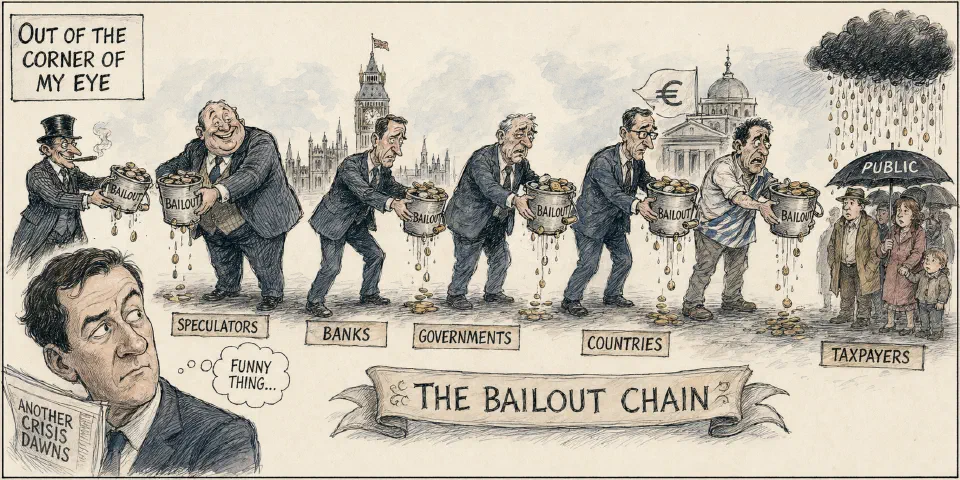
Do you recall how keen those at the top in Europe and the United States were to ‘prevent a catastrophic collapse’? Banks in Europe bailed out their speculators. Then governments bailed out the banks. They then bailed out the countries that bailed out the banks. The Americans went the whole hog. The government bailed out the banks, the insurance companies, the vehicle manufacturers ….. and? The Europeans and the Americans bailed out each other. There are huge sovereign deficits all over the place. PR China seems to have become fed up with falling exports and has offered to buy a few assets and bonds. Is it possible that doing more of this sort of thing is not a bright idea? When you lose money on every transaction, it is unwise to go for increased sales. Bit by bit, the mainstream media is starting to realise there was no ordinary recession. A conventional recovery is unlikely. Thanks to Bill Bonner.
The goings on are a reminder of a nursery rhyme from childhood: Ring a Ring O’ Roses, A pocketful of posies, Atishoo, Atishoo!, We all fall down! It is said to be about the horrors of the Great Plague.
Makes you think
During the times of a humourless Cold War , the inner-councils of Government in America asked the Central Intelligence Agency (CIA) to write a profile of a country that might have a revolution. These professional interventionists decided upon three characteristics. They were: (i) a large gap between rich and poor; (ii) a middle class that is disappearing, or one that never existed in the first place; (iii) a lot of people with a grudge.
Robert Heller reckons managing is a far more homely business than its would-be scientists suggest
Like cooking, it rests on a degree of organisation and adequate resources. But just as two chefs do not run their kitchens alike, so no two managements are identical, even if they all went to the same business (or cookery) school. You can teach the common rudiments of a subject, but you cannot make a great cook or a distinguished manager. In managing and cooking, you ignore fundamentals at grave risk – but sometimes succeed. In both, science can be extremely useful but is no substitute for the art itself. Inspired amateurs can outdo professionals. Perfection is rare, and failures can be common but not realised by customers. Practitioners of managing and cooking do not need recipes which show timing down to the last second, procedures to the final flick of a wrist, all ingredients to the precise fraction of an ounce. They have reliable maxims, instructive anecdotes, and no dogmatism.
Think of the new entrant to this managerial lark
Our world is confusing. The young person is told, ‘Look before you leap or be an entrepreneur’. Then, ‘He who hesitates is lost’? Sometimes a firm declares it is the dynamic, young, forceful, aggressive manager it is seeking. Other times, the future is held to be in co-operation and team spirit. ‘Too old at 40’ this week. Pensions for patriarchs and all manner of fringe benefits the next. We want initiative in one appraisal, then statesman-like restraint. One company reduces variety of products. Some see salvation in diversity. For every administrative proposition, there is another to deny it. The problem is absolutes. We must have learning managers, rather than learned ones. Then our successors will think about resolving issues and not possess answers.
By jove, he’s right.
‘Just because you do not take an interest in politics doesn’t mean politicians won’t take an interest in you.’ Pericles (430 BC).