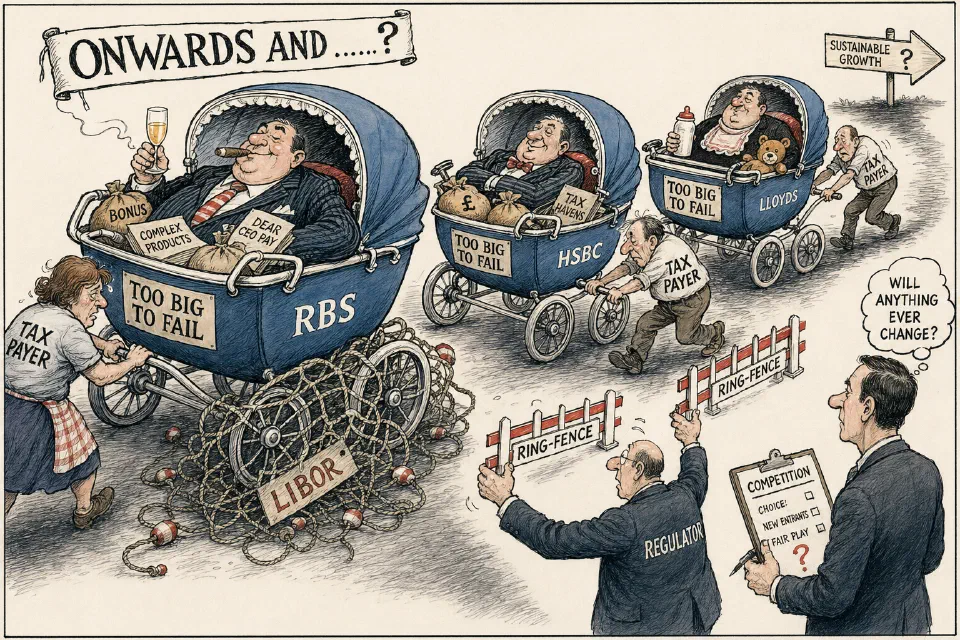
Major banks in the UK are a pampered and subsidised industry.
They have been implicitly backed by taxpayers and underpinned by complacent regulators. There is inadequate competition and a formal acceptance that they are too big to fail. This means no fear of ruin in boardrooms. The scandal based on Barclays continues to cause anger in many places. However, it is clear the problems still have legs and the attempts to manipulate Libor, the benchmark interbank interest rate, was not confined to Barclays and this particular issue. There is more to come. The underlying systemic problem is not the danger of the excessively free markets’ mentioned by Allister Heath. Quite the reverse. Our economy has endured a rigged market. The players have not acknowledged that the world has changed. Large indefensible bonuses and do-as-you like behaviour are not acceptable in this age of longish-term austerity. Particularly because the banks were a key cause of the crash in 2007/08. And now the Financial Services Authority has described ‘serious failings’ in the sales of products by banks to small businesses.
Think globally, act locally.
Stewart Black and Dave Ulrich suggest certain capabilities to enable to firms to integrate and concentrate global activities and simultaneously separate and modify them to free local markets. The overall task is difficult and needs special and constant attention.
The first critical factor is to understand the distinction between what should be standardised throughout the business and the exceptions. Disney set out the principles for all its theme parks – a clean, safe and enjoyable experience for families. Even so, the world is too various for every policy to be the same everywhere. A ban on alcohol is regarded by Disney as consistent with safety, but visitors to Disneyland Paris complained about this omission and withdrew their custom. Now beer and wine are served.
The second feature is to have consistency with flexibility. Start by helping employees to understand the core. People cannot acclaim what they do not comprehend. Some companies make a point of selecting newcomers who believe already in the core values – and stick to those standards. Flexibility assumes a tolerance of differences outside the basics.
The third element of a framework is to manage the tensions between building international brands and respecting local customs. Consumers decide whether they are satisfied with the central values. It would not be much good for Disney to declare clean and safe family fun as an imperative if its visitors did not value that.
The fourth centres on matters of size. Managers must be able to balance leverage with focus. We usually know the expectations of major mergers. But in their search for efficiencies worldwide, companies can forget that they are competing with local suppliers. These businesses are familiar with the intricacies of government, have close relations with influential officials and know how to serve locals. Thus, global firms have to manage with precision their responses to a market.
The fifth ingredient is knowledge. Staying competitive as you globalise relies on the ability to disseminate knowledge throughout an organisation’s far-flung operations. The danger of ‘not invented here’ can kill an initiative.
Lastly, overall success demands skilfully bringing together views from both ends of the telescope: being aware of the wider ordering whilst retaining a fervent accountability for one’s own domain. From an astronomical perspective, the world is mostly water, so having technologies to cross the oceans makes sense. On terra firma, ships seem of little use. Bear in mind that only a handful of people have truly worldwide responsibilities. Nearly all directors, managers, supervisors and other staff have national duties and targets.
Tom Peters listed the reasons for success in Silicon Valley (California).
He says:
- acceptance of failure – it’s a badge of honour
- tolerance of treachery – no such thing as loyalty
- pursuit of risk – of twenty ventures: four go bankrupt, six lose money, six do OK, three do well, one hits the jackpot
- willingness to reinvest – cash flows into The Valley … and stays there
- enthusiasm for change – make ourselves obsolete or competitors will
- promotion on merit – politics count for little: performance is all
- obsession with product – find the ‘cool’ idea
- openness to collaboration – generations last months … borrow and get going
- variety, variety, variety – mix fleeting with permanent
- anybody can play.
So there.
‘Politics is the art of looking for trouble, finding it everywhere, diagnosing it incorrectly and applying the wrong remedies.’ Groucho Marx, quoted in The Daily Telegraph