Why do we listen?
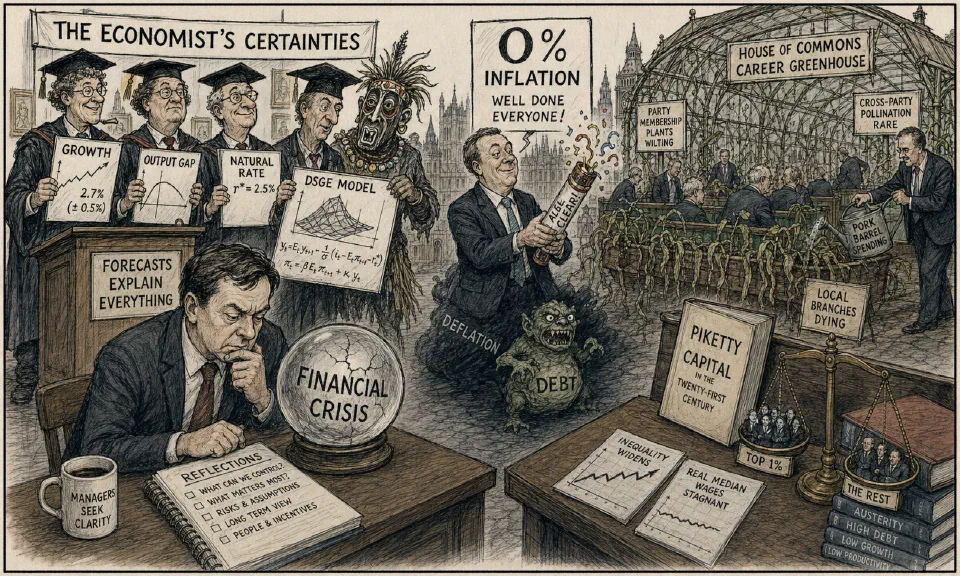
Economists had a collective failure to predict the financial crisis and unwisely ignored John Maynard Keyne’s advice to make sure they were thought of as humble, competent people. Nonetheless, they are an influential group. They are retained as expensive consultants, advise politicians, and write articles for respected publications. As the subject has become more mathematical, their confidence has grown. The Economist magazine has pointed to the ‘odd thing’ that we believe in economists almost as much as they believe in themselves. Journalists and politicians like strong argument and clear answers. Most academics are diffident. An economist talks with all the confidence of a witch doctor.
Inflation.
0% has been declared as good news by the Government. In truth, it is a sign of failure. The target is 2% and for good reason. This objective allows room for rising prices which help to stimulate demand. If periods at below the target become prolonged deflation, then purchase of goods and services could fall as a result of a combination of delayed expenditure by consumers and a rise in the real value of debt.
Unaltered perception.
Hilaire Beloc and Cecil Chesterton wrote in their 1911 book, The Party System: ‘The House of Commons has ceased to be an instrument of Government. Its ancient functions have been killed under the prolonged and continuous actions of hypocrisy. It affords today … no more than an opportunity for highly lucrative careers. That career is founded upon the bamboozlement of the public (whose faculty for being duped these professionals hope to prey upon indefinitely), with the complicity of nobodies content to write MP after their name as a sufficient reward for supporting the Party System; to whom, of course, must be added the lawyers and businessmen for whom Parliament offers definite financial rewards, and that in proportion to their indifference to their representative duties.’
Wealth and inequality.
Thomas Picketty is the author of the best-selling book on economics, ‘Capital in the Twenty-First Century’. He is not the first person to suggest that wealth assures increased assets. This tends to bring unsustainable inequality. Nonetheless, when his conclusions were published last year, they received a warm reception. Earlier, Barack Obama said economic inequality is the ‘defining challenge of our time’. Moreover, the issue was seen as a major threat for the world at the recent World Economic Forum in Davos. Financial inequality has been regarded as a social topic for many years. However, there is evidence now that its effect on economic growth and employees’ well-being is quickly adding this subject to agendas for managers. It’s essential this awareness does not become a resentment of wealth.
Tribal politics going, going …
Loyalty to a particular political party has decreased in the UK. The major ones have converged ideologically in recent times. Scandals seem to be a constant feature. These factors make electors feel there are difficulties in finding distinctions between the offerings and understanding why their votes matter. The Conservative, Labour and Liberal Democrats have lost large numbers of members. Yet, there was a remarkably high (84.6%) turnout in the recent referendum in Scotland. So, it is reasonable to conclude that voters can be motivated into participation when there are clear electoral choices and important consequences. But it might be too late. There must come a time when decay of political parties will be followed by dilapidation of the structure of power they inhabit and preserve. Change is on its way. This can revive, as well as undermine. The main opponents will be present politicians of all shapes, colours and sizes. They will protect their over-populated chambers.
Dangerous complacency.
Those who travel the country lanes of industry and commerce will have noted a whiff of complacency. Just the odd comment : ‘our economy performs relatively well in periods of slow growth elsewhere’ or ‘we are responding well by reducing costs’ or ‘we have been so bad that we do not have to do very well to do better’.
Doers.
‘What we think, or what we believe is, in the end, of little consequence. The only consequence is what we do.’ John Ruskin (1818 – 1900).
And.
‘So much of what we call management consists of making it difficult for people to work.’ Peter Drucker; American academic/economist, born in Austria.