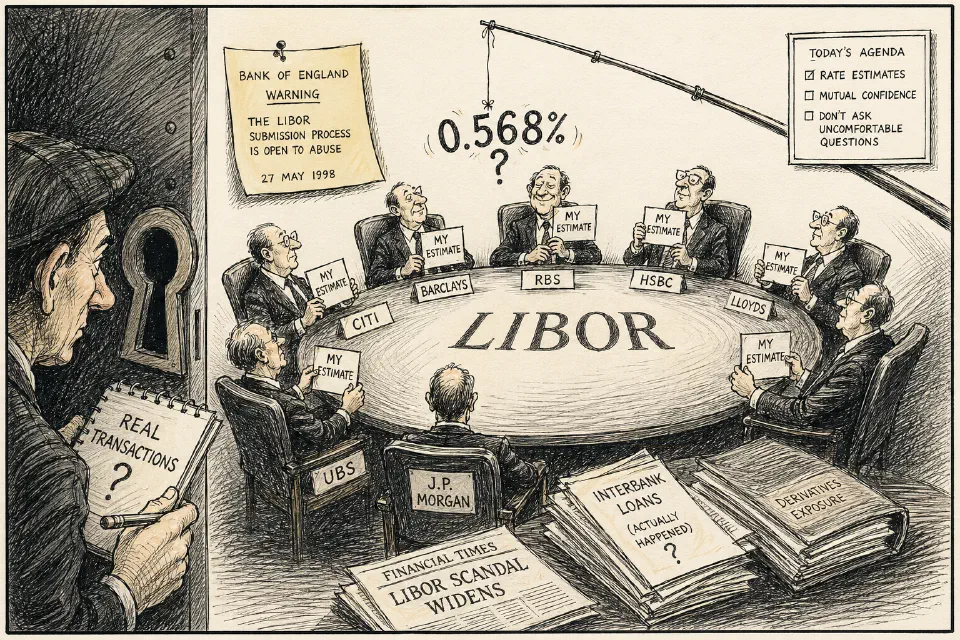
‘Libor’ rolls off almost every tongue.
But worries are not new. Back in 1998, there were warnings that the polling process to set Libor was susceptible to misreporting, whether intentional or accidental. Practitioners have recognised always that the calculation is not based on actual transactions. It is the result of a self-assessment among a panel of major banks active in the London interbank money market. The specific daily question is, ‘At what rate could you borrow funds, were you to do so by asking for and then accepting interbank offers in a reasonable market size just prior to 11.00am?’ These are subjective estimates. They are neither actual rates nor real transactions or promises to complete any transactions in the future. So, there began to be spreads of rates as lenders looked closely at which banks might be in serious trouble. How can a bank answer the posed question if it is unable to borrow at all? Some did. And just consider the inherent conflicts of interest. Moreover, submissions carry no obligation to deal at a self-proclaimed cost of borrowing. Strange, innit?
The Olympics are regarded as a success for good old Blighty by most watchers and commentators.
There are plans for an ill-defined legacy and actions of all kinds. Let’s keep a sense of proportion. Not so long ago, many of us were aggravated by the insistence of politicians that expenditure of £9.3 billion-ish was within what they claimed as ‘the budget’. The original forecast used for the decision to make a pitch for the job was £2.4 billion. A majority of informed estimates put the final cost at £12 billion, the most expensive Olympic Games ever. Will the feel-good factor have a short life? Keep alert for the promise of a fitter population, better infrastructure and a lot of affordable houses.
Feeding problems and starving opportunities is one of a manager’s deadly sins.
It is astonishing how many companies assign their best performers to problems. These people are devoted to the old business which is sinking faster than forecasts. They try to avoid the declining product being outflanked by a competitor’s new offering through spending money on ageing technology. The opportunities are left to fend for themselves. They are the future and bring growth. They are every bit as difficult and demanding as problems. Maybe a manager ought to draw up a list of opportunities facing the business and make sure each one is adequately supported? Only then list the problems and worry about managing them.
Peter Drucker’s thoughts always deserved attention.
He argued in The Wall Street Journal (later in his life) that cutting costs, reducing the labourforce and jettisoning unprofitable products may well be a good starting point for better results. ‘However, it is often only a short time before they return to us, unless managers take other actions.’ Drucker reckoned a firm must re-examine its ‘business theory’. This covers assumptions about external factors (customers, markets, competitors and distribution) and internal matters (technologies, products and processes). The ‘business theory’ often remains intact even though the marketplace and methods have moved on. Unless managers recognise these changes, no amount of surgery and re-engineering will restore and sustain previous performances.
A company must stop asserting ‘we know’ and say ‘let’s ask’. What are competitors doing? What ‘business theory’ are they using? What is the value your customers are willing to pay for? It is even more important to find out what those who do not buy from you are seeking. There can be uncomfortable conclusions. Contemplate the probability of difficult decisions. Some parts of a fondly-held core might be a bad investment.
Listen to other people, particularly the inexperienced, but bright, ones.
“So we went to Atari and said, ‘We’ve got this amazing thing, even built with some of your parts and what do you think about funding us? Or we’ll give it to you. We just want to do it. Pay our salary, we’ll work for you’. They said ‘No’. Then we went to Hewlett-Packard; they said, ‘We don’t need you. You haven’t got through college yet’.” Steve Jobs, founder of Apple Computer, on attempts to secure interest in his and Steve Wozniak’s personal computer.
Well! Well!
The village of Shitterton in Dorset’s Piddle Valley has Britain’s most embarrassing place name. This conclusion is from a survey in which its neighbour, Scratchy Bottom, came second. Third place went to Brokenwind in Aberdeenshire, with Crapstone on the edge of Dartmoor, fourth.