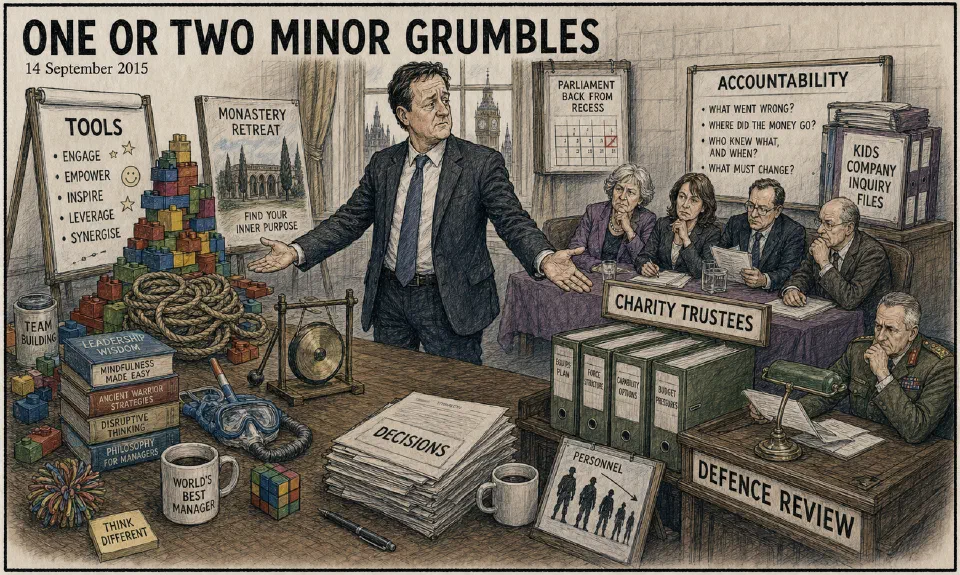
Decisions.
MPs returned to the House of Commons last week after a long break. The government and civil servants appear to do quite well without them. August and September saw the start of both world wars. Kuwait was invaded in August, 1990. August and September of 1992 had a major economic crisis and British armed forces went into Bosnia.
Every craft needs tools.
Nothing is too exotic when it comes to equipping managers. They go rock-climbing, white-water rafting and fire-walking. They have played Lego, studied medieval painting and gone on retreats in Benedictine monasteries. The prescribed reading at bedtime includes Karl Marx, Machiavelli’s The Prince and Sun Tzu’s Art of War. All of this since F W Taylor, Fayol, Herzberg, McClelland, McGregor and . . . . Cynics say that managers are just insecure and exploited by clever entrepreneurs. They are caught between the demands of efficiency and personal decency. Simultaneously, they search for assurance of success and moral guidance in a world of shifting value. Professional philosophers are taking their offerings to market. They assert an importance for managers to learn what they really believe. In other words, this is supervised brainstorming with real bite. Watch out for the flyers on your screen.
Charities and services.
Reduced budgets and increasing demand almost assure that central and local government will ask charities like the now infamous Kids Company to fill the gap. In principle, this is a welcome proposition which shows the importance of localism. At their best, such organisations are more flexible and innovative than bureaucracies. Also, they are capable of attracting cash from supporters. But the crash of Kids Company emphasises the known need for more effective accountability and transparency. Also, there is urgency to strengthen the duties and responsibilities of charities’ trustees. The Charity Commission is the regulator and close examination of its performance would be beneficial. It would be wise to make sure the public sector does not dump its most difficult issues and cases onto charities. The undesirable result from the demise of Kids Company would be discouragement of other charities from taking on a task that many can do better than social workers. There remains the imperative of direction from experienced and successful managers.
Defence and status.
The UK’s strategy for defence is guided by three processes: the Strategic Defence and Security Review (SDSR), the National Security Strategy (NSS) and the Comprehensive Spending Review (CSR). Each of these reports plays a pivotal part in determining expenditure on defence, how those funds are allocated and what role the UK will play on the international stage. All three activities are due to be completed by the end of this year. One key question is whether the SDSR will be driven financially, and if it will reflect an armed forces that are retreating, or investing in the future. A growing number of European nations – Germany, Netherlands, Poland and Sweden – are increasing spending on defence. France has decided to ring-fence such outgoings. This country’s expenditure on defence is 19% lower today in real terms than it was in 2010. Will cuts harm our worldwide credibility, reputation and standing? For example, the so-called special relationship with the US is, in large part, a military alliance. The Pentagon has voiced misgivings.
There are no indications that the UK will devise a robust and responsible foreign policy. In the pre-election debate (2 April) not a single question was asked about foreign or defence policies. The closest the debate came to such issues was immigration and Britain’s membership of the European Union. As a large power in relative decline, this country has a tendency towards hubristic intervention overseas and anxious introspection at home.
Things will change.
‘The salary of the chief executive of the large corporation is not a market award for achievement. It is frequently in the nature of a warm personal gesture by the individual to himself.’ J K Galbraith, American economist in ‘Annals of an Abiding Liberal’ 1980.
‘There is no stronger craving in the world than that of the rich for titles, except that of the titled for riches.’ Hesketh Pearson, 1887 – 1964. British biographer in ‘The Marrying Americans’, 1961.