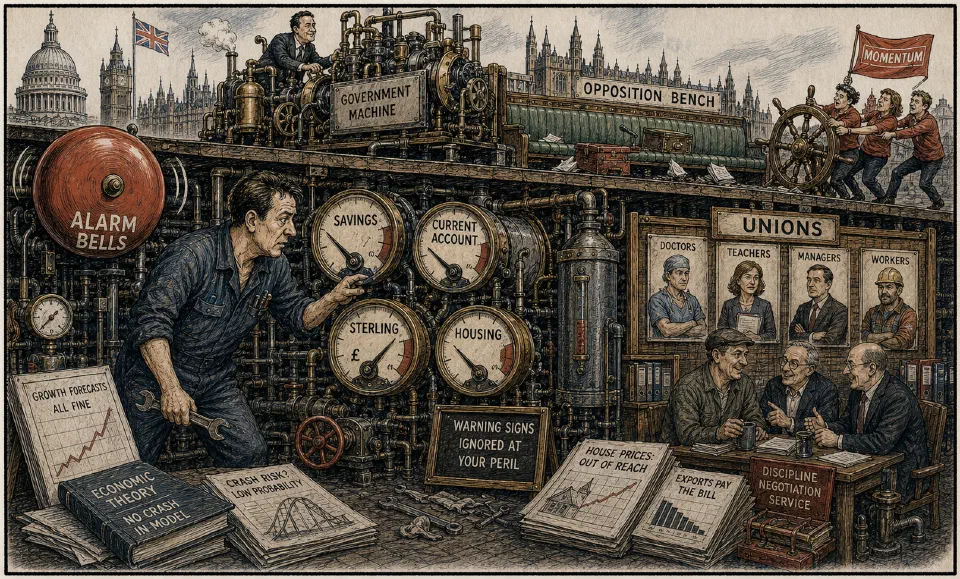
‘Alarm bells are ringing in the engine room of the British economy’, says Ed Conway in The Times. People have been depleting their savings since 2013.
Houses and land in London are less affordable than they have ever been. Britain’s current account has been in deficit since 1998 – that is, we have been importing and borrowing more than we export and earn. Last year, the shortfall hit a record 6% of Gross Domestic Product – the equivalent of every British household borrowing of £3,500 from overseas. We do not live within our means and the pound could be heading for a fall. This might be fine for underperforming exporters. For those who trade in sterling, the outcome will be ‘being squeezed all over again’.
A growing concern?
Momentum was established recently inside The Labour Party by supporters of Jeremy Corbyn, the new leader. Caroline Flint, a senior MP, suggested it is being used by ‘far left’ groups seeking to penetrate the Party. Is the history of the 1980s and Militant repeating itself? We do not know much about Momentum’s organisation, membership, priorities and leadership. The media has not helped. There has not been much analysis, just glib descriptions of ‘Corbynistas’. Momentum has said blandly it aims to encourage those inspired by Jeremy’s Corbyn’s campaign to get involved with The Labour Party and ‘to assist the creation of a mass movement for change’. Contemporary sects do not pose a threat comparable to the dedicated, energetic and disciplined Trotskyist Militant in the 80s. Events rarely replicate themselves. Of course, a lot depends on effectiveness of new leadership in managing the party’s internal affairs. Will it opt for conciliation and inclusivity? Indecision and uncertainty, leaving the party rudderless appear to be the present choice. 2015 was a strange period for politics in the UK. But the general election in May gave the Conservatives an unexpected majority as a starting point. Later, Her Majesty’s Loyal Opposition stopped turning up for work. Labour’s humiliating defeat, destruction of the Liberal Democrats, The Scottish National Party’s (SNP) astonishing success and UKIP’s breakthrough that came to nothing, delivered a new, though difficult to define, political ‘mix’. The impact is substantial. The Conservatives will gain most benefit. Disappearance of opposition. The Liberal Democrats are now so small they will have little influence and the SNP is too localised to have a national (UK) impact. Any real opposition has come from the Government’s own backbenches. Prime Minister, David Cameron, and Chancellor, George Osborne are trying to fill the vacuum. They claim to champion ‘blue collar workers’ and have added the word ‘progressive’ to all kinds of proposals. They even announced the creation of a national living wage – a straight grab from Labour’s offering. In December’s spending review, George Osborne revealed that funding for opposition parties will be cut by 19% and then frozen until 2020. Then there is the forthcoming review of boundaries of constituencies, that will reduce the number of MPs from 650 to 600. Labour is expected to be the big loser.
Unions are professionals.
A member of a trades union is as likely to be a lawyer as a factory worker. Figures from the Trades Union Congress showed that professionals such as doctors, managers and teachers now account for over four in ten of unions’ members. The percentage has climbed in recent years. 13% are plant and machine operatives. Salespeople are 3% only. The north-south divide is here too. 40% of employees in the north of England and Wales are in unions, compared with 23% in the south (excluding greater London). Maybe a higher proportion in public services?
Crash.
‘The crisis happened partly because the economic mainstream rendered that outcome ostensibly so unlikely in theory that they ended up making it far more likely in practice.’ Martin Wolf in The Shifts and the Shocks (Allen Lane).
More care.
‘We cannot safely leave politics to politicians, or political economy to college professors. The people themselves must think, because the people alone can act.’ Henry George (1838-97). American economist.