Quantitative easing (QE)
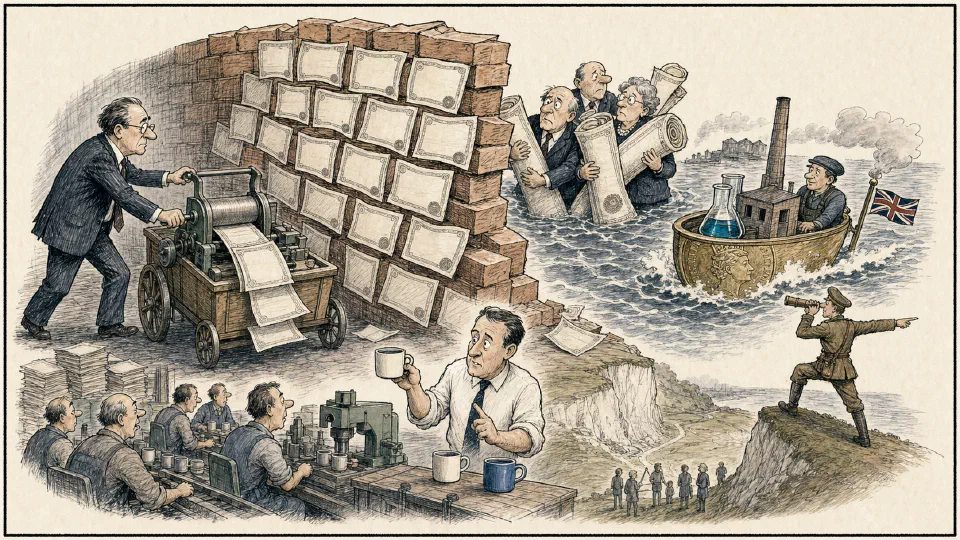
The Bank of England’s latest programme has hit a proverbial brick wall. The plan was to buy £1.17 billion of long-dated gilts. Not enough bondholders wished to sell, despite the Bank being prepared to pay prices well above those in the market. What’s going on? Pension funds and insurance companies are keen to have the payments from bonds. They especially want long-dated paper, which helps them to match their liabilities with almost guaranteed income. However, reinvestment of funds at historically low and consistently falling interest rates and yields are not attractive options. Investors are worried that they will end-up with too little money to cover payouts in the future. In other words, HM Government’s plan for quantitative easing faces major difficulties caused by earlier quantitative easing.
Getting better
Orders for the UK’s exports were higher in August than each of the previous two years. This reduced fears of a further fall in manufacturing. The Confederation of British Industry’s (CBI) industrial survey found that demands for 505 of this country’s largest exporters had risen to their highest level since 2014. 21% reported orders at above their normal levels. The CBI said the major factor in the figures was by chemicals’ manufacturers, which accounted for over half the increase. Of course, the weakness of the pound has helped these companies, but pushes up costs and prices. Capital Economics reckons the results are a reason to be ‘tentatively optimistic’ about outlooks for the UK’s economy.
Innovation
is a much-used word. Our government loves it. The UK has been ranked third, after Switzerland and Sweden, in the World Economic Forums’ Global Innovation Index for 2016. This country was second last year and scores ‘highly for infrastructure, as well as market sophistication and creative outputs.’ This index is produced by the World Intellectual Property Organisation (WIPO), Cornell University and INSEAD. The group assesses 128 of the largest economies.
Decisions, decisions, decisions
All decisions should be made as near to the action as possible. The charge of the Light Brigade was ordered by an officer who was not looking at the territory. There are two kinds of decisions: those which are expensive to change, and the rest. A decision on relocation from Manchester to Cardiff must not be made hastily. Nor should one to build the self-drive motor car. Plenty of contributions from operating people and specialists are important, too. But the common or garden decisions ought to be made quickly. Brand of pencil and times for canteen can be decided in three seconds and changed at little cost later. The company might lose a lot of business while you oscillate between blue and white coffee cups.
A warning.
‘Education costs money. But then so does ignorance.’ Claus Moser. British statistician. Quoted in Forbes.com and in MoneyWeek.
The future.
‘That period of time in which our affairs prosper, our friends are true and our happiness is assured.’ Ambrose Bierce , 1842 - 1914. American journalist and humorist.