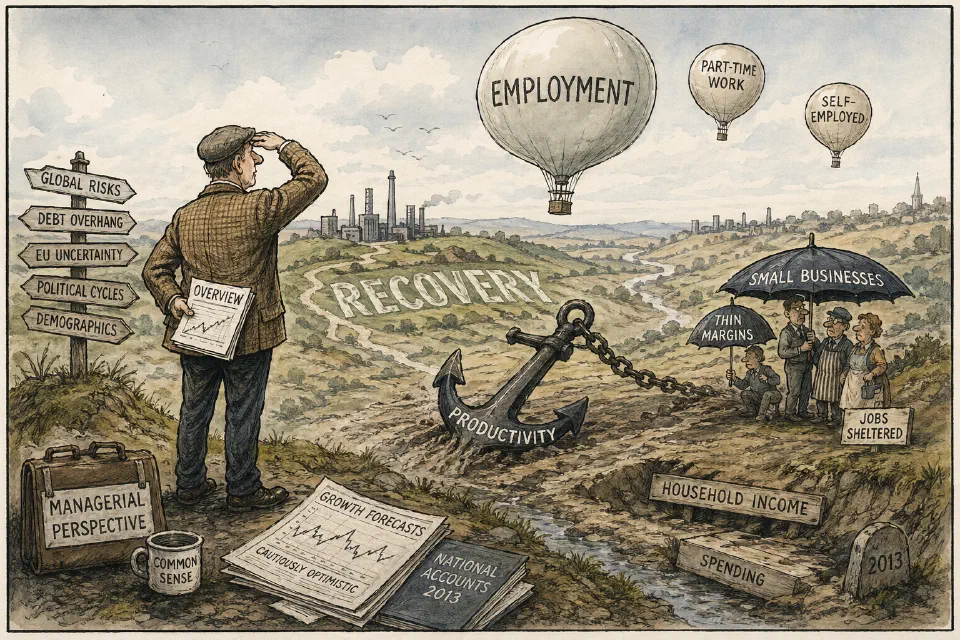
The recent recession has looked different.
It has been deeper and longer than its predecessors in the 1990s, 1980s and 1930s. Income and expenditure of households had a larger fall and remained so for a longer period. Productivity dropped dramatically. Nonetheless, employment remained relatively high and unemployment increased less than most predictions. These facts have connections. Businesses, especially smaller ones, appear to have been willing to retain people even when confronted with big shocks in demand. Also, employees have accepted lower wages. Perhaps these reactions reflect a combination of the effects from welfare reform and greater flexibility in the labour markets. Inequality has fallen as those in work have had real cuts in wages and benefits rose with prices. The contrast with the ‘80s is sharp. There is still a need for reforms by government. Policies that come to mind are: land-use planning, repairing a shortfall in infrastructure investment, improving the quality of education, facilitating the expansion of successful companies, improving productivity, making the tax system more conducive to growth and assuring commercial competition. Of course, each option is riddled with political challenges.
Competitiveness down
The World Economic Forum ranks the UK as tenth in the world for competitiveness. There is a drop of two places since 2012. Strengths are listed as a large economy (sixth) and a flexible labour market (fifth). Weaknesses include the size of government’s deficit (136th), low savings rate (122nd) and the general economy (115th). Germany is fourth, up from sixth, America is fifth from seventh, Holland eighth (was fifth). Switzerland and Singapore sit on top of this league.
One pound in every five pounds earned by Londoners is used to fund the rest of this country.
The Centre for Economics and Business Research (CEBR) is a respected firm of economic analysts and has examined the widening north-south divide. The prosperous South assists poorer parts of the UK. Based upon data released in mid-2012, CEBR’s report showed the dependence on public monies in different regions. The biggest beneficiaries are Northern Ireland, Wales and the North East. Each receives more than 20% of its income as support from the taxpayer. Wales pays tax at 30.3% of GDP generated in that country. London contributes at 45.2% of GDP created in the capital. For some taxes, the regional differences are huge. A large proportion of Stamp Duty Land Tax is paid in London. The 50p rate for income tax was collected largely from London and the South East.
Here is the scale of subsidy between regions/countries in the UK, 2010/11 (% GDP).
| Region/Country | Total Receipts | Expenditure | Deficit | Deficit vs UK |
|---|---|---|---|---|
| North East | 29.7% | 61.9% | -32.2% | -22.2% |
| North West | 37.5% | 55.9% | -18.4% | -8.5% |
| Yorkshire and Humberside | 35.0% | 53.7% | -18.7% | -8.8% |
| East Midlands | 34.1% | 49.0% | -14.9% | -4.9% |
| West Midlands | 35.4% | 53.8% | -18.4% | -8.4% |
| East | 36.7% | 45.1% | -8.4% | 1.5% |
| London | 45.2% | 34.9% | 10.3% | 20.3% |
| South East | 41.1% | 40.3% | 0.8% | 10.7% |
| South West | 35.7% | 47.4% | -11.7% | -1.7% |
| Scotland | 43.0% | 53.0% | -10.0% | 0.0% |
| Wales | 30.3% | 66.3% | -36.0% | -26.0% |
| Northern Ireland | 27.7% | 67.0% | -39.3% | -29.4% |
| UK | 37.9% | 47.9% | -10.0% | 0.0% |
None of this information is a shock. However, the presentation suggests that economic targets and plans for regions ought to be discussed and set in modified frameworks.
A wounded hierarchy is dangerous.
Its senior occupants feel insecure. A feeling of threats from changing values, better educated people and a decline in the influence of tradition fuel questions and demands. There is an increasing expectation of autonomy and personal recognition in the escalating competition for talented newcomers, who are not thrilled with the idea of being a cog in a machine. The accessibility of information, the leakiness of organisations, the speed of mobilisation online are all underpinned by rapidly improving technologies. They unnerve the top-heavy bureaucracies. Thanks to Matthew Taylor for idea.
Customer care?
Imagine entering John Lewis, or Tesco, or Primark . . . being stopped at the door and told ‘You cannot buy our goods unless you pay an arrangement fee’. You walk round the place but there is not a price-tag anywhere. If you ask a question, you are charged more money. It is taken from your wallet, which was left at the door. The firm employs a lot of people, but only one or two actually serve customers. You always have to stand in a queue. The shop closes at 3.30 pm Monday to Friday and does not open at all on Saturdays and Sundays. This retailer sold products recently to bankrupt countries and bought some foreign businesses. It made losses on both adventures and recoups the money quietly by increasing prices to loyal customers and monies from taxpayers.
Of course, you have not visited John Lewis, or Tesco, or Primark or . . . . You have been in a bank.
Makes sense.
‘The three articles of Civil Service faith: it takes longer to do things quickly, it’s more expensive to do them cheaply and it’s more democratic to do them in secret.’ Jim Hacker.