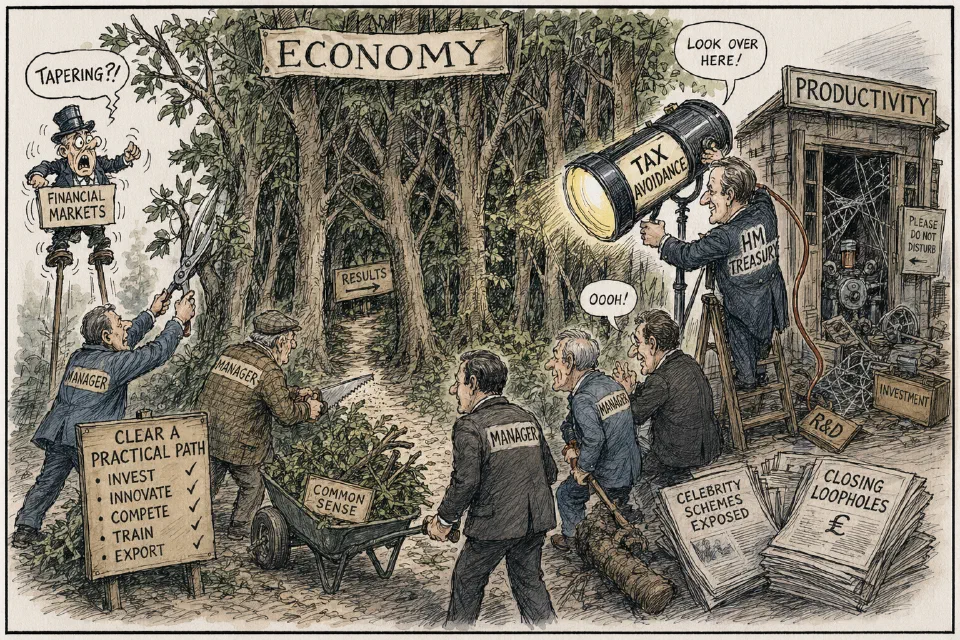
Have we seen the wood?
Or are the trees still getting in the way? Did you notice that even the threat of tapering quantitative easing in America caused trembles in financial markets. They and banks have become accustomed to the injections of new money. One wonders also if pointing to tax avoidance, not evasion, by companies makes a useful fiction for HM Treasury. It is able to claim toughness with cheats, and suggest all kinds of imaginary sums of money from curbs on culprits. The main outcomes are unrealistic hopes that there are simple solutions to the UK’s difficulties by pursuing a few tax dodgers. This is false. We have to confront the fact that output has hardly increased in the last five years. People are starting to spend again, but productivity is stagnant. Figures from the Office for National Statistics show the number of managers has gone up by 7.8% in the last two years, to 3.1 million. This is a tenth of the workforce. Do we measure performances?
Next customers?
The Chartered Institute of Marketing (CIM) reminded us recently that the population of Africa has trebled over the past 30 years and 60% of it is now under the age of 25. This segment spends $11 billion annually, with 21 to 24 year-olds accounting for $4 billion. Until recently, this was a difficult-to-reach group, but social media has changed all that, and a new middle class is growing quickly.
Entrepreneurial flair: every business seeks it.
Peter Drucker ruminated every now and again on entrepreneurship. His thoughts deserved attention and action.
‘Entrepreneurship is not a discipline, but a matter of practice.’
‘Very few things are teachable – many learnable.’
‘Unless you look on change as a lucky break, you’re unlikely to be around in fifteen years.’
‘An entrepreneur is someone who looks on change as an opportunity rather than a threat.’
‘There’s no such thing as an entrepreneurial personality, any more than there’s a pianist’s or a surgeon’s personality. The only thing that differentiates a good one from a bad one is how much s/he practises.’
‘The economy isn’t going to change; it has changed.’
Flat organisations: a small caution.
What managers do must be consistent with the results they want. The ‘right structure’ is crucial. General Schwarzkop (first Gulf War, 1991) insisted that one person (General Pagonis) be in charge of all logistics. This contrasted with the divided accountabilities of all previous campaigns. As Pagonis said, ‘decentralisation without somebody being held responsible does not work’. The need, in his words, is ‘centralised control and decentralised execution’. The organisation must not get in the way.
Pressure on prices.
Consumers today are poorer and older than they were in the 1980s. The recession has dented the value of houses and eroded confidence. Britain has an ageing population and unemployment has hit young people disproportionately hard. Retailers are recognising there is too much floorspace after frenetic physical expansion. Over capacity, coupled with a pessimistic economic outlook, is assuring a buyers’ market. The customer really is king.
Interesting thought.
‘Bureaucracy, the rule of no one, has become the modern form of despotism.’ Mary McCarthy (1912-89)
Well, possibly.
‘You used to know where you were with politicians in the 70s and 80s, ‘cos they all looked like nutters: Thatcher, Heseltine, Cyril Smith. Now they look normal, they’re more dangerous. They move among us.’ Noel Gallagher, quoted in the Guardian