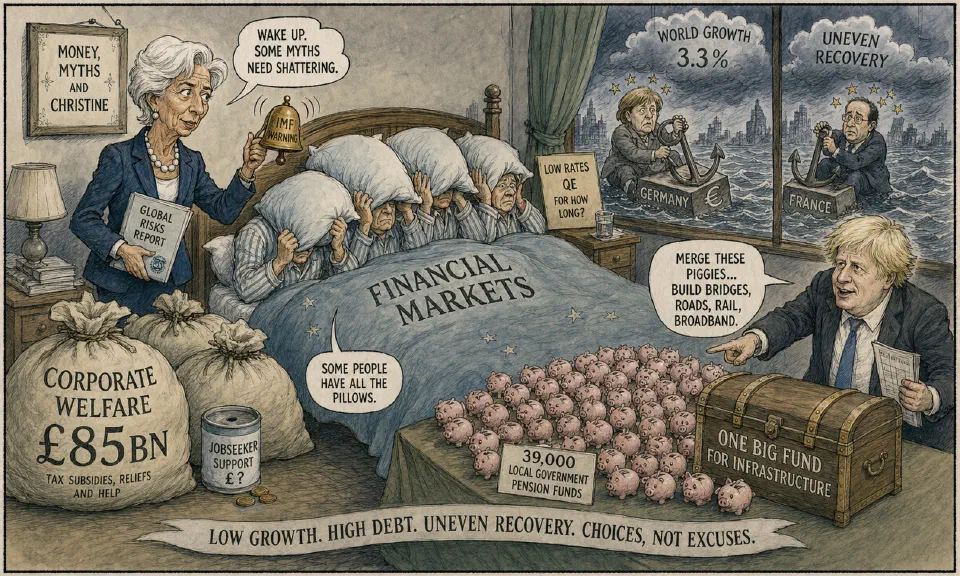
Put the pillow over your head!
Christine Lagarde, head of the International Monetary Fund (IMF) set the scene for financial markets. World’s growth is disappointing, the pace of recovery is uneven and many people are beginning to have concerns about Germany, the Eurozone’s anchor. Have we concluded that France might undermine revival in continental Europe? The IMF predicts world growth at 3.3% this year, rising to 3.8 in 2015. Some influential economists are more pessimistic. This is partial explanation of the fall in trade and commodity prices. The absence of inflation is an international factor. So. Managers must sustain strict controls on costs. Borrowing by UK’s government over the first half of this financial year was higher than for the same period in 2013. The drop in receipts from income tax and national insurance contributions is with us again.
A political and commercial myth?
Is it the assertion that capitalism and businesses do better without government? There has been much talk about benefits to those of working age who are not in a job. We know the amount of expenditure and press for stricter criteria for who receive payments. The other form of ‘welfare’ is grants and subsidies to corporations. On this, there is silence and a paucity of data, which is comfortable for government and recipients. Aditya Chakrabortty has unearthed the research of Kevin Farnsworth, who has spent nearly ten years studying ‘welfare’ for companies. In the financial year 2011 – 12, over £14 billion was paid directly to businesses – three times the amount handed to jobseekers. Add the tax breaks and more indirect aid and the total sum comes to an annual £85 billion. All this is before outgoings on support for ‘too-big-to-fail’ banks and topping up the wages of those in work but on the minimum wage. A spokesperson in Whitehall said, ‘There is no definitive source of data about spending on subsidies to businesses in the UK’. We are told snippets every now and again; almost £170 million to Disney since 2007 to make films here; last year Amazon paid less in corporation tax than it received in grants. There is a long list. Some investment of this kind is inevitable, even desirable. However, we will hear often in the forthcoming months the question – ‘what would you cut?’ Maybe, these expenditures ought to be in the discussion?
Central Planning?
Boris Johnson has pointed out in The Daily Telegraph that there are more than 39,000 pension funds for employees in the public sector. Each has it s own trustees, managers, advisers and accountants. He goes on to say, ‘The waste is extraordinary’. Other countries have spotted this opportunity and created ‘gigantic sovereign wealth funds, which they are using to invest in high-yield assets’. Sometimes in the UK. Britain would be wise to follow suit. If we amalgamated pension funds for local authorities, the ‘war chest’ would be £180 billion. Add funds covering all of the public sector and it would be hundreds of billions. These monies could be used to support power stations, new houses, railways and airports. Assets of this kind typically have a higher yield, would help us in meeting obligations to the increasing ranks of pensioners/members and save around £5 billion of administration. The idea deserves further scrutiny.
Managerial excellence needs effective processes.
The Chartered Institute of Personnel and Development (CIPD) has pointed to major reputational risks. Recent information reveals that chief executives often go through fewer interviews and tests than graduates when applying for a new job. One in three does not undergo any due diligence in the selection process. There is evidence that in a quarter of companies there are board members who may not have had checks on their qualifications, work experience or criminal record. In recent years, there has been a string of high-profile cases where senior executives were found to have a chequered history or inadequate qualifications, or, both. One observer said, ‘An entire organisation’s reputation can be damaged with a mobile ‘phone image or an inaccurate cv, followed by the click of a mouse’.
Problems.
‘Nothing will ever be attempted, if all possible objections must be first overcome.’ Samuel Johnson (1709-84). English lexicographer, essayist and poet.
Do you recall?
‘Comparison is the thief of joy.’ Theodore Roosevelt; 26th president of the United States (1901-09).