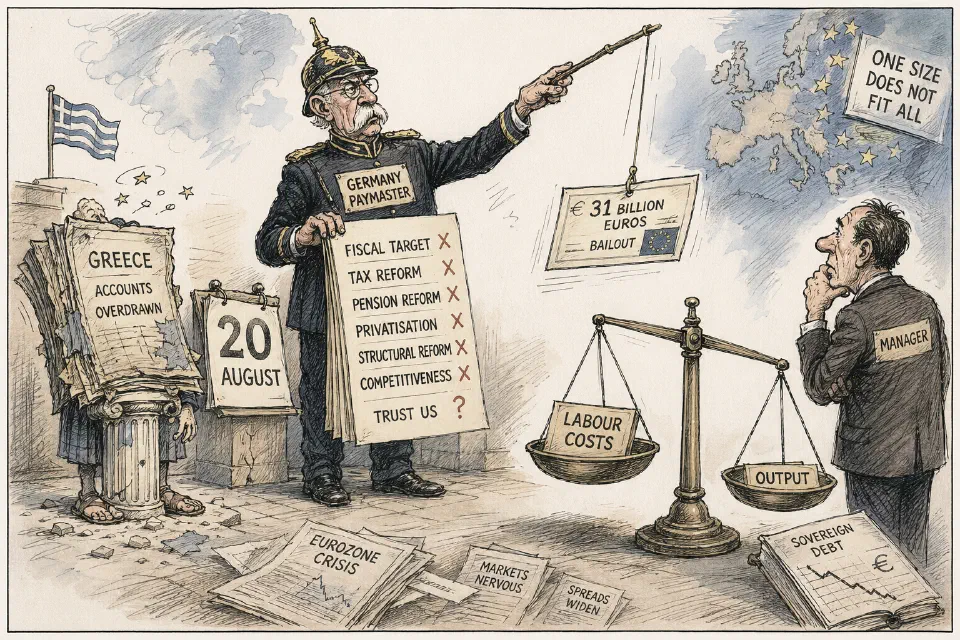
Crisis in the eurozone got worse over the last two weeks.
Has Germany decided to make sure Greece will be expelled from the euro? After all, the country has missed 210 targets set by paymasters. Nobody talks about it, but the major problem is not deficits but high labour costs/low productivity. ‘Reliable sources’ say that Greece could go bust by 20 August if the alleged programme for austerity is not meeting the promises for bailout. A loan at 31 billion euros will not start unless officials of the International Monetary Fund, European Central Bank and the European Commission release the strings. The cost of Italy’s debt is the highest since Mario Monti became prime minister in late 2011. Spain has been making noises relating to need for relief. Its borrowing rate has gone up to what is said to be an unsustainable 7.5%. One wonders if François Hollande can handle promises on becoming president well enough to create the political will for lower sovereign debt. And Britain’s economy hit the buffers in the second quarter, the third successive period of contraction. It is difficult to see how we will avoid a fall in gross domestic product for 2012. This situation will prevail despite a likelihood that the Office of National Statistics’ figures will be revised upwards. The Bank of England might well introduce more quantitative easing. Despite all this doom and gloom, do not expect disintegration of the European Union.
All political parties advocate ‘localism’ when in opposition.
The winner of power seems to shelve the idea without a formal announcement. Think about education in England. Over 50% of the 3,261 secondary schools have converted to academy status and removed themselves from the direction and guidance of the often incompetent and distrusted local councils. There have not been any signs of substantial redundancies at the Coalition’s department for education. Also, these moves will concentrate huge authority in Whitehall and for the first time the secretary of state for education (Rt Hon Michael Gove MP) will be able to open and shut schools and impose other policies without the burden of persuasion and explanation. There is a gap.
Is an entrenched and grown-like-topsy head office the opponent of progress and adaptation to changing opportunities and marketplaces?
This ailment affects organisations with several subsidiaries, outlets, sites, branches or depots. Recall the old joke, ‘I’m from head office and here to help you’. The administrators at the assumed centre lose connections with customers and do not know what life is like on the frontline. The centre becomes an overhead, not an asset. Process becomes an end in itself, rather than support for better results. Such people are expensive, often have secretaries, assistants, expenses, cars and enviable offices. They confuse activity with action and spend hard-earned margins. A small head office ought to be mandatory.
Iain Mackinnon has summarised some of the known social facts relating to unemployment and low skills.
Those people with poor skills are more likely: to be in prison; be in debt; be unemployed; be unwell and have problems of mental health; have a child who cannot read at 9 years of age; and be involved with, or have to be supported by, the state. And, they are less likely to: vote; own their own homes; take up a voluntary job such as school governor; and hear their children read. Makes you wonder?
Can this comfort us?
‘Since we have no more power of knowing the future than any other men, we have made many mistakes (who has not during the past five years?), but our mistakes have been errors of judgement and not of principle.’ J P Morgan junior in 1933. Now look at the performance of his successors.