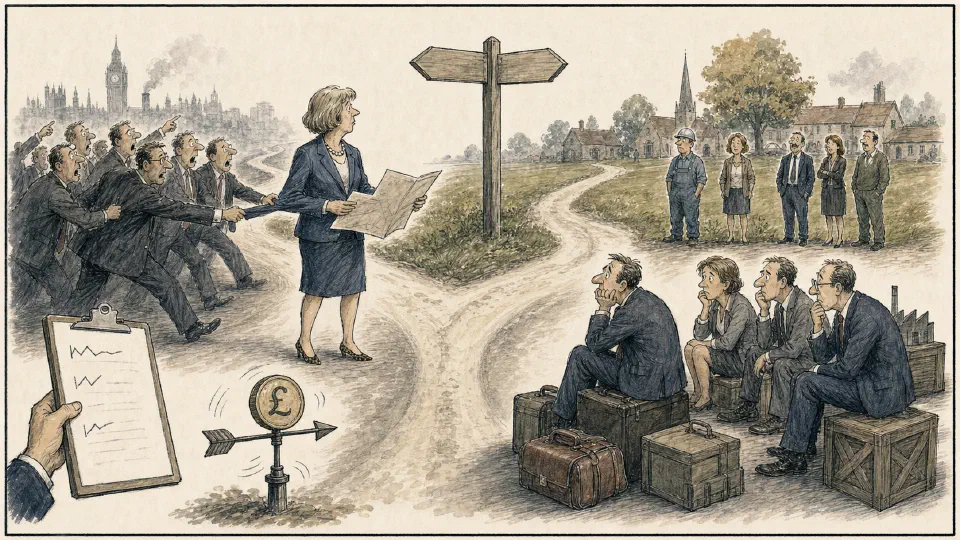
Vision
At the launch of her campaign to become Leader of the Conservative Party, Theresa May emphasised ‘a bold new, positive vision …. a vision of a country that works not for a privileged few, but for every one of us.’ This theme has become a frequent assertion in her speeches as Prime Minister. On the day she became leader, Mrs May said her plans were ‘a different kind of Conservatism’ that ‘marks a break with the past’. However, she might find it easier said than done. Electors know she was home secretary throughout the Cameron/Clegg coalition and the Cameron government. Recent research suggests that 45% of people put themselves on the centre ground of political choices. Only 30% advocate the right-of-centre ground occupied by Thatcherism. With a parliamentary majority of only twelve and both cabinet ministers and rebellious backbenchers showing signs of noisy impatience over delays on Brexit, there are temptations. More radical domestic reforms would please the parliamentary party and many local branches. Whether Theresa May decides to be in the common ground at right-of-centre or steer her government towards the middle, will be one of the defining stances of her premiership.
Post-Brexit predictions.
The Chartered Management Institute has completed a survey of its members’ predictions for the United Kingdom’s economy after departure from the European Union (EU). The conclusion was that managers expect Brexit will have a negative impact, lead to a shortage of talent and threaten the security of their jobs. 79% of respondents predict this country is set for no economic growth over the next twelve to eighteen months. 48% of managers are not confident their leaders have the ability to manage effectively their organisations with Britain outside the EU.
Pessimism of the big bank. Ben Broadbent is Deputy Governor of the Bank of England. In a speech at the Wall Street Journal’s offices in London, he said ‘There’s little doubt that the economy has performed better than surveys suggested immediately after the referendum …. somewhat more strongly than our near-term forecasts as well …. The central projection in the August inflation report didn’t involve a recession, simply a slowing down in the economy’s rate of growth. But that slowing looks so far to have been more moderate than we feared.’ Mr Broadbent then advised against reading too much into particular pieces of data and predicted that consumers’ spending would be ‘relatively unperturbed’. The bigger risk would hit investment to businesses, as companies hold off on big spending commitments because of heightened uncertainty. A lack of clarity about the UK’s future trading relationships needn’t result in visible grabbing of productive capacity. He argued that the effect is likely to be more insidious: decisions to expand might otherwise be delayed.
A glimpse. Vladimir Putin’s genius as a politician was derived from his ability to understand his electorate and to give it – or more importantly to tell it – what it wanted. To Russia’s men, he has been a tough guy, able to chat with workers and soldiers in their own language. To women he has seemed organised and sober in a country plagued by alcoholism. Internationally, he has been taken seriously, even if not admired universally.
That’s it.
‘Fiction is the lie through which we tell the truth.’ Albert Camus (1913-60). Algerian philosopher, author and journalist. On the Harvard Business Review online and in The Week.
Self-awareness.
‘What you say about somebody else, anybody else, reveals you.’ James Baldwin (1924-87), in the Paris Review. American novelist, essayist, playwright, poet and social critic.