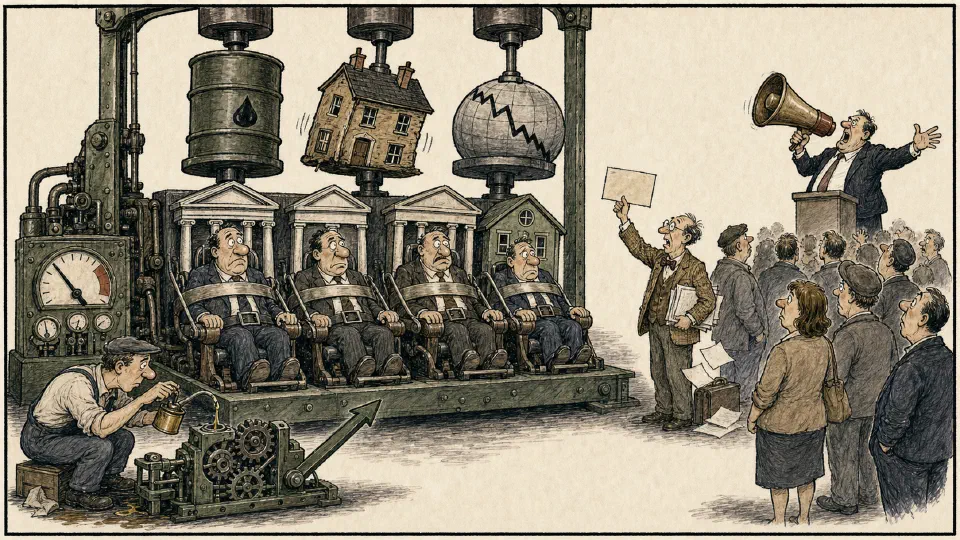
Stress for lenders.
Six of the largest banks and one building society have been assessed on whether they would be able to withstand an economic crisis. This process asks if they would survive oil falling to $20 a barrel, prices of houses going down by 31% and a 4.3% drop in economic output. One failed to prove it would overcome such an unthinkable combination of financial shocks. Analysts pointed to Standard Chartered as having the most difficulty. Barclays, HSBC, Lloyds, Nationwide, Royal Bank of Scotland were tested also. The examination is the first pressure from information made publicly available.
Back to Brexit.
One of the important factors in the debate is the way in which opinions of experts were sidelined in favour of more emotive arguments. This has caused objections from academics. Maybe there is a core fault-line which is the start of a redefinition of the future of social sciences in the UK? Not only has the Leave campaign been founded on explicit rejection of advice from sages, but it also exposed a gap between academics and the broader public. Recent surveys have suggested falling public trust in ‘academics’ as a professional group and an increasing sense that they are part of ‘the elite’.
Productivity
is a constant concern for managers. A relatively small percentage increase could add more than £200 billion to the economy. The Confederation of British Industry (CBI) has highlighted potential gains if local businesses could match those in the best performing regions. It says jobs would be created and living standards improved.
Second estimate.
The Office of National Statistics (ONS) published recently its new reckoning of growth in the economy (GDP) for the third quarter. This was confirmed at 2.3%. Services moved upwards by 3%, driven by a rise of 5% in expenditure on leisure and 4% expansion of transport and telecommunications. Manufacturing and construction continued to disappoint. Household spending increased by 2.6%. Investment went up by a modest 1.2%. The Government’s outgoings rose by less than 1%. Exports appear to have climbed by 4% and imports remained subdued at just 2.6%. There is no reason for a major slowdown in 2017. The negotiations on Brexit will take some years. We all assume that the starting gun (Article 50) will be fired in March.
Theodore Roosevelt
celebrated America’s new commercial power during a speech in Osawatomie, Kansas. Also, he warned that America’s industrial economy had been taken over by a handful of corporate giants. They were generating unparalleled wealth for a small number of people and exercising growing control in American politics. The Economist (17 September) points to Roosevelt’s caution that a country founded on the principle of equal opportunity was in danger of becoming a land of corporate privilege. This was on 31 August 1910. Does it have a familiar ring?
On Trump
MoneyWeek says most observers find it hard to disagree with the view that Donald Trump spends little time in self-examination. In the Sunday Telegraph, Bruce Anderson quotes a banker who knows Mr Trump well: ‘It is impossible to know what he thinks or what he is going to say. How could it be otherwise? He has no idea what he will say - until he opens his mouth.’
Just think.
‘You can tell the ideals of a nation by its advertisements.’ Norman Douglas, quoted on Forbes.com and in The Week.
The vanishing act.
‘Public money is like holy water; everyone helps himself.’ Italian proverb.
Making things work.
‘Bad administration, to be sure, can destroy good policy; but good administration can never save bad policy.’ Adlai Stevenson (1900-68). American politician and statesman.