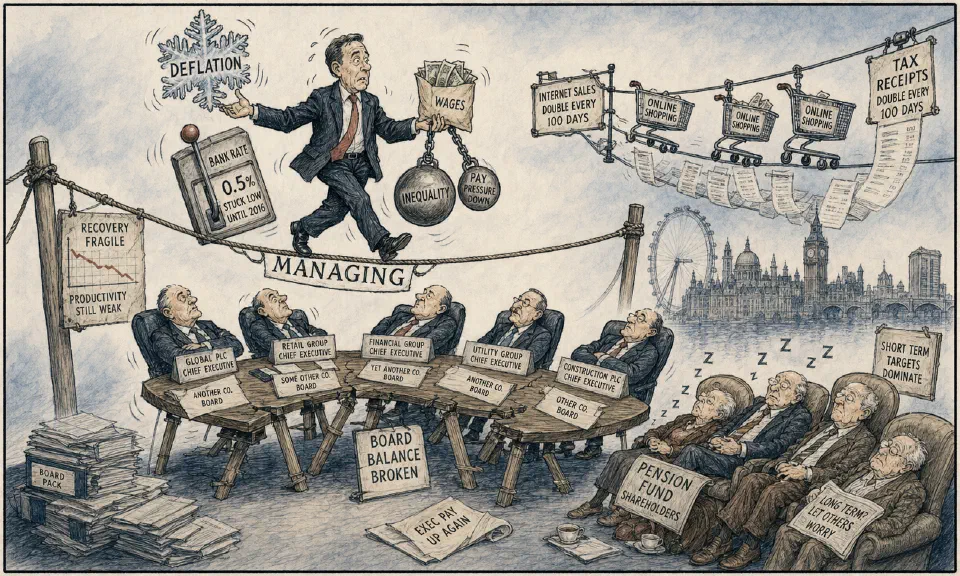
Interest rates into 2016.
The Bank of England’s Monetary Policy Committee (MPC) is showing concern about deflation. With bills for petrol and utilities falling, the Bank suggests there is a real chance of a drop in prices generally. Also, there is a risk of deep-seated low inflation. This prompts a wariness of raising interest rates in case such a decision would reduce momentum in the economy and push the downward trend in prices. Deutsche Bank has observed that there is a ‘considerable uncertainty for Western economies’. It is reasonable to assume central banks will use any signs of weaker results, including inflation, as grounds for retaining low interest rates. The Bank of England is unlikely to move before mid-2016. MoneyWeek has noted the fall of unemployment in December and that the number of claimants was down by 30,000. Wages moved up for a third month, with exclusions of unskilled/untrained people. Inequality remains a drag on economic growth.
The board is broken?
Jay Vaananen (Banker’s Umbrella) reckons if shareholders do not get a grip on companies’ power, there will be more Tescos. His conclusion deserves amplification and possibly action. Ever since the changing 80s, corporate managers have been successful in removing power from shareholders. Simultaneously, they preached the message of ‘shareholder value’ as their goal. There were some positive outcomes. However, a look at the owners of listed firms shows that the largest shareholders are investment and pension funds. They rarely take an active stand on issues. The textbooks and specialised commentators argue that corporate boards keep a check on management of a business. This is not true. Closer examination reveals that there has been cross-pollination by chief executives and managing directors from other corporations. Top managers oversee other top managers. This not a recipe for good governance and how do they find the time? There is beginning to be evidence that increased shareholders’ representation brings better results. Moreover, the financial sector has given many examples of breakdowns in corporate governance and the sad impacts on employees and shareholders.
The internet affects economies.
The dramatic expansion in the use of the internet is a major factor in economic success. It doubles every 100 days, says America’s government. Economists estimate that without the internet, inflation in the US would be higher than the present figure. Consumers employ the internet for everything from buying shares and holidays to weekly shopping. Analysts predict an enormous rise in tax revenues as a result of these transactions.
Shifts in colleges and universities.
The PIE News (for professionals in international education) sets out seven emergent trends for this year. These are:
- More industry consolidation.
- Increase in public/private partnerships (PPS).
- Significant growth in access to higher education via pathway programmes and foundation courses.
- Retention strategies will be more ‘professional’.
- Elections in Denmark, Nigeria, Spain and Britain could signal changes in policies.
- Apps in mobile education will rise.
- Greater scrutiny of agents.
We all see it.
‘This is the terrifying paradox of zealotry: no one hates humanity more than those who believe they know what’s best for it.’ Howard Jacobson, in The Independent.
Preparation for a job.
‘He knows nothing and he thinks he knows everything. That points clearly to a political career.’ George Bernard Shaw (1856-1950) Irish dramatist and critic.