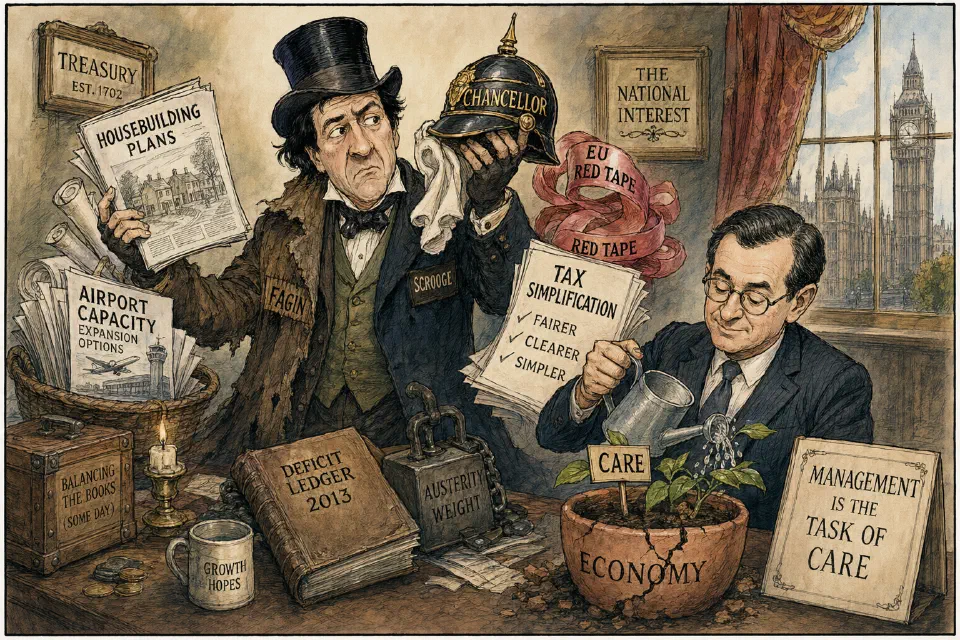
George Osborne has been likened to Fagin and Scrooge.
But Margaret Thatcher was hated from being secretary of state for education until she won the voters’ respect. Mr Osborne’s challenge is to build upon limited economic progress and present himself as the iron chancellor who takes the tough decisions needed by the UK. He might talk about putting up more houses, cutting red tape from Brussels and HM Treasury, simplifying tax or increasing capacity of airports.
News that the country’s gross domestic product grew by 0.8% between July and September will not change either of the big parties’ political fortune overnight. Nonetheless, GDP is still 2.5% below the pre-crisis peak. Real disposable income is 2.2% lower than in 1997. Oddly, the evidence suggests we have become poorer, more equal and happier. Data shows that the rich have borne more costs of the recession than the poor.
We have to be careful when claiming momentum. Probably, services have regained their pre-2008 output. However, industrial production and construction are struggling. They declined gently and flatlined in the years before recession and are still 15% below their top performances. Business investment dropped by 15% in the downturn and is still there. Politicians of all shapes and sizes keep talking about more balanced and sustainable growth. We have been given measures to boost demand, especially for houses at low interest rates, in a supply-constrained economy. The Bank of England’s policy of maintaining interest rates on the floor is beginning to look dangerous.
‘A message of the last weeks is that if business leaders do not get a grip, the politicians will attempt to do the job for them’.
This opinion was expressed in The Financial Times by Richard Lambert, former director-general of the Confederation of British Industry (CBI). It deserves both thought and action. He points to the reality that it is not only nuclear power plants failing to attract British money. Investment as a percentage of gross national product (GNP) was at its lowest for forty years before the financial crash in 2008. It is unsurprising that government is frustrated by companies still building-up cash balances and reducing this kind of expenditure. The assumed £500 billion of corporate funds is another sign something is going wrong with the UK’s version of capitalism. The problem will not be fixed by a return to economic growth alone. There is a feeling that some firms lost their sense of purpose in the years leading up to 2008, emphasising revenues and profits at expense of relationships with customers and the broader society. These problems were not limited to the financial sector. The general stances lowered the credibility of business. Richard Lambert has an uncomfortable habit of being right on these issues.
The poor state of financial management in government has been highlighted by the financial crises.
The Court of Auditors has qualified the European Union’s accounts for the past eighteen (yes, eighteen) years. The UK’s legislators have been telling us they are leaders of financial management in the public sector. Nonetheless, the National Audit Office (NAO) announced in July it had, for the third year in a row, heavily qualified the whole of government accounts (WGA). This item is the key tool for Parliament and the public to hold government to account. Amyas Morse is head of NAO. He has suggested HM Treasury must do more, such as using accounting standards!
These results are from those people who like to tell us how to run our businesses.
The six stages in management of new projects:
Enthusiasm. Sobriety. Panic. Search for guilty people. Punishment of the innocent. Reward for those who did nothing.
Sounds empirical.
‘Consultation is a good thing when people agree with you and a waste of time when people don’t agree with you.’ Ken Livingstone
and
A reasonable summary.
‘Leadership is not about being nice. It’s about being right and being strong.’ Paul Keating