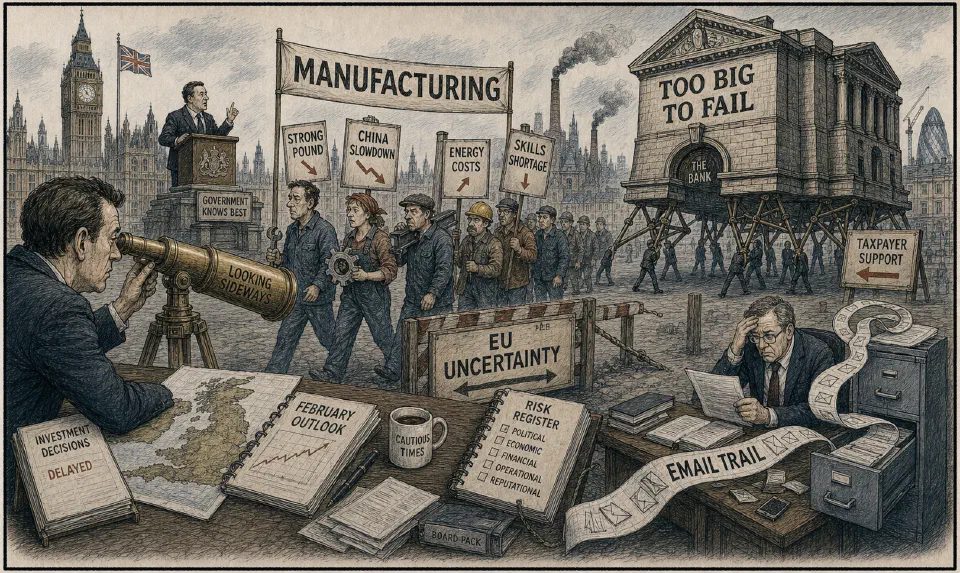
Osborne’s army.
Do you recall the Chancellor of the Exchequer’s ‘march of the makers’ in 2011? Onwards to a ‘more balanced economy’.
But the manufacturing marchers have had a bad time. The sector’s share of GDP has gone down from a disappointing 13% to 10%. Of course, factors such as a stronger pound, slowdown in PR China and emergent markets, crisis in the eurozone and general volatility are not George Osborne’s fault. Nonetheless, he has some responsibility for the Government’s fuelling of uncertainty and causing doubts on investment because of the imminent referendum relating to the European Union. Other major obstacles for manufacturing remain. These include skill shortages, access to finance and comparatively high costs of energy. Our political masters must get off their hands. Last November, industrial production (manufacturing, mining and energy supply) in the UK had its worst monthly fall (0.7% for two years.
Politics, policies and imagination.
Markets and their forces attract analysts and commentators. Managers ought to take part in the arguments and defend the need for their contributions. Not so long ago, the New Yorker, hardly a manual for the Left, chose Karl Marx as major thinker of the next decade. A market’s morality has two pivotal components. The first is an obligation to deliver measureable outcomes, founded upon the premise that pursuit of enlightened self-interest leads to the betterment of society. There will be a backlash if the market is seen to fail on either results or restraint.
Anyway, what is the job of government? After all, there are not dynamic markets without a government to define rules and context. The state must accept the disciplines of markets and understand the impact of control and intervention. This leaves our politicians with a daunting challenge. They have to devise ways for reducing and redirecting intrusion whilst fulfilling their responsibilities and preserving the electorate’s trust. It means redesigning the welfare state and securing the competences to cope with global competition. Public policies and politics are one thing. But imagination will be tested to breaking point and is in short supply.
Big questions for businesses in 2016:
- Will PR China continue to cause economic ructions throughout the world?
- Are prices and margins across commodity markets likely to still feel the squeeze? Oil fell 35% to an 11-year low of below $40 a barrel in 2015.
- What is the outlook for emerging countries? Growth has halved since a peak in 2011.
- Is it possible an ‘out’ vote in the forthcoming referendum on UK and the European Union would derail investment projects? In any event, will there be an urgent need to rebuild economic and trading bridges?
- Can we find greater clarity for the outlook between America and Europe? Will elections in the US ‘cast a gloomy shadow’?, asks Allister Heath.
- Will the Bank of England raise interest rates? Also, it is keen to use new powers to limit risky mortgages.
Too big to fail.
The Financial Stability Board advises the G20 group of countries and is chaired by Mark Carney, governor of the Bank of England. The Board says the world’s thirty biggest banks should raise up to $1.2 trillion in loss-bearing debt, in addition to their equity capital. The purpose is to make creditors liable for a bank’s failure, rather than taxpayers. Mr Carney said that the plan would ‘support the removal of the implicit public subsidy’ enjoyed by banks that are ‘too big to fail’.
Emails and pitfalls.
There are complaints of inefficient use of email. It is simple to send copies to many people who do not need them. Also, it is easy to forget that email is a permanent record, even if a document is in the electronic waste bin. Senders often say more flippant and incriminating things than they would in a letter. What about libel? Reconsider guidelines and disclaimers in conjunction with internal controls.
Use of power.
‘A government big enough to give us everything we want would be big enough to take from us everything we have.’ Gerald Ford, President of the Union States, 1974-76.
Through which end of the telescope.
‘It’s more than magnificent – it’s mediocre.’ Sam Goldwyn, American film producer.