Praise at last.
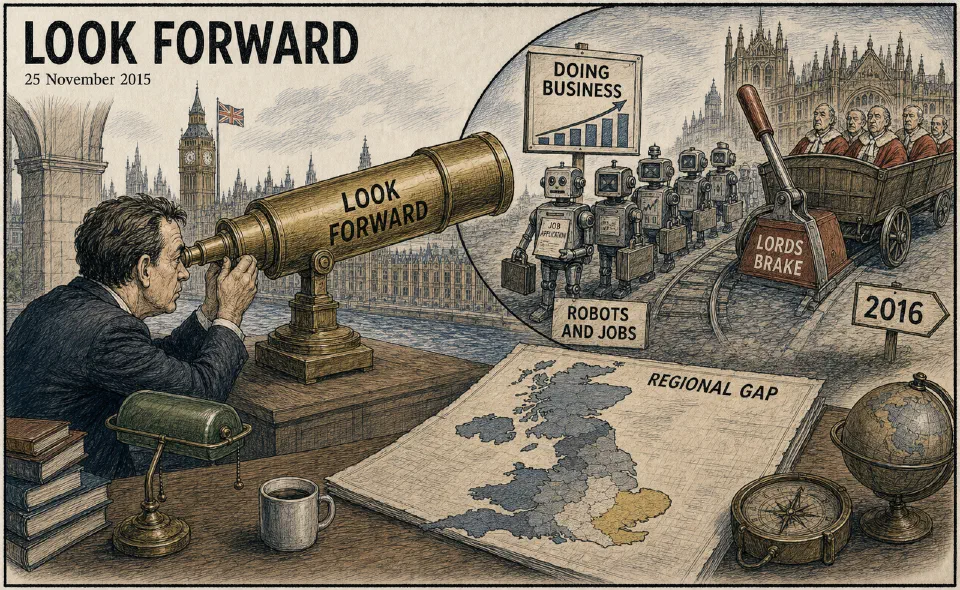
The World Bank has published ‘Doing Business 2016 : Measuring Regulatory Quality and Efficiency’. Britain has moved closer to its target of being one of the top five countries in which to do business. Singapore and the UK in particular were applauded by the Bank for taking steps to cut red tape and remove administrative barriers. The UK went up the table because of a reduction in corporation tax, lower employers’ national insurance costs and a fall in the number of days taken to start a business. 4.5 days is the present period. 20 days is the average worldwide.
Something to do?
With The Labour Party so weak in the House of Commons, an alternative check on the government is more valuable than ever. The Economist reminds us that the Lords has defeated the government 19 times since May, often with good reason. But, to act as a brake, they need clarity and a mandate. That means a written constitution to codify their powers, and election of its members. The Commons resists Lords reform for fear of a rival chamber with the legitimacy to challenge it—and then proceeds to scream foul whenever the Lords blocks legislation. If the tax-credits debacle provokes a rethink, it will be long overdue.
Robots and jobs.
The Bank of England’s chief economist, Andy Haldane, has suggested fifteen million jobs are at risk from artificial intelligence and advanced robotics. He made a major speech at the Trade Union Congress and said that unskilled and administrative tasks were in most danger from the ‘third industrial revolution’, but warned that the advance of technology is ‘hollowing out’ more and more of the labour market. ‘Machines have substituted not only for manual human tasks but cognitive ones too. The sets of skills machines could reproduce, at lower costs, has both widened and deepened.’ The implications are clear. ‘If the option of skilling-up is no longer available, this increases the prospect of large scale or un-or-under-employment. The wage premium for those occupying skilled positions could explode, further widening wage differentials.’ Haldane did not mention how long all this would take. Management Today has found that similar estimates have indicated a timespan of twenty-thirty years for this degree of displacement. Our political masters would be wise to start thinking now.
Jobs miracle.
The figures have been looking better recently. Employment continues to rise and wages have started to move upwards. But dig a bit deeper. The picture depends upon who and where you are. Viewed from London, it is possible the situation looks marvellous. Flipchartfairytales.wordpress.com points out that good jobs are being created and lots of newcomers are arriving from abroad to fill them. In other parts of the country, people feel bemused when they hear the slump is over. The North-East, West Midlands, Yorkshire and the South East still have fewer full-time jobs than before 2008. If you were born in the UK and live in the North, you will have seen slow growth, at best, of employment. The gap might well have been filled with self-employment, much of it precarious and low-paid.
This might explain the presence of Ukip in these places. It’s not so much a case of immigrants ‘taking our jobs’ – most of the vacancies are in London and that’s where immigrants tend to go. Do the unemployed wait for the magic.
Famous last words.
‘There’s no chance that the iPhone is going to get any significant market share. No chance.’ Steve Bulmer, chief executive of Microsoft, April 2007.
Muddle.
‘The trouble with facts is that there are so many of them.’ Samuel McChord Crothers. The Gentle Reader.