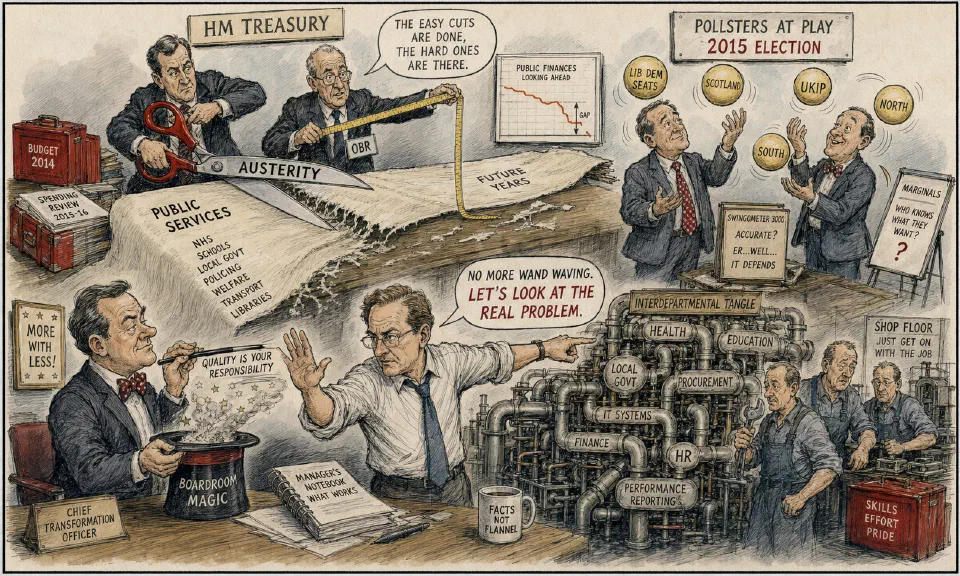
Austerity and wincing.
Despite all the talk, most of the reductions of public expenditure have not yet started. Information from the Office for Budget Responsibility (OBR) shows total spending fell by 3.5 percentage points of Gross Domestic Product (GDP) to 43.5% since 2009/10. The formal plan is to lower these outgoings by another 5.5 percentage points before 2018/19. This will take public expenditure as a share of GDP to its lowest since 2001/02. The government has not made a case for a smaller state. Is there evidence that such objectives would boost economic growth and reduce the rising inequality? Or has the UK’s political elite come to a silent conclusion that the private sector is not able to fill the gaps left by a shrinking state? Maybe they have lost the ability to argue about big ideas and values? Or perhaps they are being told by mandarins that cuts are unlikely to be offset by gains in efficiencies, meaning deteriorating services?
The Audit Commission has said costs of management in local authorities have increased by ten per cent in the past ten years. This watchdog examined the cost of central management functions, such as finance, human resources, information technology and property. It has called for greater scrutiny. The Commission’s chairman, Jeremy Newman, alleged an analysis had been undermined because only 223 councils had a complete record of outgoings on central functions. How is it known they are value for money?
The oddities of 2015’s general election.
The pollsters are working hard and getting headlines in the national newspapers. When Andrew Neil has difficulties in finding hot topics for his Daily and Sunday Politics, these programmes devote time to speculation on prospects for the political parties.
Little is said in these punts of the media about the Liberal Democrats’ special skills in retaining seats in the House of Commons. Once they are incumbents, they tend to be re-elected, however low the party’s position is nationally. There are fifty-nine MPs for Scotland – one Conservative, forty-one Labour, six Scottish National and eleven Liberal Democrats. If there is a ‘yes’ vote in the referendum on independence, will these jobs in Westminster cease? And what about Ukip? Bear in mind that the UK uses the first-past-the-post system for elections to the national parliament – though there is a form of proportional representation for the European Parliament and the Scottish Assembly. A majority of electors voted against many MPs. Labour has strongholds in the North of England. If Ukip has a high vote in such constituencies, the Labour members will still be in place. However, Ukip seems likely to attract Conservative votes and this will hit marginals in the South. Predictions from polls are not as simple now we cannot assume that at least 80% of votes will go to either the Conservatives or Labour.
Quality beware.
Managers who rely on exhorting the workforce to ‘do the job right first time’ or ‘accept that quality is your responsibility’, should be aware of the unspoken insult. They will not only fail in the ‘search for excellence’, but also create division and conflict. These calls imply that faults are caused by the shopfloor and difficulties are departmental. In fact, the opposite tends to be true. Most problems are interdepartmental. The contribution of all people in a business is a necessity for better quality. The idea is that everyone must co-operate in accepting that all internal and external transactions have a customer and a supplier. This can happen only if the Boardroom demonstrates by behaviour its commitment to improvements. Otherwise, the stance will be recalled in 2020 as one more amusing piece of managerial magic.
Use of English.
‘I find the public utterances of permanent secretaries so predictable and completely interchangeable that I have stopped listening to them. It has to do with Civil Servant English. You have to squeeze all personality out of it.’ Sir Antony Jay, co-author of the TV series ‘Yes Minister’.
Obtaining an agreement.
‘One of the things I learnt when I was negotiating, was that until I changed myself I could not change others.’ Nelson Mandela, former president of South Africa.