Confidence.
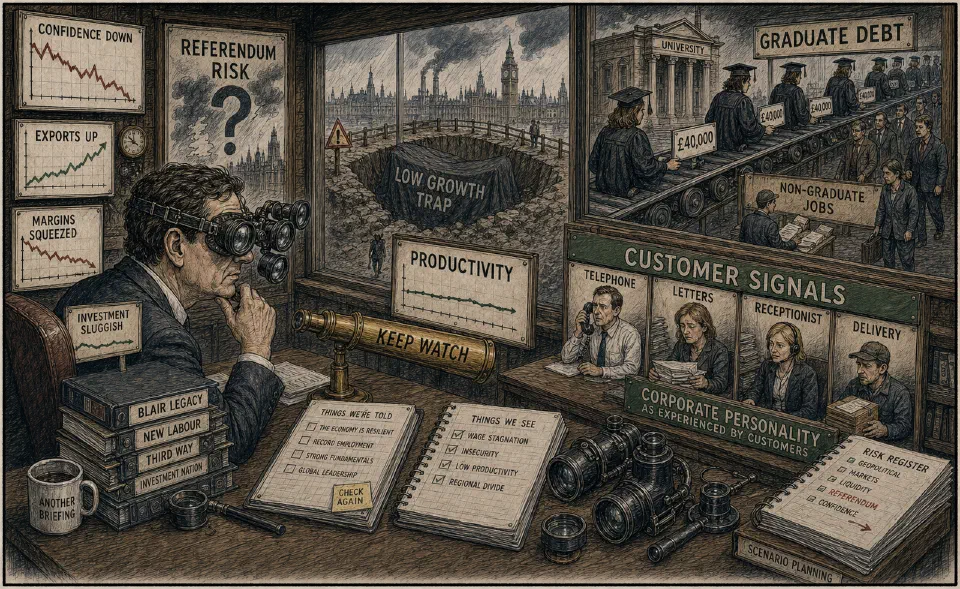
The report for the second quarter (2016) from Grant Thornton and the Institute of Chartered Accountants in England and Wales contains some uncomfortable key points. Business confidence remains on the downward trend of the last two years. Domestic sales continue to ease and exports have started to rise. As a result, overall growth in turnover has stabilised but at a slower pace than a year ago. Profit margins are under pressure as businesses are able to achieve only modest increases in prices. Capital investment and research and development are still sluggish because of uncertainty in the wider economy.
Remain cautious.
The Organisation for Economic Co-operation and Development (OECD) has warned that the world’s economy is stuck in a low-growth trap. It said monetary policy alone could not be relied upon to deliver growth and governments ought to use other available fiscal tools, such as additional investment in infrastructure to stimulate demand. OECD pointed to several risks for global growth. The immediate one is if the UK votes on Thursday to leave the European Union.
Blair is still around.
The continuing attraction of the former prime minister’s ‘third way’ to politicians in Europe was spotted by George Eaton in the New Statesman. It confirms the failure of critical social democrats to establish and advocate an alternative. Tony Blair said recently of Jeremy Corbyn’s supporters: ‘It’s clear they can take over a political party. What’s not clear to me is whether they can take over a country.’ Mr Blair’s lack of attention to the former task enabled a revival of the left. Alastair Campbell summed-up the situation: ‘We failed to develop talent, failed to cement organisational and cultural change in the party and to secure our legacy.’ New Labour did not outlive its creators. Some of Corbyn’s allies privately fear Labour will one day re-embrace Blairism. Any new adherents would not dare to use the name.
Higher education and better pay.
Politicians have encouraged the notion that the offerings of higher education will make individuals richer and the economy more productive. The Times (Alison Wolf) has wondered why it is that eight years after the financial crisis and with more graduates than ever before, we have ‘low growth, falling or flat productivity and stagnant wages?’ Also, around 33% of graduates are in ‘non-graduate’ jobs. Of course, graduates do, on average, earn more than non-graduates, but if the real incomes of both decline, the pay gap between them can stay the same, while students’ fees and debts remain fixed. We could fund higher technical education by providing skills the labour market demands and stop favouring teenagers over adults for loans. But above all, we could stop treating universities as having a narrowly economic purpose. This would mean an intensive and new think about what a university ought to be.
Corporate personality.
An organisation’s self-perception plays only a minor part in its personality. Almost everything in better results is about what the customers believe or feel about the business, brands and services. These come from experience and observation. Snippets – even if hearsay – on a product’s performance, price, availability, design, delivery and after-sales service are fragments in the mosaic. But the product is not everything. What is conveyed by telephone, letters, emails, salespeople, a receptionist’s greeting? The signals transmitted by the group (team?) with which a customer has contacts bellows volumes.
Sad reality.
‘We have more ability than willpower, and it is often an excuse to ourselves that we imagine that things are impossible.’ Francois La Rochefoucauld, 1613-80, French writer.
Process.
‘Between saying and doing many a pair of shoes is worn out.’ Proverb.