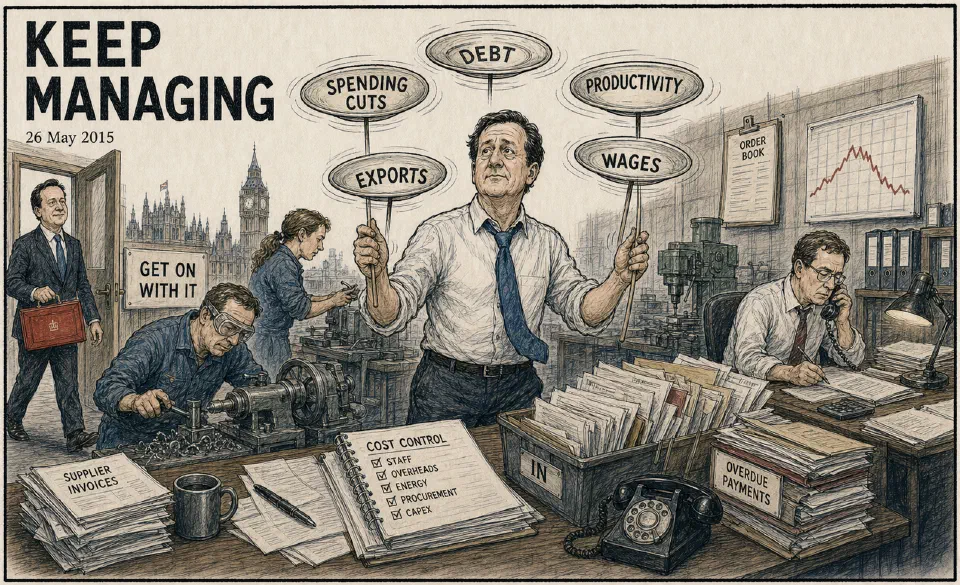
George Osborne is back as Chancellor.
Pity him, says James Meadway, neweconomics.org/blog. He has inherited a mess from the last government. Here are five of his major problems.
- Spending cuts will not work. He had to slacken harsh austerity as the economy slumped. So, he missed the targets on reduction of deficit. Things have not changed much.
- The easy reductions in expenditure have been made; for example, capital expenditure on buildings and some benefits. There will now be difficulties in avoiding politically damaging cuts.
- Household debt is rising again. Maybe a crisis looms?
- We are less productive. Since 2002, productivity of labour has slumped. There is little scope for raising pay.
- The current account deficit – the gap between what we earn from the rest of the world and imports – is nearly 6% of GDP. If interest rates in America go up and/or credit in the PR China collapses, then there would be reductions in exports accompanied by trouble.
A different place.
It’s easy to forget the changes between 1950-51 and 2010-14. The figures were started by David Butler, the psephologist. Remember him? He appeared on television and radio during the results of every general election.
This information is important to marketers.
- 1950-51 Total UK population 51 million
- 2010-14 Total UK population 64 million
- Top rate of income tax 90% 45%
- Women in the workforce 31% 65%
- Life expectancy 67 80
- Population over 65 11% 19%
- Non-white population 0.4% 16%
- 17s – 19s entering higher education 6% 47%
- At school after leaving age 31% 76%
- Airline journeys 2 million 160 million
- Owner-occupied households 29% 69%
- Car-owning households 12% 77%
- Telephone-owning households 12% 99%
- Computer-owning households Nil 76%
- Television households 1% 99%
- Armed forces regulars 688,000 174,000
- Self-described working class 47% 31%
- Mining and heavy industry jobs 39% 10%
- Unemployed 1.5% 8.1%
- Criminal convictions (England and Wales) 17,100 352,000
- Prison population 20,000 83,000
- Major party members (combined) 4 million 476,000
Do as we say, not as we do.
It is crucial that politicians and other public officials do not commit acts of corruption or behave unethically. But it is just as essential they are not seen as unscrupulous and immoral. With the recent suspension of Malcolm Rifkind (Conservative) and Jack Straw (Labour) from their political parties for allegedly offering influence for money, questions are being asked again about whether members of parliament should be allowed to sell their services to individuals or groups. Simultaneously, the UK presses other countries to stamp out corruption of all kinds. Our government has a long history of trying to prevent unethical activities by people in public office. However, the laws passed to prevent them are not enforced effectively. There is nothing wrong in principle with trying to influence politics and using money to do it. Practitioners include single-issue lobby groups, campaigners of all kinds, trade associations, non-governmental groups and trades unions. They spend their funds on compiling briefings and other materials to persuade decision-makers who can make or reject changes which affect them. Problems arise when the relationship becomes a direct transaction.
The British public has, for more than 10 years, been urged by politicians and public officials to pay their taxes, work harder, take responsibility for their children, respect the environment and support the government’s military actions overseas. There seems to be questionable connections behind these moral advocacies. This country needs to demonstrate it insists upon good governance at home. Jon Moran, University of Leicester, has done valuable research on this topic.
Paying the price.
John Ruskin (1819-1900), gives a warning. ‘It’s unwise to pay too much, but it’s worse to pay too little. When you pay too much, you lose a little money – that is all. When you pay too little, you sometimes lose everything, because the thing you bought was incapable of doing the thing it was bought to do. The common law of business balance prohibits paying a little and getting a lot – it can’t be done. If you deal with the lowest bidder, it is well to add something for the risk you run, and if you do that you will have enough to pay for something better.’
Experience tells.
‘Live by the sword, die by the sword. I just didn’t realise there’d be so many swords.’ Rt Hon Nick Clegg MP, deputy prime minister of UK, 2010-2015.
Predictions.
‘Nothing is more fickle than people in a crowd, nothing harder to discover than how men intend to vote, nothing trickier than the whole way in which elections work.’ Marcus Tillius Cicero (106-43BC), Roman statesman and orator.