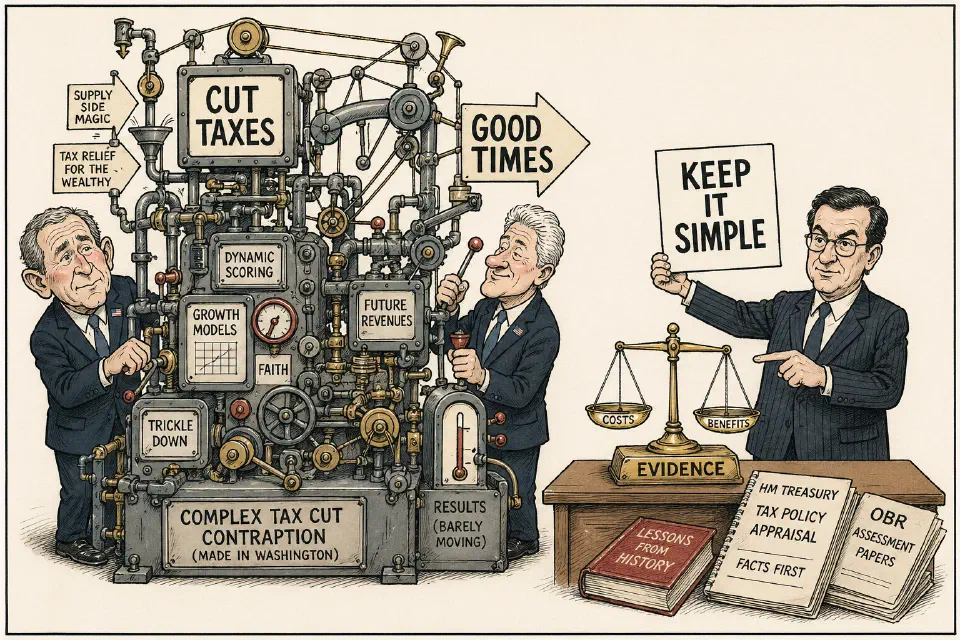
New York Times emphasised recently that we live in a funny economic world
Some commentators and politicians are certain that if the government cuts taxes, good times will be the outcome. Yet close examination says George W Bush passed large reductions in taxation between 2001 and 2003 and the United States experienced the slowest decade of growth since 1945. However, the economy boomed when both Bush senior and Bill Clinton increased taxes in the early 90s. A new non-partisan analysis by the Congressional Research Service has concluded that since the end of WW2, amendments to the top rate of tax ‘do not appear correlated with economic growth’. Dealing with reality is one of the serious challenges to modern politicians.
Some people say the ‘90s was a decade of flowering brands
After all, accountants seem to want mention of these assets in their jottings. But it is dangerous to make a happy assumption that brands are recognised for their true value, at last. Just reflect on the demises: Bronco (loo roll), Weekend, Spangles, Treets, Farley’s Rusks, Watney’s Red Barrel, Fine Fare, Quatro, Munchies, Now Magazine, News on Sunday. And more. Rinso, PanAm . . . so many memories. Is it all another form of short-termism?
Have you tried to work with self-proclaimed ‘progressives’?
They claim to believe in progress, but almost without exception reject any notion of reform within their own preserves. They have embraced antiquated institutions and systems that represent entrenched interests and creaky procedures. Their ideas have not been reconsidered since the 40s and 50s. Productivity is low and still declining. They are in every sector. But circumstances have changed significantly. People live longer and are more demanding. Government and households have huge debts. Large groups of jobs have disappeared for ever and families are fragmented. Well-trained competitors from, for example, China and India are intervening in most markets and creating new ones. We would be silly to ignore these trends and set out on the mission impossible of holding back the tide. Well-thought-out action is quite urgent.
There are a few simple guidelines on planning for the longer-term
The starting points are: Where am I now? Where am I going? How am I going to get there? Easy to ask: but difficult to answer.
The need for unrivalled persistence defeats most managers. Don’t accept more of the same, a future dictated by others, feeling trapped, or a business without passion or inspiration. Do plan for the results you want, increased financial independence, to be inspired again, to feel in control, and for measurable success. These urgings resonate with soundly-based knowledge.
MBO, PERT, ZBB, theory X and theory Y, DCF, managerial grid, transactional analysis, matrix management, one-minute managing, QCs, TQM, Excellence, BPR, NLP and so on.
Why are managers still attracted to the quick fix? This, despite many years’ experience of fixes and fads that move in predictable cycles. Many researchers have attempted to explain the fascination. Peter Drucker thought the love of patent medicines neither new nor exclusively managerial, but endemic: ‘It’s an old habit. We love panaceas that can solve everything from bad breath to cancer’.
Employees know at first hand the complexities of an organisation. They see the simple solutions embodied in fixes as little more than bandaids for what may be systemic illnesses. Moreover, they have to live with the consequences of applying one sticking plaster after another. When they lose faith in the acumen and actions of managers, no fad nor fix can remedy the situation. Vogues easily become myths that distort reality, promote automatic means and ends, and kill imagination. None of these words of caution should distract from the importance of demanding managers.
Will we ever learn?
‘Banking establishments are more dangerous than standing armies.’ Thomas Jefferson (1743 – 1826), US President, in letter dated 26 January 1799.
Makes sense. In retrospect !
‘It wasn’t until quite late in life that I discovered how easy it is to say ‘I don’t know’.’ W. Somerset Maugham, quoted in The Miami Herald.